Updated: Jul 23
A New Chapter in Martial Arts Evolution
Innovation in martial arts has never arrived quietly.
I’ve seen it time and again—moments where the very idea of change unsettles tradition.
When Bruce Lee challenged rigid systems and spoke of adaptability over form, he was met with resistance from those who believed the old ways needed no questioning.
When the Ultimate Fighting Championship first emerged, many dismissed it as chaotic, even disrespectful.
Even today, taekwondo continues to navigate the tension between Olympic sport and traditional practice.
Yet, none of these moments diminished martial arts. They expanded it. Sometimes through argument. Sometimes through resistance. And sometimes—through open arms.
At Black Belt Magazine, we will not shy away from standing at the front of that conversation, not to provoke division, but to document, understand, and share the ongoing evolution of martial arts worldwide.
So I begin here, with clarity.
For years, Filipino martial arts have quietly influenced the world:
Military combatives
Law enforcement tactics
Hollywood fight choreography
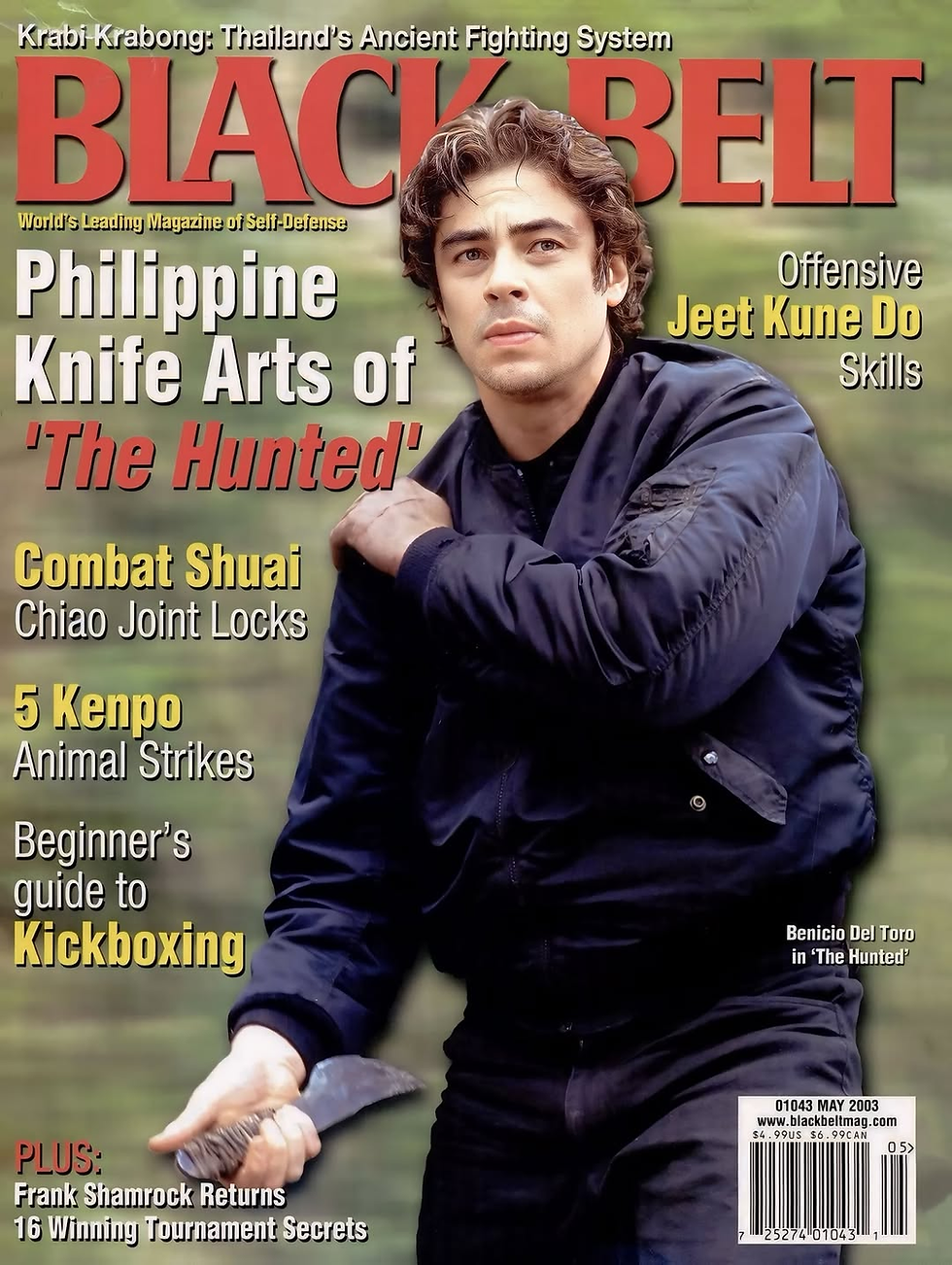
Bruce Lee’s weapon work on screen reflects clear influences from Filipino martial arts—whether widely acknowledged or not. And yet, despite this reach, the art itself has remained under-recognized as a competitive sport on the global stage.
This is not an argument about what is better. This is not a challenge to tradition. And this is not about taking sides. There are established organizations such as WEKAF, and there are valid discussions about rules, direction, and preservation within Filipino Martial Arts.
But this moment isn’t about choosing between them.
Much like MMA once faced skepticism, any new format challenges convention.
Juego Todo is not a replacement for tradition, it is a new lens. A format. A proving ground.
The question is not whether Filipino martial arts still embody adaptability, efficiency, and
realism.
The question is, how do those qualities express themselves today?
This is where the conversation begins.
Black Belt Magazine sees this as an opportunity—not to persuade, but to present.
To offer something new to a community grounded in tradition. Something to observe. Something to consider. Perhaps even something that changes the way we watch Filipino martial arts.
And like every turning point before it, the value is not in immediate acceptance—but in the willingness to see it for what it is.

Enter Juego Todo: Where Art Meets Sport
Juego Todo was created in 2014 by Ferdinand Munsayac, a retired U.S. Navy Chief with 20 years of honorable service and a Persian Gulf War veteran. After his military career, he returned to the Philippines with a mission—to transform the lives of underprivileged fighters through combat sports.
As the founder of UGB Corp and Juego Todo, he has become a driving force in elevating grassroots Filipino martial arts to a global level. with a clear mission: to unify Filipino martial arts and provide fighters a professional platform to test their skills.
Inspired by the rise of MMA in the Philippines, Munsayac envisioned something more:
A system that doesn’t dilute tradition but instead tests it under pressure.
In speaking with Munsayac, one idea surfaced immediately—something was missing.
For decades, Filipino martial arts lived in demonstrations, seminars, and small-scale tournaments. What they lacked was professionalization—a true pathway for athletes, a unified structure, and a global competitive identity.
Today, we recognize national combat sports as symbols of their countries—Muay Thai for Thailand, taekwondo for Korea, karate for Japan.
Juego Todo aims to position Filipino martial arts in that same global conversation.
But building something new in a deeply traditional space rarely comes without resistance.
Munsayac points candidly to what he calls a familiar challenge within the community: division.
The mindset of “my system is better than yours” has long fractured unity within Filipino Martial Arts. Add to that a lack of institutional support and concerns that the format was too intense, too unfamiliar—and the resistance became inevitable.
Yet, in many ways, that resistance revealed something deeper.
It wasn’t just about rejecting a format.
It was about resisting change itself.
And still, the question remains: how do you evolve an art rooted in real combat without losing its essence?
For Munsayac, the answer lies in balance.
Historically, Filipino martial arts were practiced in duels—often with life-or-death consequences. That reality is part of its identity.
Juego Todo does not ignore that history—it transforms it.
From no rules to structured competition. From bare combat to protective gear and safety protocols. From open grounds to a regulated arena.
The goal is simple: preserve the essence—remove unnecessary risk.
At the same time, it becomes a bridge between generations—educating younger practitioners while encouraging elders to recognize that evolution is not abandonment, but survival.
After more than a decade and over 100 events, Juego Todo has grown into a global movement:
52 countries represented
500+ fighters worldwide
Recognition by the Philippine Games and Amusements Board
Beyond growth, the identity of the sport is ultimately defined by its athletes. A Juego Todo champion, as Munsayac describes it, represents something distinct:
Not theory.
Not choreography.
Not controlled demonstration.
But truth under pressure.
It is what works when resistance is real.What holds up when there is no script.What survives in full contact, unpredictability, and consequence.
In that sense, a champion reflects more than skill—they reflect the very core of Filipino Martial Arts: adaptability, composure, and authenticity.
And perhaps the most important question of all is not about the present—but the future.
What would it mean for Filipino Martial Arts to finally stand on a true global competitive platform?
The answer reaches far beyond sport.
It means recognition—that FMA is not just cultural heritage, but world-class combat. It means opportunity—for Filipino athletes to build careers, earn respect, and be seen.And it means legacy—the creation of something future generations can stand behind with pride.
More than anything, it signals a shift: The Philippines is no longer just the birthplace of Filipino Martial Arts. It becomes its global leader.
Where Evolution Leads
Martial arts have never been static.
They adapt. They respond. They evolve.
Bruce Lee understood this long before it became widely accepted. His philosophy was not about abandoning tradition, but about freeing it from limitation. To keep what is useful. To discard what is not. To allow growth where growth is necessary.
That same tension exists here.
Juego Todo may not be the final form. It may not be universally accepted. And it will certainly be debated. But so was everything that came before it, and that is precisely the point.
The value of innovation in martial arts has never been in immediate acceptance—
but in the willingness to see it clearly.
To watch it. To question it. To understand it.
Because evolution, whether welcomed or resisted, has always been part of the journey.
And perhaps, in that way, this moment is not so different from the ones that came before it.
It’s simply the next expression of a timeless idea: that martial arts are not fixed.
They are alive.
THE FORMAT: THREE ROUNDS. TOTAL COMBAT.
Juego Todo is a three-round war of progression, where every phase demands mastery:

Round 1: Doble Baston (Double Sticks) Weapon-based combat. No disarms—because every strike is treated like a blade.
DOBLE BASTON (Two Sticks)
Allowed
Body strikes with sticks
Kicks, knees (body only)
Takedowns & disarms
Key Restrictions
No strikes to the head
No thrusting or butt-end strikes
No illegal weapon use
No intentional weapon dropping (penalty)

Round 2: Solo Baston (Single Stick + Striking) The fight intensifies. Fighters add knees, elbows, takedowns, and sweeps—blending weaponry with close-range brutality.
SOLO BASTON (One Stick)
Allowed
Stick striking
Limited hand strikes
Body kicks & knees
Takedowns & disarms
Key Restrictions
No strikes to the head
No thrusting or butt-end strikes
Must follow referee during disarms
Dropping the stick = penalty

Round 3: Mano-a-Mano (Hand-to-Hand) MMA rules
MANO Y MANO (Full Contact)
Allowed
Punches & kicks (head and body)
Elbows & knees (with limits)
Takedowns & submissions
Key Restrictions
No strikes to a downed opponent
No groin attacks
No headbutts, eye gouging, biting
No strikes to back of head or spine
No cage grabbing
No soccer kicks
FOLLOW THE ACTION
1. Watch the Weapons
In Doble & Solo Baston, fighters score with:
Clean stick strikes
Control and disarms
Important: No head strikes in weapon divisions
2. Look for Control & Damage
Judges score using a 10-point must system
Fighters win rounds by:
Effective striking
Takedowns and control
Ring/Cage dominance
3. Know the Fight Phases
Standing: Striking and movement
Clinch: Close-range control, knees, takedowns
Ground (Mano y Mano only): Submissions and control
4. Understand the Differences
Doble Baston
Fast-paced weapon exchanges
Disarms can change momentum instantly
Solo Baston
Mix of weapon + limited hand strikes
More tactical and controlled
Mano y Mano
Full MMA-style action
Striking + grappling + submissions
5. Watch for Fouls
Referees will stop action for:
Illegal strikes (back of head, groin, etc.)
Dangerous behavior
Weapon misuse
Penalties can affect scoring or lead to disqualification
Win Conditions
Decision (judges’ scorecards)
Submission (Mano y Mano)
Referee stoppage (TKO/KO)
Disqualification
UNIVERSAL FOULS (All Matches)
Low blows
Rabbit punches (hits to the back of the head/neck)
Holding and hitting simultaneously
Eye attacks or open glove abuse
Prolonged stalling/clinch
Faking injury or knockdown
Unsportsmanlike conduct