Updated: Jan 2, 2025


In the past four decades, Cynthia Rothrock has accomplished what many of us dream of but few of us achieve: nurturing martial arts skills into an international career in fight films. Here’s a look back for those who are too young to have witnessed the rise of Rothrock.
Competition
Before she graced her first silver screen, young Cynthia Rothrock was a force to be reckoned with on the East Coast. She won numerous forms and sparring championships on the regional circuit, then graduated to the national scene, where she continued to dominate in weapons and kata.

Known for blending disciplines—including Tang Soo Do, taekwondo, eagle claw, wushu, and Shaolin Kung Fu—Rothrock used flashy moves that caught the eye of a Chinese movie producer in 1983. Soon after, she found herself in Hong Kong starring in her first film.
It didn’t take long for the martial artist from Wilmington, Delaware, to parlay her tournament-winning skill set into on-screen success. She cultivated such a following that there is still demand for Cynthia Rothrock movies—she worked on a number of film projects in 2016 and has several slated for 2017.
Her accomplishments and acting shouldn’t be interpreted as evidence that Rothrock is just a film fighter, however. At heart, she’s still a fighter.
“One of my go-to combinations when fighting in tournaments was to set my opponent up by doing a front kick with my right leg, and when [my opponents] would drop their guard to block it, I’d turn it into a roundhouse kick to the head,” Rothrock says. “I also like to use my sidekick a lot. I just looked for an opening and shot it in real fast.”
She still has a plethora of fighting moves in her arsenal, thanks to her experience in all those aforementioned arts.
“One of the techniques from my kung fu training is a trapping hand counter punch,” she says. “When my opponents have their hands up and stretched outward, I like to trap their hand with my right, then with the lost speed, I hit their front hand with my left and come in with the back fist.”

Recognizing the advantages that accuracy and explosiveness could confer, Rothrock long ago decided to transform herself into a better athlete, always staying in top physical shape for every match and performance. This further polished her fighting methods.
“I moved quickly, faking with one technique and hitting with another,” she says. “The instant they’d buy into my first technique, I’d shift my position and attack in the way they weren’t expecting.”
Athleticism
Yes, point fighting is exciting to watch with its kicks and punches that can score in the blink of an eye. But we all know that on the street, no points are awarded for finesse, and the loser doesn't walk away with a consolation prize.
To Rothrock's credit, her roots in the traditional arts kept her from ever thinking that success on a tournament mat translates to success in a dark alley.
"Point fighting does sharpen your reflexes—like how to block and move fast—but fighting on the street is an entirely different ball game," she says. "When you're point fighting, you might do a move that you would never want to do in a street fight. Point fighting is a sport. I'm not saying you can't get hurt, but it's nothing like being in a street fight."
The attributes you develop in competition aren't entirely useless, she adds. "Tournament fighters are trained to move fast, to get in and out quickly while scoring a point in the process. So traditional tournament fighting is really good to help you with your reflexes and help you avoid something that's coming at you fast."
Furthermore, she's quick to point out that a kick is still a kick, and a punch is still a punch. If you land any technique with speed and power—especially if you hit a vital point on the body—it has the potential to take out an opponent. “Potential” is the key word there, and that's fine because not every martial artist trains for combat.

"Traditional fighters are sportsmen and sportswomen; they're guided by rules and regulations," she says. "It isn't a fight to the death. There's the occasional broken nose, lots of jammed toes and [even] knockouts.
But tournaments, even those that allow light contact, can't be compared to a street fight because we have a code of conduct and rules to follow—even MMA fighters. That's one big difference between a professional fight and a brawl."
Believability
Despite the obvious difference between movies and the streets, Rothrock has always fought to keep her action scenes as realistic as possible. The quality of the result, she says, depends in large part on whether the film is from Hong Kong or Hollywood.
In the States, most action films benefit from having adequate rehearsal time built into the production schedule, having access to state-of-the-art safety gear, and employing an experienced stunt coordinator.
In Hong Kong, however, many safety practices get tossed out the window, leading the star to do the stunt in one or two takes. In contrast, a Hollywood production might spend the whole day getting a fight just right.
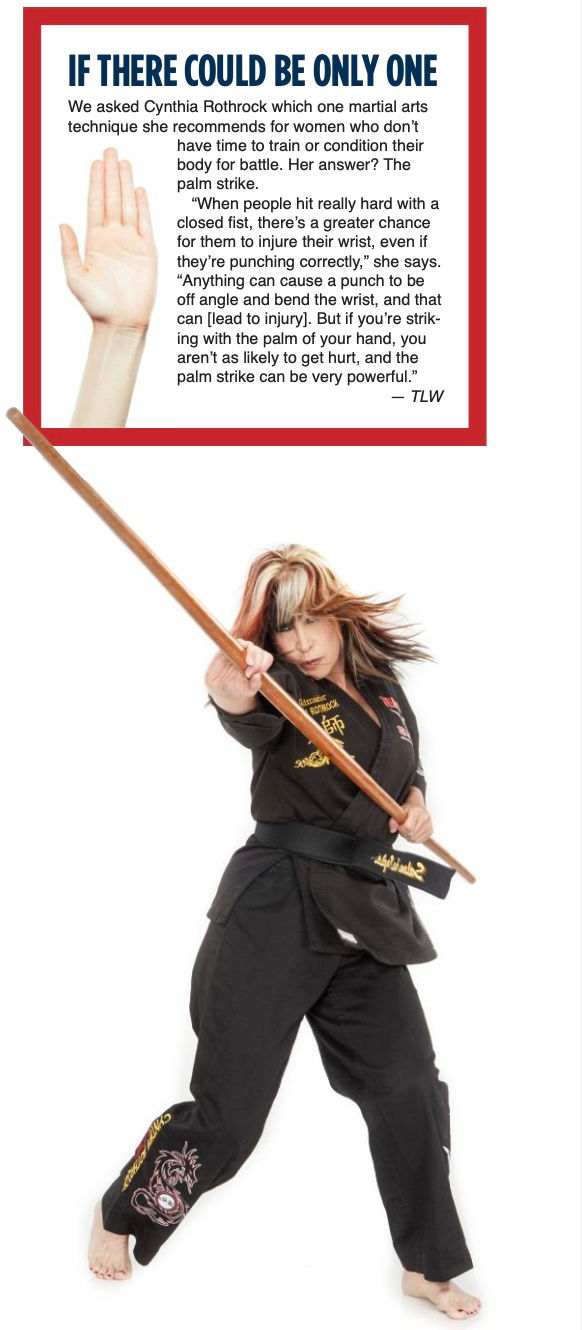
"There were a couple of times when I thought I was going to get killed while filming in Hong Kong—I did some pretty dangerous stuff there," Rothrock says. "[In Yes, Madam!] I had to fight eight guys with weapons. I turned to do a block, and the guy actually hit me in the nose with the sword. My eyes started to water, and my nose turned red. The director came over and said, ‘That's okay, your nose looks better now,’ and we kept filming."
That bashed beak was a walk in the park compared to what another Hong Kong director had his American star do. "In the movie Lady Reporter (also released as Female Reporter), they wanted me to jump off a two-story building in high heels with a fake baby in my arms," Rothrock says. "That was hard enough, but there was also going to be an explosion behind me."

"The director said, ‘If you don't jump when I say action, the flames are going to hit you.’ This was the first high jump I’d ever done, and they had me landing on a stack of cardboard boxes. We didn't have big air mats that let you land nice and soft. I was really nervous. When he said action, I felt the heat of the flames, so I jumped—in my heels and with the fake baby, landing on the cardboard."
On impact, Rothrock's knee smacked her squarely in the nose. Her vision blurred, and the pain nearly caused her to pass out. She thought her nose was broken.
"I was a martial artist, not a stunt person," she says. "Nobody taught me how to jump off a two-story building in heels while holding a fake baby. Then the director decided he didn’t like the camera angle, so we had to do it again!"
"So now I was extremely petrified and nervous because I knew I’d almost knocked myself out and nearly broken my nose. This time, the director said I had to once again jump off the 10-ft ledge in high heels, holding the fake baby—but he told me not to bounce when I land. He wanted me to stick the landing like a gymnast."
Like a trooper, Rothrock did everything the director asked, but that evening, she paid a high price. "I started feeling as if I was going to pass out," she says. "I went to the doctor, and he said, ‘You’ll be okay—you just jumbled all your internal organs.’ I was like, ‘What?! Jumbled organs don’t sound like everything’s okay!’"

Rothrock went back to her room but couldn't sleep. "I kept thinking that they were going to lose the film or someone was going to steal it—or maybe a goat was going to eat it," she says, laughing. "I just knew I was going to have to do that scene again."
Fortunately for the film fighter, the footage didn’t get misplaced, purloined, or digested. The Hong Kong premiere was a success, and it propelled her further along the road to stardom.
It also drove home the notion that, even though she was no longer taking a beating in the dojo, punishment was par for the course if she wanted a career in action films.