"Speak softly and carry a big stick; you will go far.” Theodore Roosevelt
Historical Roots:
Can you tell us about the origins of Irish stick fighting and how it evolved over time?
For centuries all across Europe, people trained for using bladed weapons by practicing techniques with wooden sticks: spears, axes, and swords. Over time the stick-training evolved more and more into its own unique way of fighting.
In fact, some historians think that the idea for using a two-handed longsword actually came from an earlier staff fighting style with a stick of the same size. In time Irish styles evolved mostly into two main groups that we know of: a two-handed staff style and a one-handed style based on broadsword fencing.
Given the number of Irishmen who went abroad to serve in the armies of Europe, it’s not too surprising to find that the one-handed stick style was meant as training for broadsword fencing. You can still use the stick in its own way, but the basic strikes and parries come directly from broadsword fencing.
Cultural Significance:
How did Irish stick fighting become an integral part of Irish culture, and what role did it play in the lives of Irish people historically?

Well first, it was used as a kind of “contact sport” – very often hurling matches broke down into all-out fights, but in the 18th and 19th centuries people all over Europe and America viewed almost any kind of violence as exciting and a form of entertainment.
Modern ice hockey actually comes from playing Hurling and Shinty on ice in Canada, so that gives you an idea of what I mean! Some people think it was also a kind of safety valve for letting off steam in a country almost constantly on the brink of revolution.
Some guys did use it as training for a career in the military and at battles like Fontenoy, the Irish Brigade closed with their enemy and engaged in hand-to-hand fighting – little different than faction fighting. Fighting duels with sticks was also a way for the Gaelic Irish to settle disputes amongst themselves and avoid the British courts in Ireland, which they detested.
It also laid the foundations for modern Ireland’s tradition of sports. The men who founded the GAA, John Cusack in particular, seem to have known stick-fighting. Some of the earliest Irish boxers like Dan Donnelly were trained stick-fighters first who decided to try this new English sport of pugilism which, in the beginning, used a lot of ideas (like footwork) from fencing.
Using fencing concepts was something they were already used to as stick-fighters. And I think modern Irish interest in Asian martial arts and MMA, is all an unconscious legacy of bataireacht.
Bataireacht and Shillelagh:
What are the differences between bataireacht and the use of a shillelagh, and how are these terms interrelated?
Bataireacht simply means “stick-fighting” or “fighting with cudgels” in Irish. (Japanese stick-fighting would be Japanese bataireacht for example).
Shillelagh is a phonetic translation from Irish into English, of the words “sail” and “éille”, formed into the word “sail-éille”. Sail means (among other things) a cudgel and éille means a thong or strap. So together it means “thonged cudgel” or “a cudgel with a thong”.
It’s an English myth that the word comes from a forest in Wicklow. Actually, both terms are found in Dineen’s Irish Dictionary and Thesaurus, the bible of the Irish language. The thong on the cudgel was used like the sword knot is used on broadswords and sabres; if you lost your grip on it, it would still be dangling from your wrist.
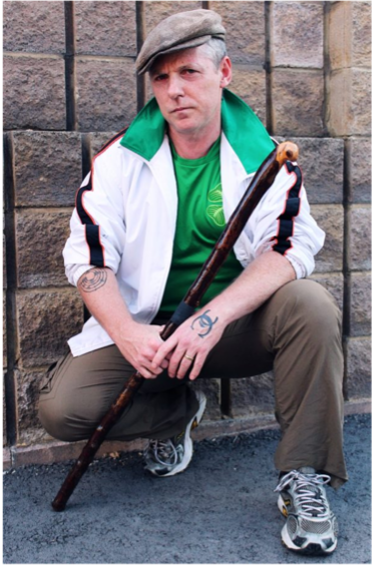
But today even though “Bataireacht” means just stick-fighting in general, it has become a catchall or slang used by people practicing Irish stick-fighting for any style of specifically Irish stick-fighting. And in a similar way a very long time ago “Sail-éille” became a catchall to describe the various kinds of Irish fighting sticks.
So as for the relationship between the two you could look at it as saying “I practice bataireacht with a shillelagh”.
Factions and Violence:
In the 18th century, bataireacht became associated with Irish gangs known as factions. Could you elaborate on how faction fighting shaped the practice of bataireacht?
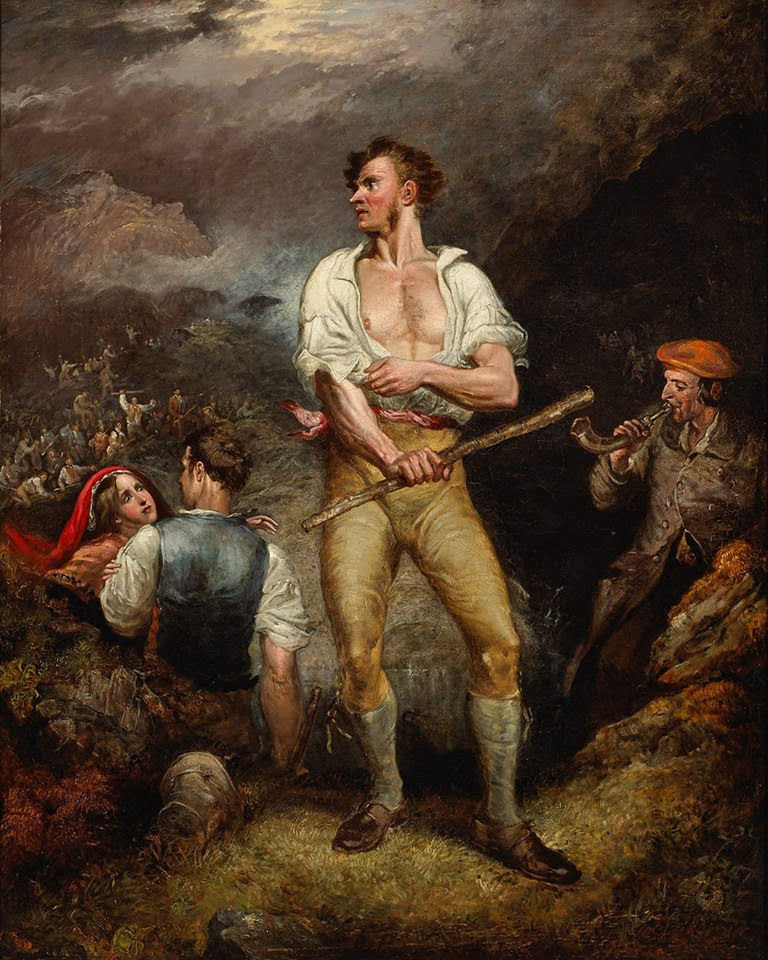
Well, the competition for success between factions seems to have caused the bar for stick-fighting to be raised high. It was also looked upon as a kind of gladiatorial fighting so in one “match” people would want to see two guys (or factions) trained in the same style of stick-fighting compete against each other to see who was the best in a fair and equal fight.
But in another situation, they might have liked to see people from different styles (and people using other weapons like swords or scythes), compete against each other to see how each style or weapon stood up against one another. Could a man with a three-foot stick beat a man armed with a scythe? Could a man armed with a five-foot-long stick beat a man armed with two sticks? That sort of thing. It was a constant “arms race” so to speak.
Class and Political Overtones:
How did class and political issues influence the faction fights and the practice of bataireacht, as seen in historical accounts?
Well, conditions varied around the country so in Ulster, for example, it was common to see fights between Catholic secret societies like Ribbonmen and Protestant secret societies like the Orange Order. So there you have a combination of everything - political, religious, and class issues all rolled into one.
In Munster, there were long-standing family feuds among Gaelic Catholics over control of land which translated into economic power. Within that, there were further societal schisms or fractures based on class: the common farm laborers like the Spailpíns opposing their employers and their hired hands.
So the Caravat-Shanavest feud in the early 1800s, for example, was based on tensions between middle-class Catholic small farmers and the very poor wandering laborers whom they employed. So you could argue that the Caravats were a kind of early labor union fighting for better wages.
This is ironic because they started out more or less as a Jacobite secret society. Which is another issue: France’s Irish Brigade was disbanded in 1790. The United Irish Rebellion took place in 1798. The old Irish Brigade families were all loyal to the Catholic Bourbon monarchy whereas the United Irishmen were all influenced by French Republicanism and the Jacobins.
It's small wonder then that faction fighting exploded onto the scene in the early 1800s.
Decline and Suppression:
What were the main factors leading to the decline of bataireacht by the turn of the 20th century?
The main factor in its decline was the association of bataireacht with factions and the divisiveness of factionalism. After the horrors of An Gorta Mor, there was this strategy among the people who cared that they needed to get serious about a political revolution and take back the country to ensure policies were in place so that this never happened again.
I’m not trying to preach here, I’m just saying that we know historically that this was the case. To achieve that they felt the first step was to put a stop to fighting amongst themselves: give up the old-fashioned shillelagh of the village warriors of your grandfathers and pick up the modern new shiny rifle of the soldiers of Ireland, the “vast hidden legion” they used to call it.
The decline of factionism was accelerated by An Gorta Mor, but even before that the efforts of the Catholic Church and finally the efforts of Irish nationalists really convinced people that this old custom of fighting at fairs was doing more harm than good.
The cool thing was to become a soldier and it became uncool so to speak, to want to have anything to do with stick-fighting and faction fighting.
There is evidence to suggest that in the 1840s, the remnant of the old Shanavest Faction seems to have morphed into a faction in Tipperary calling itself the Fenians, and then not much long after that in the 1850’s you have this militant nationalist group calling itself the Fenians.
One of the founders of the Irish Republican Brotherhood (and the guy who coined the term “Fenian”), John O’Mahoney, was born into a wealthy family in Tipp., with a lot of land and he could call on about 1000 tenants to have his “back” if he needed them in a faction fight.
So it seems like many stick-fighters were in the early ranks of the Fenian movement and voluntarily ceased including bataireacht into their way of life. They became instead intensely committed to the establishment of an Irish Republic and felt that to do that bataireacht had to be sacrificed.
I mean it did not just stop or end overnight, bataireacht was still being practiced until the 1920s but the Irish War of Independence seems to have put an end to that. And one historian even says that she was approached after a lecture by an Irish guy who said he was involved in a faction fight in the 1960s.
I wouldn’t doubt it. But a lot of the spirit and competitive rivalries once associated with faction fights and factions, were absorbed into the GAA team system with its county rivalries in Gaelic Games, especially Hurling. Some modern county colors are the same colors of the largest factions in the pre-GAA era.
Modern Revival:
How has bataireacht experienced a resurgence in modern times, and what has driven this renewed interest?
Well in 1995 Glen Doyle who taught me this style, was being interviewed by Inside Kung Fu magazine. During that, he mentioned that his father had gotten him started in martial arts as a kid when he taught him boxing and a family style of Irish stick-fighting.
A guy named John Hurley had already been researching the history of Irish stick-fighting and read that interview and contacted Glen asking him to teach anyone, just to make sure it survived because it was such a rare and culturally important thing. And eventually, he did. It took a while to catch on mostly because of the negative stereotypes of stage Irish shilelaghs and “Paddywhackery,” but it just kept growing. In the beginning, it was mostly non-Irish Americans who were open to it but the more people in Ireland see it the more they get it. The Doyle style is pretty amazing. It speaks for itself.
Family Traditions:
Can you discuss the importance of family traditions in the preservation of bataireacht styles, such as the rince an bhata uisce bheatha?
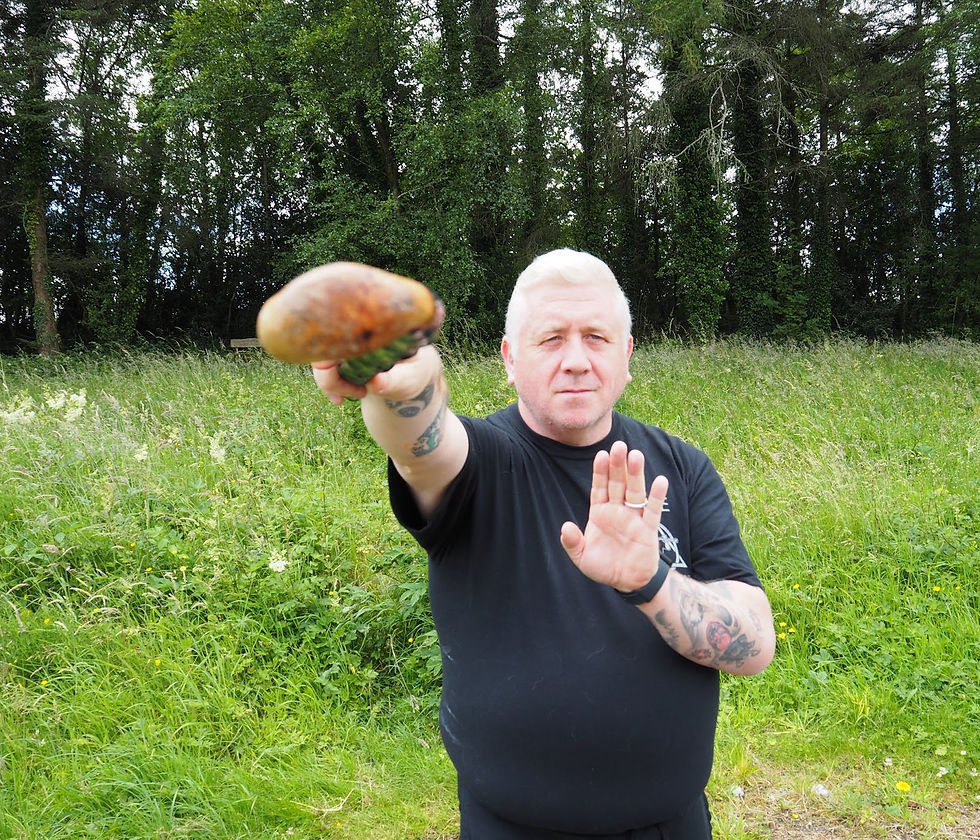
Preservation of the family system is what we are about. The importance of that tradition is passed down from student to student. Our forms are not public knowledge as was the traditional stick fighter's way of teaching. Yes, we use forms, but we call them dances or Rhince (rinka). This is the traditional way of teaching as in Asian martial arts, where it's done to assist the student in remembering techniques. We have a set of rules called the 10 commandments, which is passed to every student in their grading books, and this outlines how we fight.
Traditionally each school would be called a hedge school, and each school is a faction under their instructor. The factions are given names for some animals such as mine the fighting hares, others would be named directly after their family.
I currently run a hedge school from my house which is taught in the traditional way. And each faction student instructor coach is vehemently proud of their heritage and the link to the Doyle family.
Global Practice:
How has Irish stick fighting gained popularity outside of Ireland, especially in North America, and what appeals to international practitioners?
Well, the revival of it started in North America so it actually gained popularity there first and then made its way back to Ireland really because of Glen Doyle. I think what appeals to people is that the Doyle family style is just really practical. You try it and immediately see how effective and no-nonsense it is. Most Asian martial arts are or were meant to be forms of moving meditation and in the West things like fencing and boxing became sports. So, with the Doyle style you have something truly unique as it's something that comes directly from faction fighting, isn’t a sport, and isn’t a Zen kind of thing. There’s nothing wrong with any of those but the Doyle style is definitely different from most martial arts that people have encountered before.
Currently, we are growing substantially throughout the US, Ireland, and Europe, and even have a school called the Macedonia faction in Egypt.
We will continue to grow primarily because of the directness and versatility of the system and the fact that we are a family and that everybody's viewed as a member of that family.
I currently run a coaching course once a year in Ireland for people who want to learn intensively, and this is proving to be very popular.
Reconstructed Styles:
What is the role of historical research in reconstructing traditional bataireacht styles, and how do modern practitioners use historical manuals and other sources to revive these techniques?
Well, there’s the living style, the reconstructed styles, and then something in the middle where people have taken 10 minutes' worth of “living” techniques from an incomplete style and then tried to reconstruct its missing elements.
Since the start of this revival, there’s been a lot of heated debate over whether or not there should be a clear delineation between a living style (like the Doyle family style) and something reconstructed.
There are people who want to mix styles and add things that can’t be verified as being real… So, it’s very useful and interesting and fun to research and try to figure things out. It gives you a bigger picture of how people were doing things.
But it would be another thing altogether and very very dangerous for example, to say to someone “Here’s my reconstructed style, and by the way you can use this to defend yourself.” That could potentially get someone killed as it’s all purely theoretical. And that’s still a big point of contention among people practicing Irish stick-fighting today.
The reconstructed stuff is more in the way of sport and testing and experimentation and there’s absolutely nothing wrong with that. But I think anyone would agree that that’s very different from a learning style like the Doyle style that takes 2 or 3 years to really learn and master.
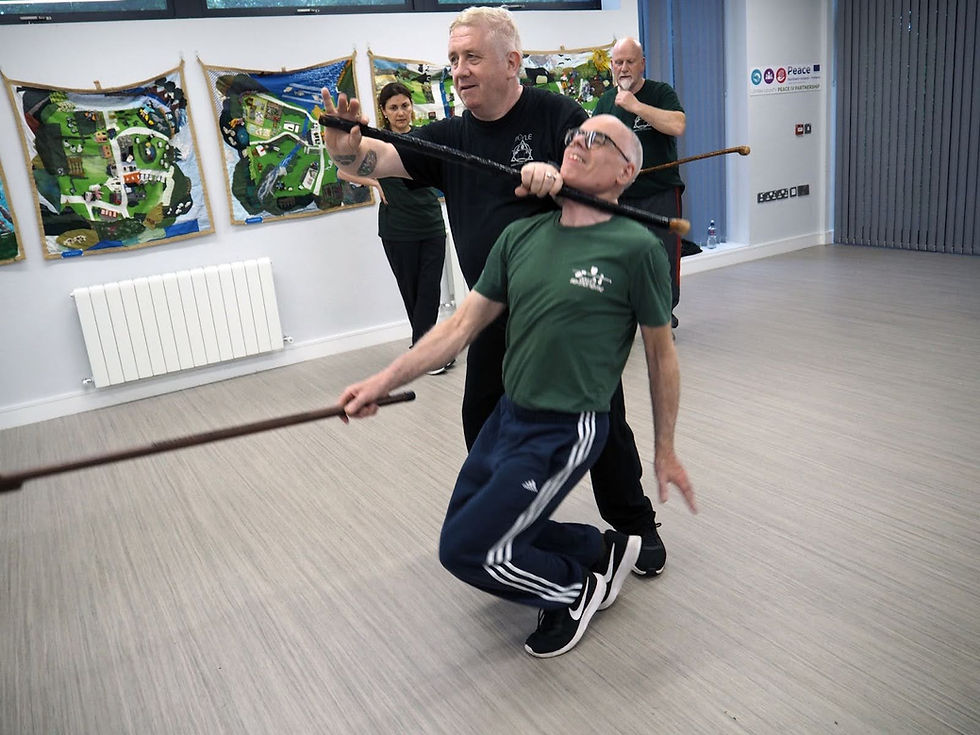
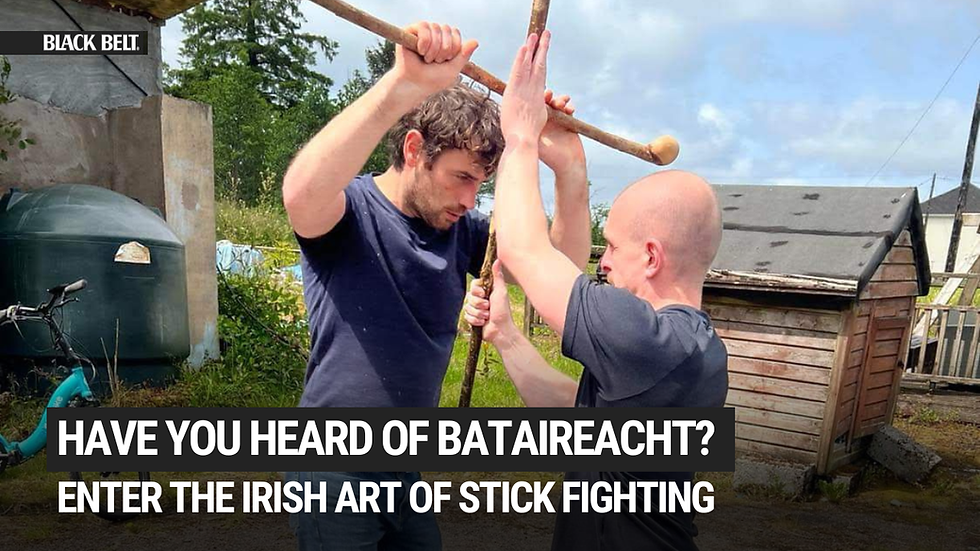
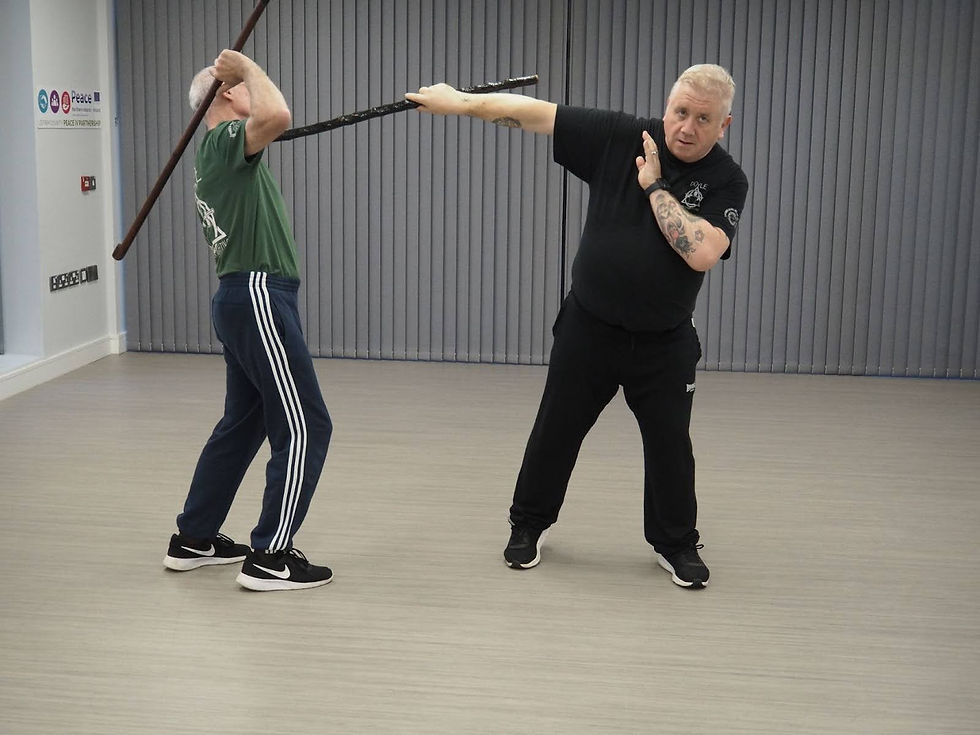
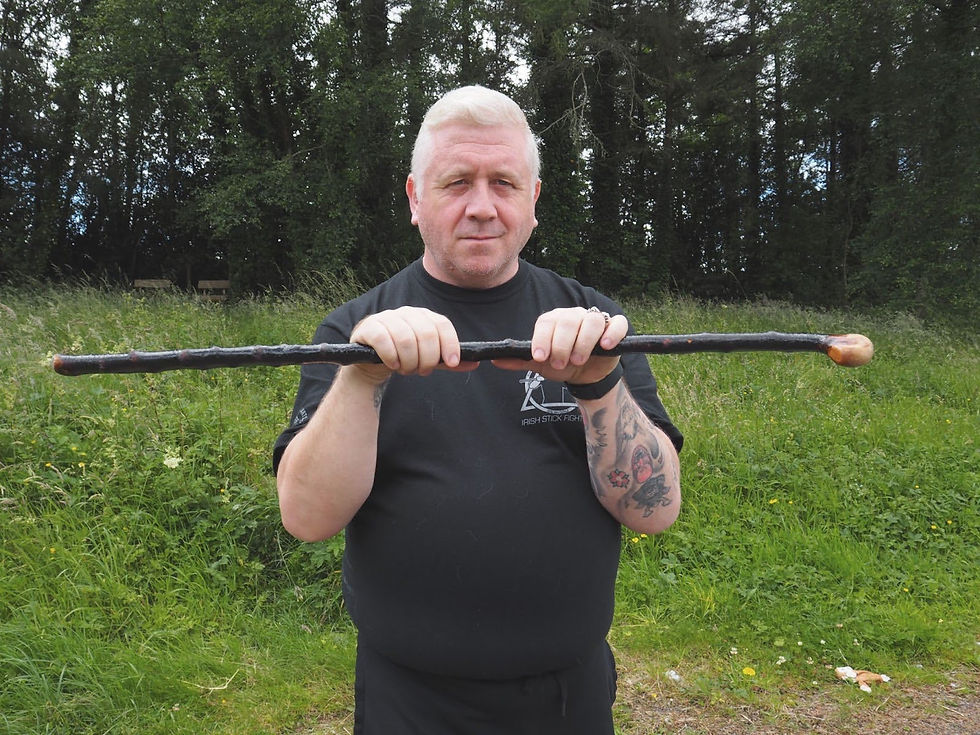
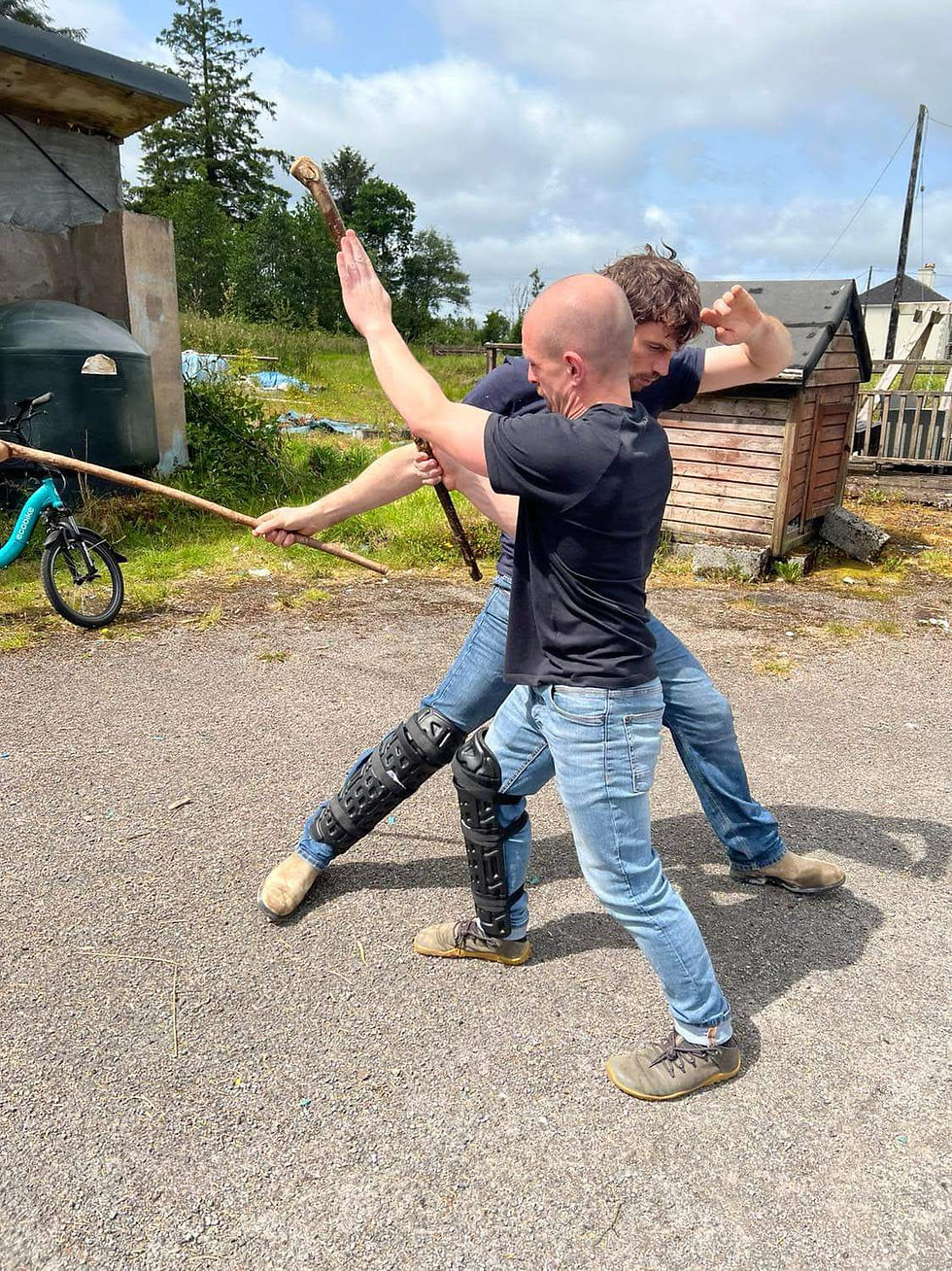
The Doyle system is a devastating two-handed system using the Shillelagh to shut down and destroy your opponent as quickly as possible. It's based on the pugilistic style of fighting where we punch with the stick, in quick succession or a “fury “of punches to end the confrontation. The style is very quick as it is designed for multiple opponents.
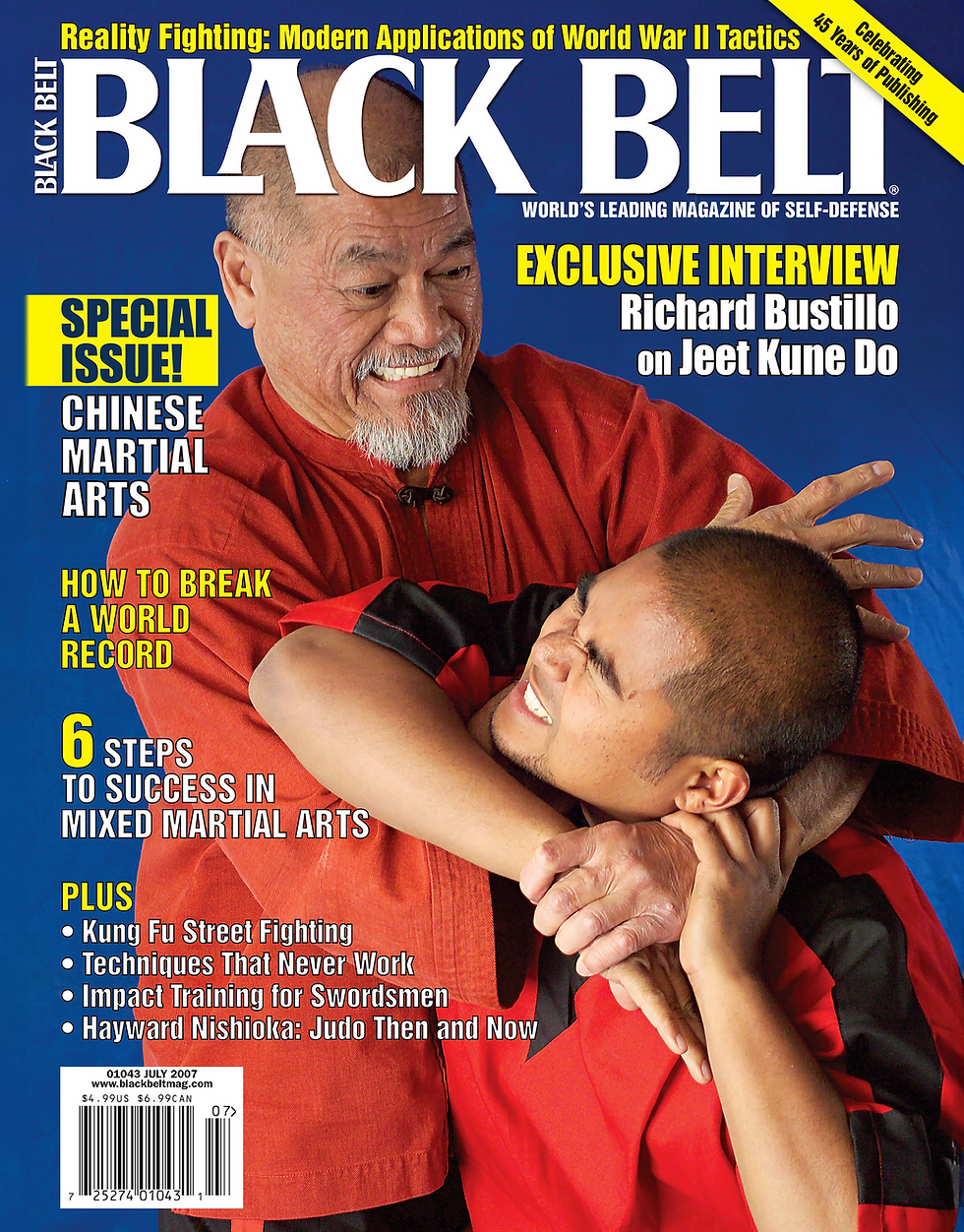
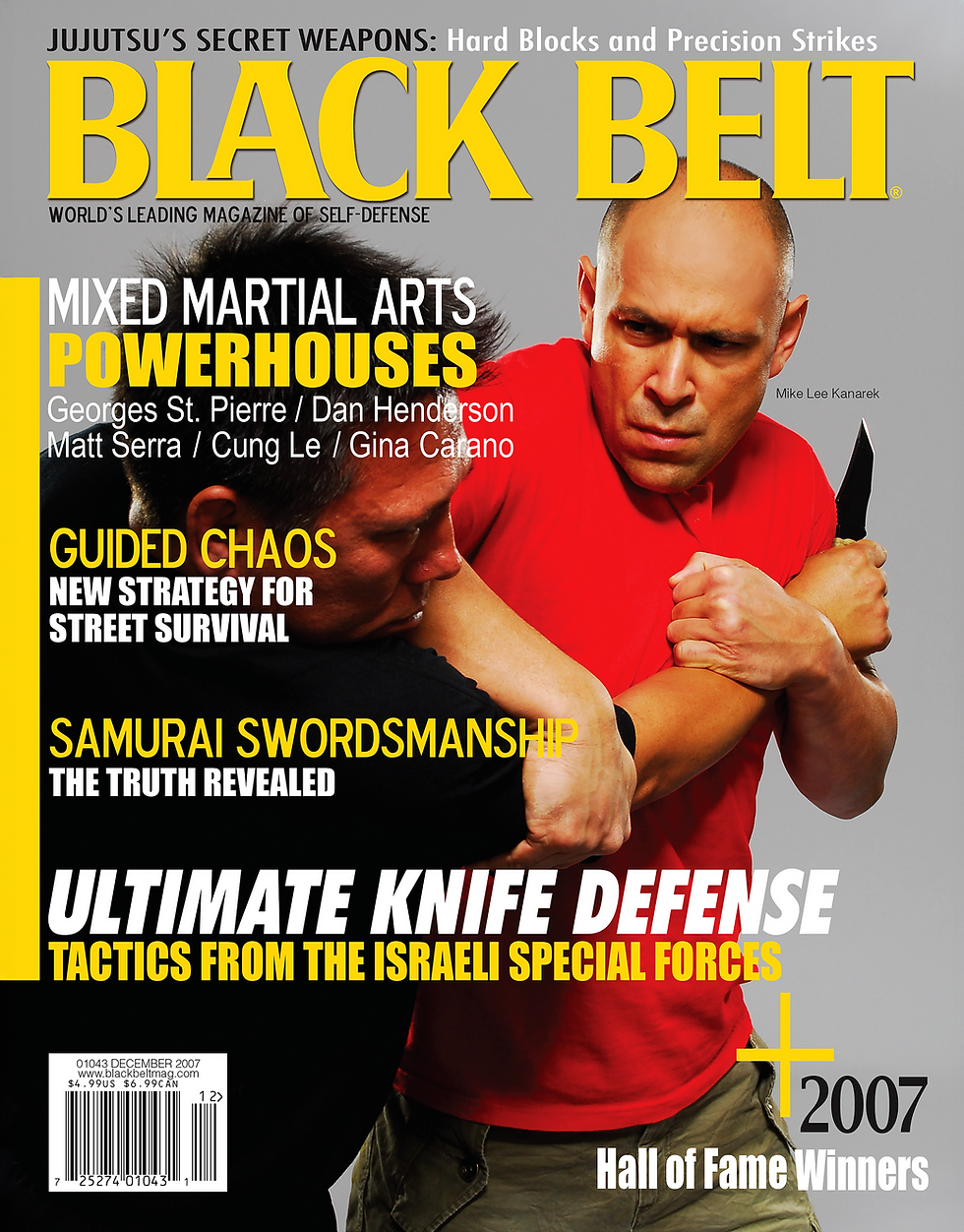
As you can see from the pictures not only is it punching but it's also locking or trapping the opponent.
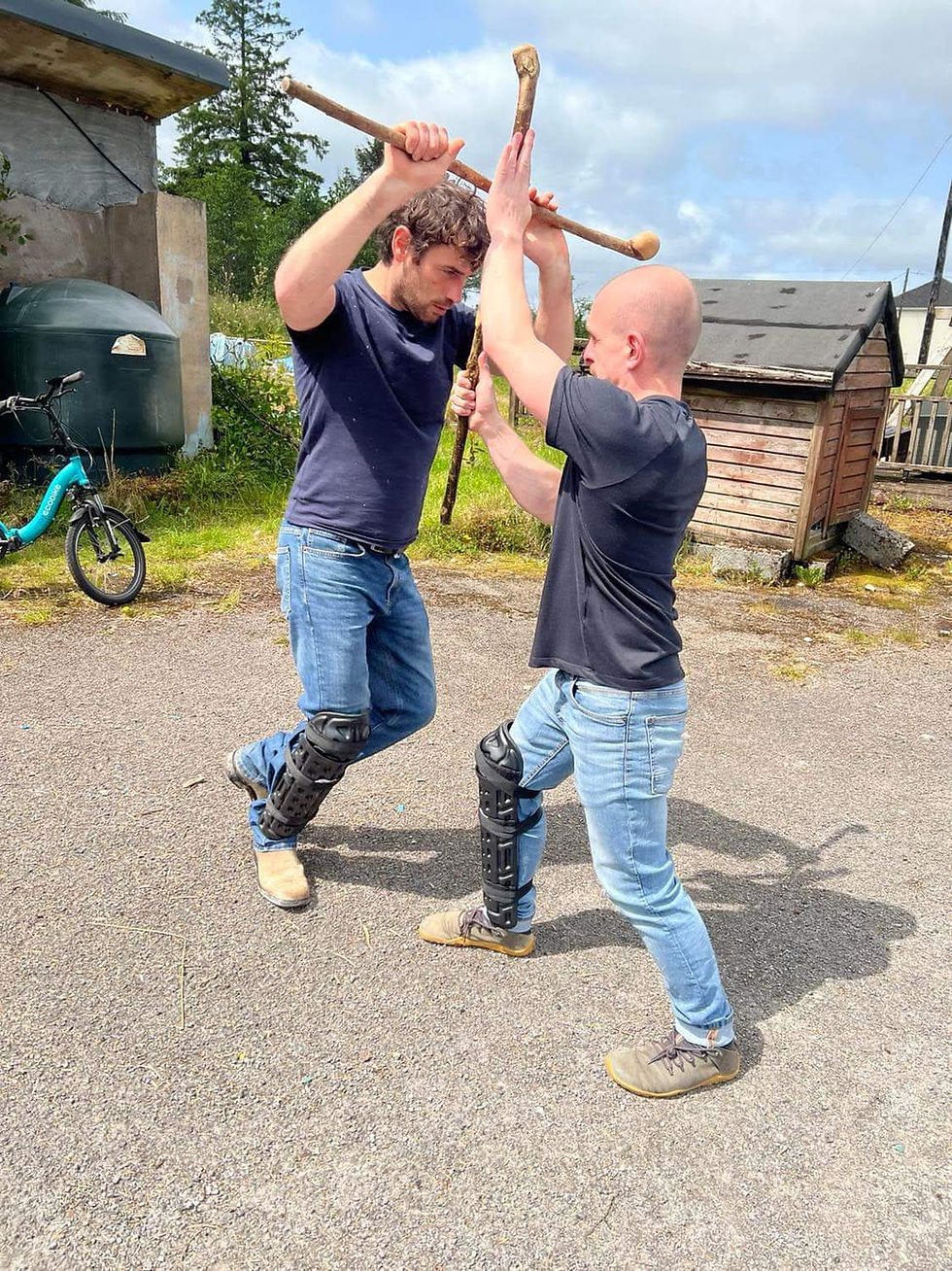
Not in the traditional FMA form but in the more direct and controlling method. The system is very destructive as it is in its original form and has not been tampered with over the generations. It deals primarily with” learning on the job,” meaning techniques were developed in actual fighting and these would be added to the system so if something worked it would be used.
It's fast and is designed for multiple opponents and our Motto is “ever forward,” meaning we keep going forward into the fight to finish the conflict as quickly as possible. Age is not an issue, in fact, we encourage students of all ages and all backgrounds.