We know that karate was developed in the Ryukyu Islands, an archipelago located southwest of Japan. The largest of the Ryukyu is, of course, Okinawa. The people of the Ryukyu shared a common ancestry with the people of Japan and spoke a language, called Uchinaguchi, that had a common origin with the language of Japan. This is why many of the words we use in karate are actually Uchinaguchi words.
Before 1429, there were three warring factions on Okinawa: Hokuzan (literally, “northern mountain”), Chuzan (“middle mountain”) and Nanzan (“southern mountain”). In 1429 Chuzan emerged victorious, and all the Ryukyu Islands became unified under its first king, Sho Hashi. But precisely when on this timeline did karate develop? The origins of the art are obscure — and have been made even more so by the passage of time and the spread of myths and misconceptions. Gichin Funakoshi, the father of modern karate, addressed this subject: “Inasmuch as there is no written material on the early history of karate, we do not know who invented and developed it, nor even, for that matter, where it originated and evolved. Its earliest history may only be inferred from ancient legends that have been handed down to us by word of mouth, and they, like most legends, tend to be imaginative and probably inaccurate.”
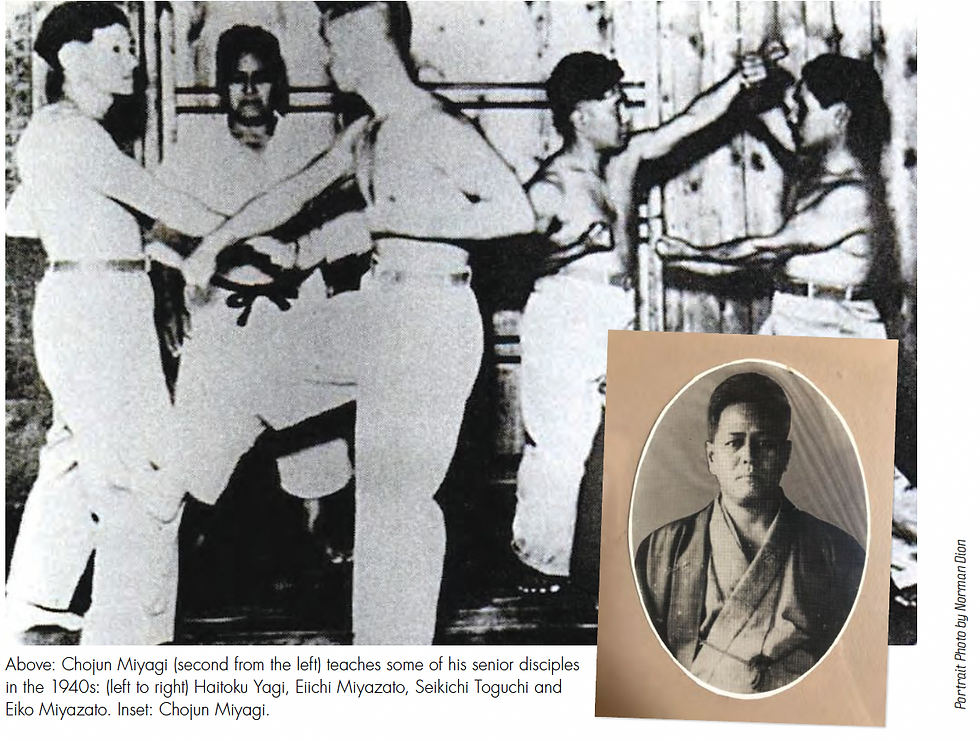
In 1936 Chojun Miyagi, the founder of goju karate, gave a lecture in Osaka, Japan, titled “Karate-do Gairyaku,” or “General Explanation of Karate-do.” In one section that dealt with the history of karate, Miyagi stated that it has its roots in the Chinese martial arts: “The name karate is a special term in Okinawa, and if we look for its origin, we find it can be traced to Chinese boxing.”
Later in the lecture, Miyagi discussed the major theories concerning the introduction of the Chinese martial arts:
“How was Chinese boxing introduced to the Ryukyu Islands? There is no definitive historical evidence, but there are many theories. The three main theories are:
• The 36-Men Theory. This theory asserts that in 1392, 36 Chinese men came to the Ryukyu Islands and introduced Chinese boxing to the Ryukyu people.
• The Oshima-Note Theory. In 1762 a Ryukyu ship bound for mainland Japan was forced ashore by a storm at Oshima in Tosa, a province of Shikoku Island. Among the crew was an intellectual named Shiohira Pechin Seisei, who talked about the Ryukyu Islands and their people to a native scholar of Tosa Province, Choki Tobe. The latter recorded the conversation in a notebook, which was titled Oshima Hikki (Oshima Note). In the third volume of the Oshima Note, a section of gossip entitled ‘Skillful Boxer’ relates that a Chinese boxer by the name of Kusanku traveled to the Ryukyu Islands with his students and practiced what, at that time, was called kumiai-jutsu (combat techniques). This book, then, contains some of the most reliable literature about the origins of karate in the Ryukyu Islands.
Even Gichin Funakoshi weighed in on the lack of facts pertaining to karate’s origins: “Inasmuch as there is no written material on the early history of karate, we do not know who invented and developed it, nor even, for that matter, where it originated and evolved.
• The After-Keicho Theory. In the year Keicho 14 (1609), the Satsuma clan conquered the Ryukyu Islands and established a regime based on brutal repression. Official policy prohibited ownership or use of weapons. One theory has it that for lack of better means of protection, the art of karate developed naturally among the defenseless Okinawans. Another theory asserts that it was during this time of crisis that karate was actually introduced.” Let us consider each of these possible explanations.
The 36-Men Theory
Starting around the year 1372, Ryukyu established a formal relationship with China. As was typical of many smaller countries in Asia, Ryukyu took on the role of a vassal state.
In exchange for acknowledging China’s supremacy, the government of China sent envoys to Ryukyu to provide culture and technology. In 13935 the Ming emperor sent the so-called “36 men” (also known as the “36 families” to Ryukyu. Their purpose was to educate the people of Ryukyu in various Chinese ways. Some taught navigation and the Chinese written language, while others brought crafts such as shipbuilding and papermaking. However, there appears to be no direct evidence of the 36 men having
brought martial arts to Ryukyu.
The Oshima-Note Theory
The pertinent section of this document states that one year earlier — presumably in 1761 — a man named Kusanku traveled to Ryukyu with several disciples and taught his kumiai-jitsu, or combat techniques. While we don’t know exactly who Kusanku was or why he visited Ryukyu, he might have been part of a diplomatic mission from China because such missions were common during this period. But as we shall see in the discussion of the final theory, the knowledge gained from Kusanku may have been just part of the total martial arts knowledge acquired and subsequently developed by the people of Ryukyu.
The After-Keicho Theory No. 1
In Japan, the Shimazu family became the lords of Satsuma domain on the island of Kyushu around the year 1030. Around 1196, the shogun Minamoto no Yoritomo conferred the title “Lord of the Southern Islands” — that is, the Ryukyu — on the leader of Satsuma, and the title was passed down through the family. While the Shimazu may have claimed the right to control the islands, there’s no evidence that they ever attempted to do so before the late 16th century.
Beginning in the late 16th century, a Satsuma lord named Shimazu Iehisa began a quest to invade Korea. To support this, he made frequent demands of the king of Ryukyu (Sho Nei), such as resupplying Iehisa’s troops. While Sho Nei agreed to some demands, he chose to ignore others. As a result, in 1609 some 3,000 troops from Satsuma invaded the Ryukyu Islands as punishment.
Despite having considerable forces (estimated between 1,000 to 3,000 soldiers) and weapons (including swords and Chinese-style firearms), the warriors of Ryukyu were defeated by the battle hardened Shimazu — thanks in no small part to his effective use of European-style matchlock arquebuses.
Sho Nei was taken prisoner and held captive in Japan for three years. He was allowed to return to Ryukyu only after swearing an oath of allegiance to Shimazu. From that point forward, while the king was allowed to remain the nominal ruler of Ryukyu, ultimate authority rested with the lord of Satsuma. In his discussion of the After-Keicho Theory, Miyagi actually outlines two theories. One proposes that the Shimazu governed Ryukyu with “brutal repression,” thus forcing the people of Ryukyu to develop karate-do “naturally.” This tends to support the belief by many students of karate-do that the art was created by the peasant class to defend against the military forces.
There are two problems with this theory, however. First, there is a well-established history of martial arts residing in the domain of the pechin (warriors) rather than the peasants. The pechin were part of the gentry of Ryukyu, and many served as royal guards — for example, Sokon Matsumura, one of the most famous of the pechin, was the personal bodyguard of the last three kings of Ryukyu. Second, the historical evidence indicates that while the Shimazu did establish certain rules of law within Ryukyu (with strict punishments for failure to abide by them) and demanded what essentially amounted to taxes, day-to-day governance of Ryukyu still rested with the king’s government. There is little, if any, evidence of repression. In fact, Shimazu went to great lengths to make life seem normal to allow Ryukyu to maintain a profitable trade relationship with China.
The After-Keicho Theory No. 2
The other theory is that karate resulted “during this time of crisis.” While Miyagi did not explain what he meant by this, it’s reasonable to assume he meant that the pechin, defeated by the Shimazu and disheartened at the capture of their king, may have pledged themselves to prepare for the next battle — a battle that could have ended the Ryukyu kingdom entirely.
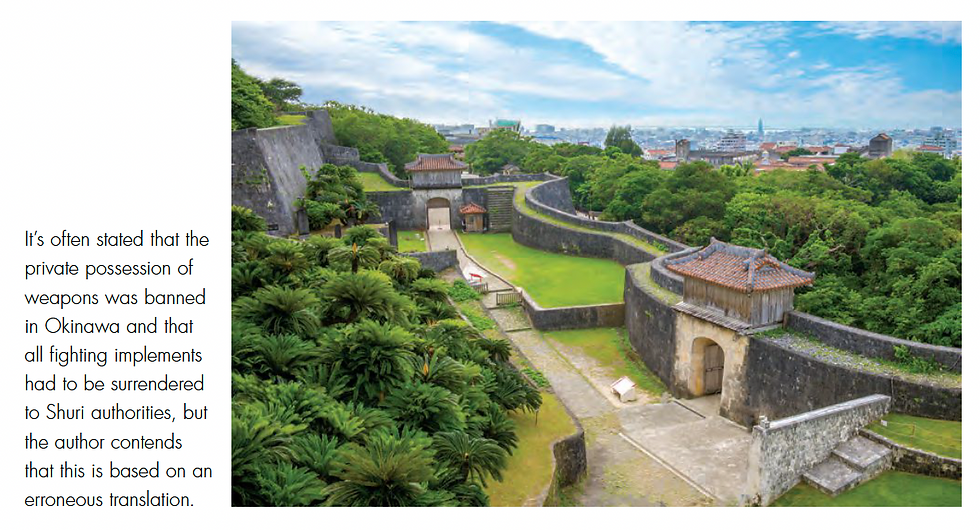
Miyagi stated that “official policy prohibited ownership or use of weapons” after the 1609 invasion. The belief that Satsuma rule prohibited weapons is incorrect. What it prohibited was the export of any new arms to Ryukyu because of an embargo put in place by the Tokugawa shogunate in 1634. Ryukyu was free to retain its existing arms.
It also must be noted that Miyagi may have been referring to a supposed weapons ban instituted earlier in Okinawa during the reign of King Sho Shin. The belief that weapons were banned by the kingdom can be traced to an erroneous translation made by noted Okinawan historian Ifa Fuyu.
The reign of Sho Shin (1465-1527) lasted half a century and was noted for the development of a centralized government, the establishment of a social class system, the organization of religion and an increase in prosperity via trade. In 1509 a monument known as the Momourasoe Balustrade was erected in the king’s honor. It listed 11 “distinctions” marking the greatness of the country under the king’s leadership. In 1932, just four years before Miyagi’s lecture, Ifa, a historian born in Naha and known as the father of Okinawan studies, translated the fourth distinction as “this country used the armor for utensils” and suggested that karate was a direct result of the loss of weapons.
George H. Kerr, author of the highly regarded Okinawa: History of an Island People, used Ifa’s work to conclude that “private ownership and use of arms were done away with,” that “swords were no longer to be worn as personal equipment” and that “the petty lords were ordered to bring all weapons to Shuri, to be stored in a warehouse under supervision of one of the king’s officers.”
However, in 1955 Okinawan researcher Nakahara Zenchu discovered a flaw in Ifa’s translation.10 He found that the fourth distinction actually states, “Brocade and embroidered silk are used for garments, and gold and silver are used for utensils. Swords, bows and arrows are exclusively accumulated as weapons in protection of the country. In matters of finance and armament, this country excels other countries.”
Rethinking Karate History
As a result of the 1609 invasion and subsequent imprisonment of the king, it’s reasonable to assume that the pechin would prepare, albeit secretly, for another invasion by Satsuma, one that might bring about the end of the kingdom. Such preparations likely would have included the development of improved hand-to-hand fighting techniques (karate-do), as well as new types of weapons (Okinawan kobudo) fashioned from common implements. Such weapons included the eku (oar), kama (sickle) and kuwa (hoe).
In conclusion, I believe there’s a strong argument to be made for the following: Karate was developed by the pechin of Ryukyu as a result of the Shimazu invasion of 1609. Its purpose was to defend the kingdom in the event of another invasion by the Shimazu. The pechin sought knowledge and training from their martial arts friends in China, and they weaponized common tools to conceal their purpose from the Shimazu. Why is this important to martial artists today? Because karate is not just a martial art; it was developed as a strictly defensive art, never intended to be used in anger or avarice.
Understanding the history of this art gives us a greater perspective on that old maxim Karate ni sente nashi. There is no first attack in karate.
Gary J. Garrahan has a third-degree black belt in karate-do from the Shoryuin Muso Chishin Ryu Heiho school. Based in Bakersfield, California, he’s a member of the Dai Nippon Butoku Kai.
This article originally appeared in a 2021 edition of Black Belt Magazine.