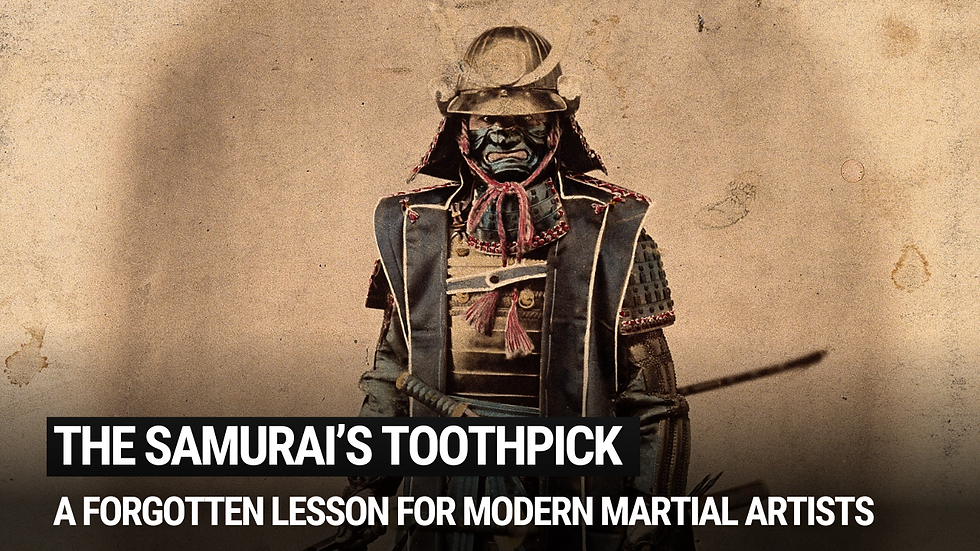
There was a saying in old Japan: Bushi wa kuwanedo taka-yoji. Roughly translated, it means, “When he’s hungry, the samurai uses a toothpick.”
There are layers of meaning to this. Understanding them gives us insight into the warrior culture that's had such a direct effect on the martial arts we practice today.
The Changing Identity of the Samurai
It’s foolish to talk about samurai as if they were a monolithic, never-changing institution in Japanese history. The samurai class varied widely in its makeup, influence, and behavior.
There were periods when they were almost constantly at war and times when they were little more than foppish dilettantes. Clearly, generalizations are impossible.
However, over the centuries, a discrete culture began to take form. In part, probably, because of the class stratification that dominated social and political life in Japan, the samurai came to see themselves as different.
To be sure, they didn't always live up to their own collective sense of self. It's doubtful they were entirely aware of that sense in any comprehensive way. They did, however, understand that their role in society was unlike that of any other class.
How an individual reacted to that, how he embodied it—or perverted it—said much about him.
The Toothpick as a Symbol of Pretense
To use a toothpick—as if one has just eaten a sumptuous meal, even though one's belly is empty and aching—can imply many things. It can be pretense.
Think of the guy who purchases a new luxury car on an already maxed-out credit card and then drives around as if he's financially flourishing even though the creditors are already gathering at his door.
There were samurai with toothpicks who absolutely fit this behavior. They would swagger about with their twin swords, arrogant in their position over the commoners who, ironically, were the source of every bite of food that went into their mouth.
Yes, the samurai were looked up to by those of the lower castes, to some extent, as exemplars of virtue and selfless bravery. They were also models of contempt, regarded as parasites.
They were held up as figures of ridicule, and the toothpick proverb can be interpreted that way. It winds up being about a haughty buffoon pretending to be well-fed and satisfied when in reality, he's nothing but a starving failure.
There's another layer of meaning to be found in the image of the hungry samurai with his toothpick, though.
Hunger and the Samurai’s Stoicism
Japan, through much of its history, has dealt with famine. The last of these occurred in the late 18th century, caused by bad weather and disastrous government policies.
Even in good times, hunger was a frequent part of daily life in Japan. Major riots occurred when farmers and other producers objected to high taxes, paid in rice, on dwindling food supplies. (Incidentally, in virtually all these riots, farmers armed with rakes, hoes, and other tools put the samurai to rout.)
During periods when hunger plagued Japan, others could grumble and complain. The samurai, however, often projected an air of calm stoicism.
Think of an inn of the sort frequently depicted in samurai films.
Farmers, merchants, the katsugi men who haul products up and down the highway—they're all complaining about the cost and scarcity of food while longing for a meal that will leave their belly full instead of pinched.
And there sits a samurai, toothpick in mouth, saying nothing. His imperturbable self-control has an effect on the crowd.
"Look at that samurai," they say. "He must be as hungry as we are, but see how he conducts himself."
The Samurai as a Model for Strength
In this way, we can see how a samurai could be a model for others, displaying coolness, refusing to complain. This is a kind of leadership that came naturally to at least some of the samurai class.
They saw themselves as special, as people who needed to serve as exemplars, as men who had a duty to live up to the expectations of their position. If we look at the saying in this light, we can see where a samurai would have pretended to be full when he was actually hungry because he believed behaving in that manner would make others consider their own behavior.
Today's martial artists are not samurai, however. Samurai are so far from modern society that it's impossible to think of our being related to them any more than we could identify with a galley slave on a Roman ship. Life is just too different. Nevertheless, it's useful for us to reflect on our own roles, in the dojo and in life.
Do we think of our status as black belts, masters, or experts as a sign of how special we are? Do we saunter about the dojo as if we're elitists, possessing some remarkable talents?
If so, we can expect that, like the pretentious samurai with the toothpick, there are people who will be quietly ridiculing us. We will be seen as arrogant, grandiose clowns.
If, on the other hand, we regard our training as a means to become more honest and to polish our integrity, we should see, as well, that there must be expectations of us. We can set the standard for good, unselfish behavior. We can act in such a way as to make others look up to us.
Everyone knows, if not true hunger, at least some level of discomfort in life. How we react to it, like the samurai with his toothpick, says much about the seriousness of our martial arts training.