Updated: Mar 10
So this guy is standing 6 feet in front of me.
He’s got his right hand behind his back, and he’s saying he wants to f@%* me up. It’s midnight on a sidewalk in Hawaii with no one around except my buddy, who’s occupied with the two other people in the pickup truck the man was in.
In the dim street light, I can barely make out the handle of a kitchen knife protruding from the right side of the man who’s confronting me.
It seemed like the perfect time to let loose a front kick — but I couldn’t do anything at that moment. I was a fairly accomplished martial artist, so what was my problem? Too many options were running through my head, and it locked me up.
I couldn’t decide what would work best, when to do it and what to follow up with if it didn’t get immediate results. That’s when I realized I was the kind of guy who needs simplicity.
That led me to krav maga.
SIMPLICITY, IN MOTION
In krav maga, instructors try to keep things simple because they assume their students have limited training time. So they pare down the defenses to the lowest number of techniques that will enable a person to solve the widest range of problems.
Krav’s kicks are no exception. Because kicks by themselves take away our ability to move in the moment and inherently compromise balance, our goal is to reduce the time we spend on one leg while delivering maximum damage or stopping power — and doing this in a manner that enables the average person with limited training time to learn quickly and execute easily.
In krav, we categorize kicks into two groups: defensive and offensive. Defensive kicks are those that put our full leg between us and the attacker on impact. They’re designed to maintain or create distance between the two parties. An offensive kick is any kick that doesn’t do that.
The krav front kick is broken down according to three goals:
Damaging a horizontal target
Damaging a vertical target
Creating or maintaining space between defender and attacker
The resulting three moves are called different things by different people, but in general they’re known by descriptive names: the regular front kick, the ball-of-the-foot front kick, and the defensive front kick.
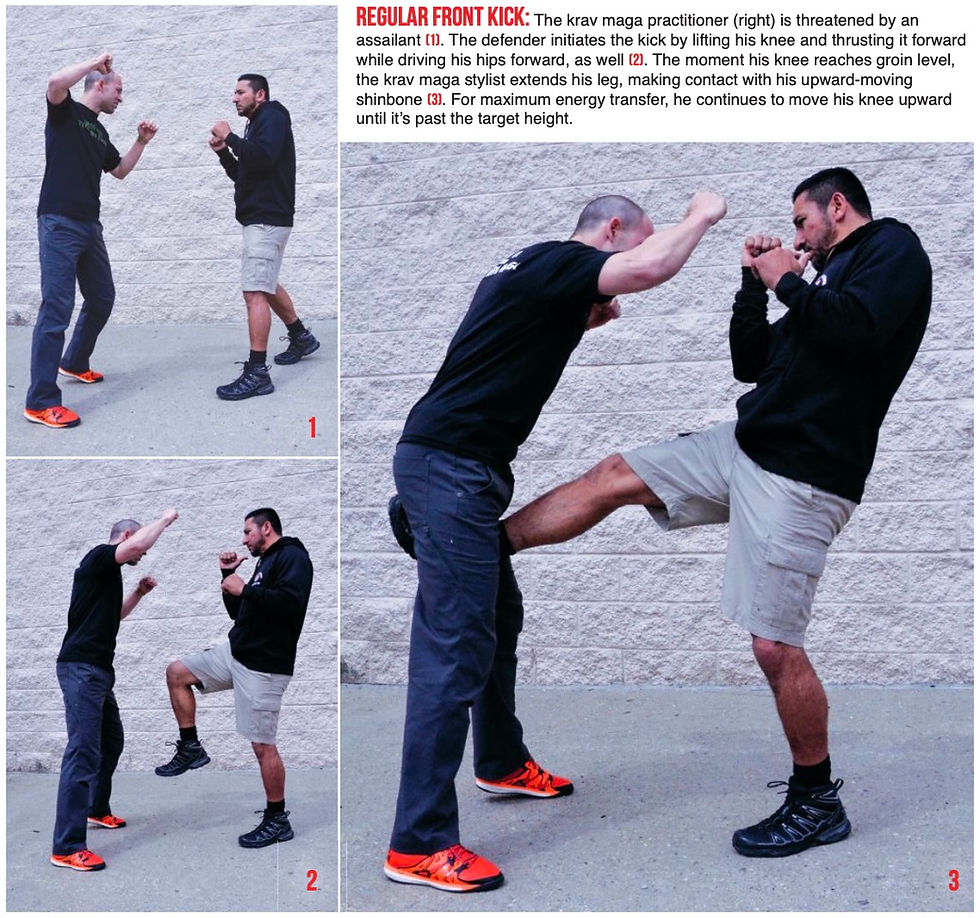
REGULAR FRONT KICK
This technique is sometimes mistakenly called a groin kick. It’s the kick a lot of people think of when you mention krav maga because the system is billed as no-rules self-defense.
So that image of someone being kicked in the groin may drive home the point, but the move is far more than a groin kick.
The kick uses the shinbone — generally, between just above the ankle and halfway to the knee. Go any higher, and you’ll turn it into a knee strike. The groin is a great target for the regular front kick but not the only target.
In fact, it’s good for any horizontal body part. Imagine that your attacker is bent over in front of you in a perpendicular orientation.
This is the perfect technique to slam into his face.
ACTION:
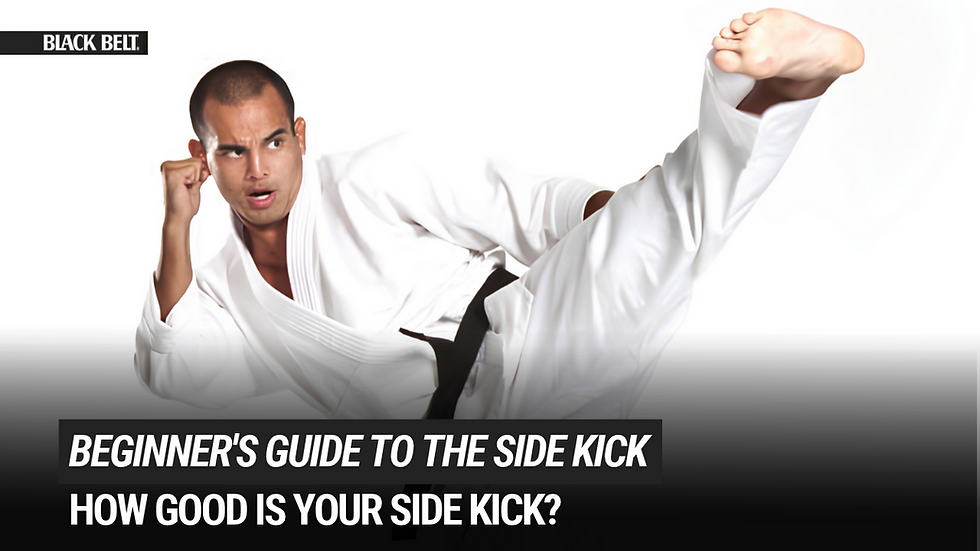
To deliver this front kick, start by moving your knee upward and forward.
To get your knee moving forward, you’ll have to drive your hips (note the plural) forward, and that’s exactly what you want. Just make sure your hips don’t initiate the movement, which will telegraph the technique.
As you do this, your knee should bend to approximately 90 degrees. Take care that your foot doesn’t travel backward, away from the target. (Envision the foot trailing the knee slightly in the initial movement.) As your knee approaches the target’s height, explosively extend your leg.
Note that the knee never holds that 90-degree bend. Rather, it hits that angle and begins its unbending immediately. Point your foot forward while extending your leg to expose your shinbone better and to emphasize your hip driving forward.
Continue to drive your knee so it passes the target height, which ensures that your bodyweight goes through the target. Think of your knee as the last hinge in the weapon system: If the hinge stops opening before the target is reached, or even at the same height, the mass on the back side of the hinge stops there, too. For that reason, it won’t transfer all its energy into the target.
Because your hips are driving forward, it might appear like you’re leaning backward, but you shouldn’t lean away. The fact that both your hips are extended forward just gives the illusion of bending backward. Your upper body should stay very much over your base leg.
The final step, as in all krav kicks, is to recover your stance. The most common practice is to simply put your foot down where the fight dictates it should be. That’s logical because what you do next is mostly determined by the attacker’s reaction to your kick.
Putting down your foot in front effectively advances you into the fight, while placing it back where it started puts you at long range, which offers different options.
In most cases, you’ll put it down somewhere in between with a small adjustment step that gets you into a good stance, which will allow an immediate follow-up strike or set you up for a fast escape.
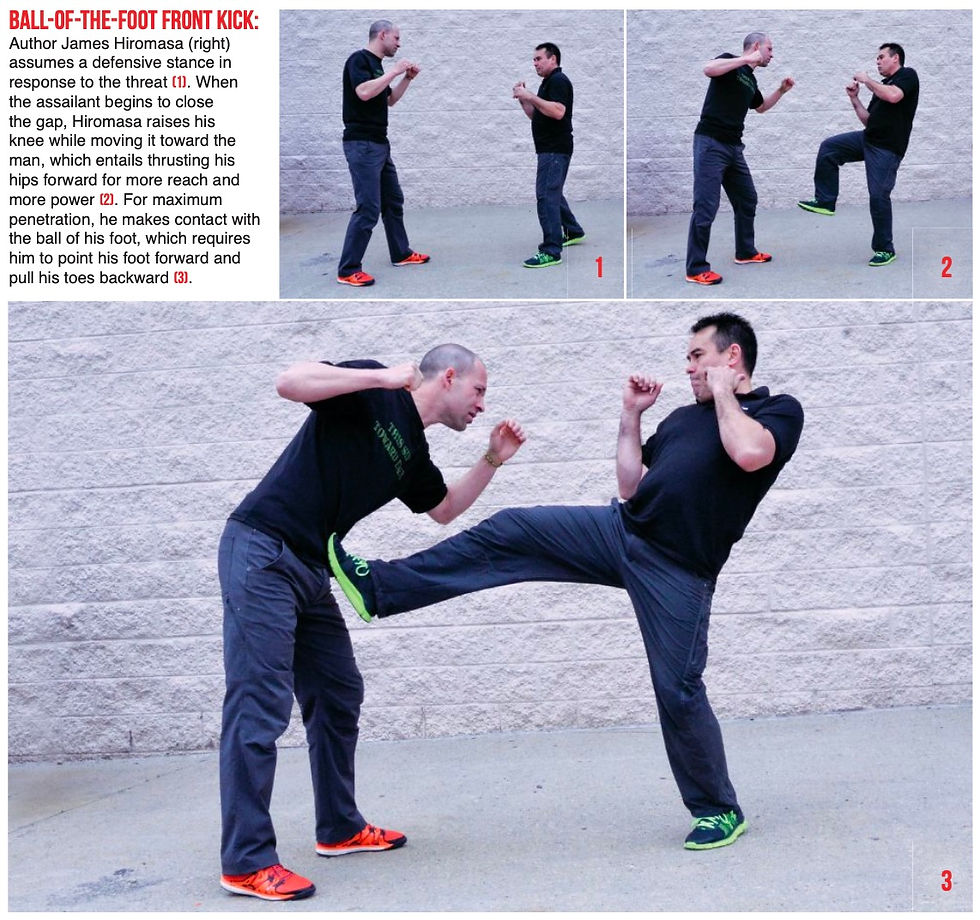
BALL-OF-THE-FOOT FRONT KICK
Also known as the vertical-target kick, this technique is similar to a muay Thai kick known as the teep. It’s designed to penetrate rather than stop an opponent’s forward movement. (Although, a well-executed kick can indeed accomplish that.) Just as the name states, its aim is to make contact using the ball of the foot.
When landing it, you’ll want to point your foot forward and pull your toes backward.
The targets for this front kick are the vertical surfaces of your opponent’s body. When you’re face to face, prime examples include the front of the groin and the abdomen. It’s easy to make the liver a target, or the kidneys, if your attacker isn’t facing you.
As always, the head can be a target, assuming it’s been lowered to a reasonable height so kicking it doesn’t compromise your balance or cross the threshold of where a hand technique would be preferred.
This front kick develops almost exactly as the regular front kick does. It’s intentional. Krav maga practitioners appreciate the freedom to start a regular front kick and quickly morph it into a ball-of-the-foot front kick if the target changes mid-delivery.
ACTION:
As in the previous kick, start by raising your knee and moving it forward — make sure you’re using your hips for power.
This time, however, create a slightly greater knee-bend angle and hold it a little longer because your goal is to effect a more linear, horizontal projection. As your knee reaches target height, drive your foot forward. Your knee will get a little higher than the target, but it will come back down to line up between your hip and the target on impact.
Just before that impact, “punch” both hips forward, driving your bodyweight into the kick. In this move, real power depends on timing more than anything else. To visualize the trajectory and angles involved, think about how you’d shut a car door with your foot. The foot comes up, but ultimately the trajectory flattens on contact.
You want all the energy and mass thrusting forward at the moment of impact, as opposed to still moving upward.
Recovery is the same as with the regular front kick, but it’s more likely there will be a slight advance, and because much of your energy is moving forward, you may have to advance after the kick to follow up anyway.
A well-placed ball-of-the-foot kick can bend an attacker in half at the waist, often causing him to stop moving forward with his lower body. Just be aware that his upper body might still be moving forward.
This can have serious consequences, especially if he has a knife. In any case, you should plan for anything and be able to adjust quickly to deliver a follow-up or make an exit.
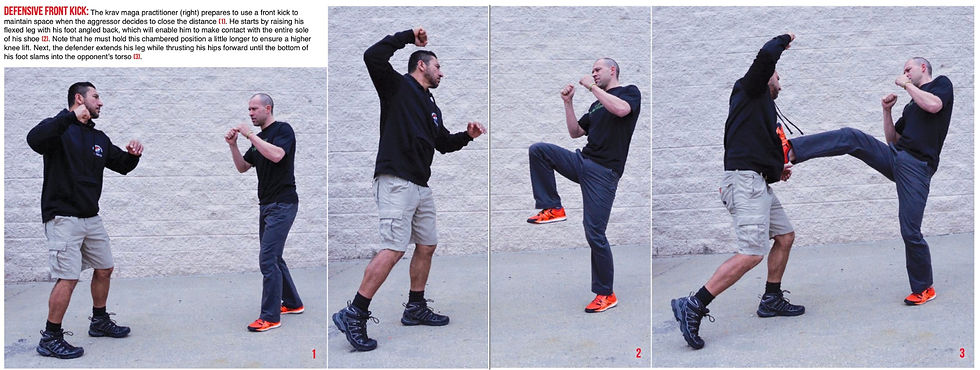
DEFENSIVE FRONT KICK
This kick is primarily designed to create space — or maintain space if the target is moving forward. To see a great example of the technique, search online for “this is Sparta kick” from the movie 300.
The clip shows a very strong kick with lots of mass behind it, but because it’s a higher kick, it takes longer to develop, which increases the chance your foe will defend against it or move. Of course, the higher the kick, the more your balance is compromised, as well.
Because this is primarily a “stopping” defensive kick, you want as much surface area as possible making contact. That means you need to angle your foot back in an attempt to land the entire sole on target. If you hit with the ball of your foot, you might lose some energy when your ankle acts as a shock absorber. Although technically you'd be fine just making contact with your heel, more is better. Think of trying to move a balloon with a pin versus with your hand. The pin will penetrate the balloon, while your hand will move it.
For maximum effect, this kick should make contact between the base of the ribs and the suprasternal notch. Remember that you're trying to move someone backward or at least stop his forward momentum.
Landing this kick at hip height may stop his legs from moving forward, but his upper body will still be in motion. Kicking above his midpoint hinge will have a better and more immediate result. If you can get his upper body to suddenly move behind his heels, you'll create even more space and time, especially if he stumbles backward or falls.
Raise your flexed knee — the higher the knee, the higher the kick. Unlike in the previous two kicks, hold this bent, or chambered, position longer to allow for the higher lift. Start unbending your leg and pulling back your foot. This is when you should begin thrusting both hips forward in a stomping movement. Envision your foot hitting the target at the same time your hips, and therefore your bodyweight, reach the apex of their movement.
With this kick, it's OK if your base foot pivots slightly to increase the flexion in your legs, allowing more height for the technique. Note that this will send your kicking hip farther forward, as well, thus slightly increasing your range.
As before, your hips will be far enough forward on impact that from a profile position, it might look like you're bending backward.
However, this shouldn't be the case. Your upper body should still be a counterbalance and in a good relationship with your base leg, allowing for a kick recovery in any direction.
It also will help you avoid being bounced backward by the attacker's momentum.
NEXT STEP
With these three basic, yet versatile, techniques in your arsenal, you can increase the number of targets that are available to your foot strikes in most self-defense situations.
No matter which one you select, be sure to get your kicking foot back on the ground as quickly as possible so you can move or strike immediately. And remember that a kick should always be part of a comprehensive combination that overwhelms your attacker and keeps him on the defensive.
Oh, yeah, the guy with the knife in Hawaii? Well, as luck would have it, I didn't need to use any of these front kicks.
At the last moment, a police officer cruised by and slowed down to see what was going on. As soon as he hit his lights, the perp bolted.
He was caught ditching the knife and eventually went to jail.