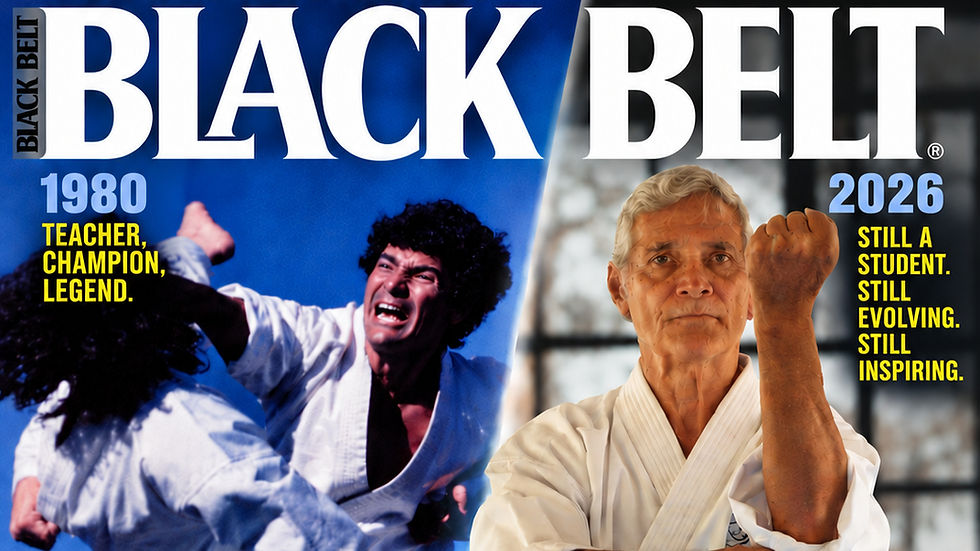
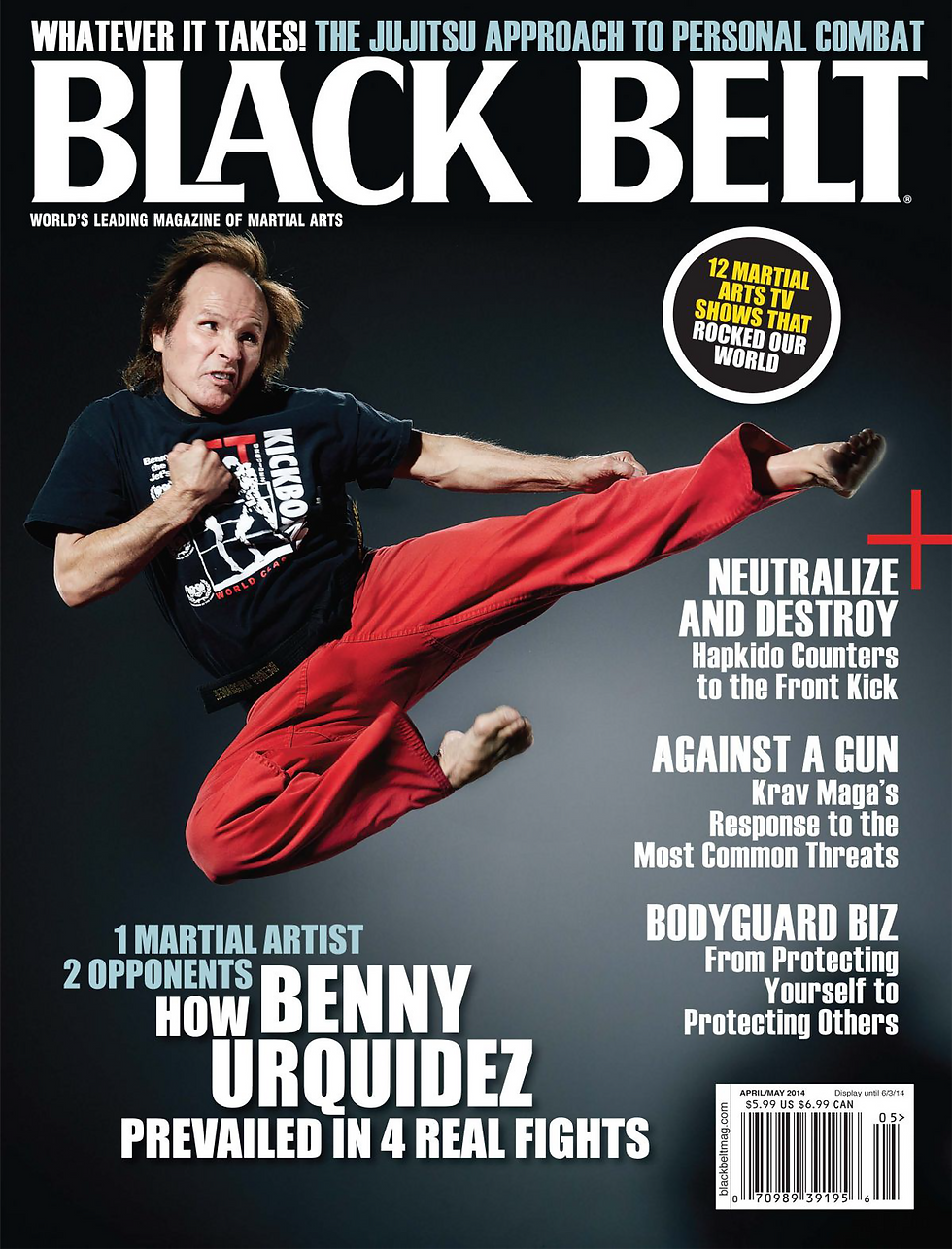
Editor's Note: Did you miss the Spring 2025 issue of Black Belt? Here's a look at one of the stories that ran in the special issue. Even better, you can check out the WHOLE issue with Black Belt Plus!
Since 1979, Burton Richardson has been on an unstoppable martial arts journey. He began training at the original Kali Academy, home to greats such as Sifu Richard Bustillo and Guro Dan Inosanto, then traveled the world to learn from the best. In Manila, he studied under Grandmaster Antonio Ilustrisimo.
In Brazil, he trained with top BJJ practitioners like the Machado Brothers and Carlson Gracie. He’s even trained with Zulu warriors in South Africa and earned a black belt in krav maga.
His broad experience makes him a sought-after instructor for civilians and law enforcement alike. A prolific writer, he’s authored five books, spent 11 years as a columnist for Inside Kung Fu, and been honored as Black Belt Magazine’s Self-Defense Instructor of the Year.
Now based in Hawaii, Burton continues to share his knowledge worldwide, always learning, always evolving.

Introduction & Background
How did you first get started in martial arts, and what inspired you to pursue this path?
As a young kid, I loved Kato in the Green Hornet TV series. I didn’t know until many years later that Kato was played by Bruce Lee. But his dynamic fight scenes were my first exposure to any sort of martial arts. I guess that is how I first caught the bug.
When I was nine years old, I endured a very horrible experience. I was abducted by a large adult male, and it was a truly horrific event. Being so utterly helpless while someone much bigger and stronger was constantly threatening to kill me ingrained a very deep desire to learn how to defend myself from evil.
It took many years, but as I was allowed to, I started training. By a stroke of luck, that training was at Guro Dan Inosanto and Sifu Richard Bustillo’s original academy in Torrance, California, which was a mile and a half from our house in Carson.
For the last thirty years, my main goal as a teacher has been to make others formidable so that they will never be at the mercy of a merciless attacker.
What were some of the biggest challenges you faced in your journey as a martial artist and instructor?
After finishing my studies at USC (I majored in biological sciences and completed a 4-year writing and literature honors program), I dedicated myself to training. At that time I had two major obstacles: poverty and health issues.
I lived in a tiny camper trailer in a parking lot of a dog and cat hospital near downtown LA for five years so I could train constantly. I lived there without having to pay rent in an exchange for watching over the facility at night. I made enough money doing odd jobs to pay for my training, food, and transportation.
It was not easy living in an area where drive-by shootings literally happened across the street and where I sometimes found bullets in the parking lot next to my beater vehicle.
Add to that severe recurring digestive problems (which was later diagnosed as ulcerative colitis) and you can imagine that I went through some very difficult times. Not to mention dealing with bouts of profound depression.
But the incredible privilege of getting to train with Guro Dan Inosanto in all 18 of his weekly classes got me through those tough times. His positive energy and generosity rubbed off on me so that I could find joy and gratitude, even in my dire living conditions.
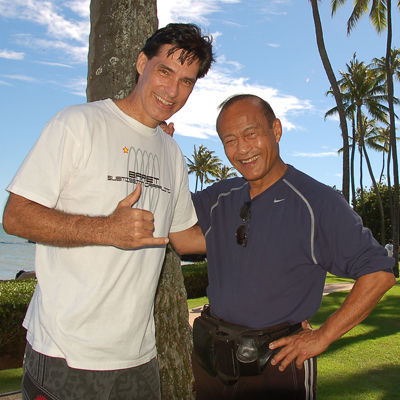
Your approach emphasizes adaptability and real-world effectiveness. How have you personally evolved as a martial artist over the years?
In the early years, I just trained and learned everything I could. I did not make any discernment between what was the entertainment art and the combative martial art.
When I started competing, I quickly discovered that there was a big difference between training to impress an audience and training to dominate an opponent who is doing everything he can to dominate you.
After a few terrible performances, I started remembering all those times that Guro Dan mentioned the differences between the stage art and the combative art. Because I was getting fight experience, I finally understood that wisdom. I made a decision to focus entirely on the combative art since my main goal in martial arts was ignited by the terrible incident I endured as a nine-year-old.
So I pushed the cool “art” portion aside and focused on the “martial”. This is when I went deep into Brazilian jiu-jitsu and no-holds-barred fighting, which was to later be called MMA.
The key to functionality is to safely train with a fully resisting opponent. This is not just all out brawling. I think many martial artists avoid sparring because they don’t understand the difference between sparring and fighting.
Fighting is doing your best to injure your opponent while sparring is trying your best to “score” on your partner without inflicting any damage at all. We spar in an intelligent manner so that people progress without fear of serious injury, including brain trauma.
I employ the principle of progressive resistance so we take a person along slowly with light resistance and only add more resistance when they are comfortable and able to handle it. Over time, I know that these students really have a fighting chance against a street attacker. These experiences all led me to my motto, "pressure test everything!"
To be clear, I do enjoy and teach aspects of the arts that are for mind, body, and spirit. These movement arts are very good for total health, which means they are functional in that very important realm!
Workshops & Training Approach
You’ve spent years sharing your knowledge worldwide. What originally motivated you to teach through books, camps, and courses?
My main motivation is to help others enjoy all the benefits that I have received from the martial arts. My quality of life is very high because I love exploring and constantly improving in the various aspects of the arts. This is so gratifying and fulfilling on a day-to-day basis that I want others to be able to feel what I feel.
I’ve had the privilege of training with so many amazing instructors that I have garnered a wide knowledge base that I am constantly expanding. Probably due to the fact that it tends to take me a long time to learn things, I happen to have a knack for teaching and explaining techniques and principles that make it easy for others to learn and progress faster.
I’m glad that learning doesn’t come easy for me. This detriment forced me to analyze everything in minute detail so I could understand it. That helps me to pass it along.
So it’s the love of the art and the love of watching others progress that makes me happy. As my wife Sarah once noted, “You love transformation. You love to see that transformation in your students and in yourself. That’s why you love teaching so much.”

What do you find most rewarding about teaching martial artists of different backgrounds and experience levels?
It is very gratifying to see people become better versions of themselves through training. It’s also fun to coach competitors and see them flourish, whether that be at a local grappling tournament or at a huge professional event like the UFC, ADCC, or ONE Championship.
But the most rewarding by far is seeing someone come in to train who is so timid that he she can barely speak to you, but after months of training they gain the confidence to let their true personality shine. That is what I love most. Through the martial arts, we’ve been able to bring out the best in human beings who can then help and inspire others.
Your training emphasizes pressure testing and live resistance. How do you structure your programs to ensure students develop both technical skill and functional application?
First, you have to make sure the environment is such that the students want to continue training for a long time. So we keep classes, fun and safe while adding that authentic resistance.
We constantly work on being precise with our technique, then subject it to pressure testing. This ensures that each student can better understand how to apply the technique under pressure instead of merely memorizing the moves. That makes their techniques sharper.
I am often asked how long I wait before having a beginner start sparring. They are usually very surprised when I say that brand new students spar their first day. Images of brutal beat downs come to mind, but that is fighting, not sparring.
Brand new students who have never trained martial arts at all play the open hand game the first class. This is where we just try to touch the top of our partners head with an open hand so that the new student immediately gets to feel the context of the environment we are working in.

I often start having them only use the lead hand to keep it simple. No choreography at all, but just safely playing the game. And it always brings out smiles and laughter in the new students because they get to play.
Over time, students who are ready add more tools and eventually move to sparring with helmets and gloves. We use a sparring helmet with a face cage on the front so they don’t have to worry about black eyes and bloody noses. We still regulate the amount of force that they can use as we don’t want heavy blows to the head.
Resistance training isn’t all sparring though. For example, we may start in a clinch position, and the directive is for one person to maintain the clinch while the other person tries to get away and make distance. So this isn’t sparring as in a back-and-forth game, but there is a lot of resistance and functional learning that goes on. We use this for weapons defense as well.
My favorite saying is “Knowledge is not power. The ability to apply your knowledge, under pressure, is true power.” These games take knowledge and develop it into the ability to apply the knowledge, in other words, skill.
What key skills or techniques do you focus on during your workshops, and how do you tailor them for different levels of experience?
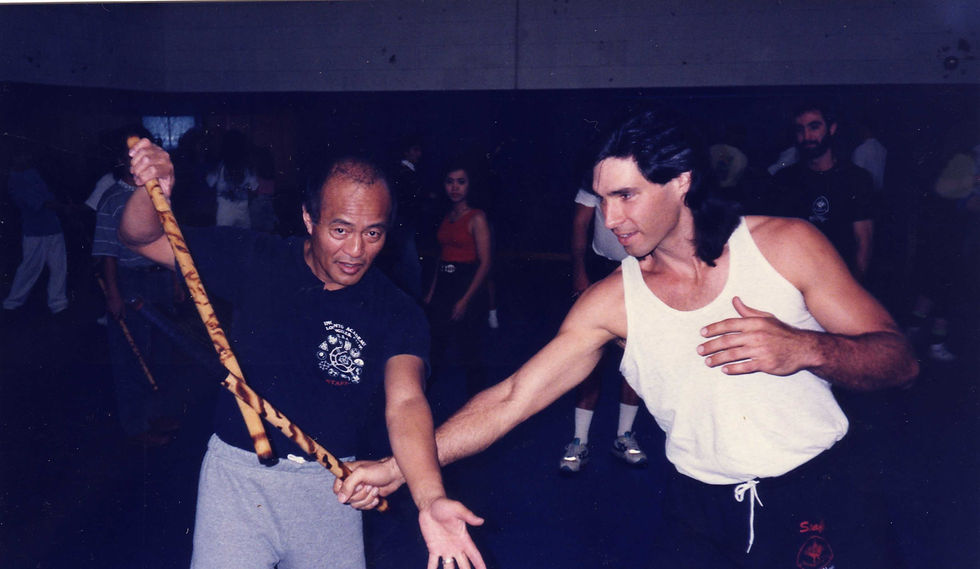
Workshops are different than teaching in class. I don’t expect anyone to spar in a workshop or seminar. In a workshop, my goal is to increase each student’s understanding of functional training methodology along with giving them important but often overlooked details of the application of techniques.
What I actually teach depends on what the seminar host has requested. I teach general seminars where I go over aspects of many of my programs, and I teach workshops that go very deep into one specific area. These workshops can be as varied as exploring combative street scenarios, silat dance, functional knife defense, or set ups and finishing the north south choke.
Like in our classes, the workshops are taught in a fun and open environment. I always encourage questions of any sort and we have a great time diving deep into whatever subject matter we are exploring.
Industry Insights & Practical Application
Martial arts is constantly evolving. Are there any emerging training trends or techniques that you’re particularly excited about?
I’m happy to see that more people are finally recognizing the difference between effective sport training and functional self-defense training. I’m just sorry it took a significant increase in violence for this to become apparent.
As functional as combat sports are, each approach evolves for efficiency within their particular rule set. Combatants do not need to account for attacks that are outside of that rule set.
But the rule of the street is that there are no rules. We must account for everything, including knives, pistols, clubs, multiple attackers, eye and groin attacks, etc. Most self-defense arts deal with these aspects, but self-defense arts often avoid the all important element of authentic pressure testing, meaning really allowing your partner to totally resist in an un-choreographed manner.
But if you take the training methods of combat sports and safely include the street elements, then you are really preparing yourself for functional self-defense. That is what all my For The Street and Battlefield Kali programs emphasize.
Let’s not just memorize the techniques and get reps in; let’s practice applying the techniques against a fully resisting partner in a safe environment. Just as training very well for a combat sport does not guarantee a victory in the cage or on the mat, this kind of self-defense training does not guarantee success against a real life attack. But it will make the defender formidable and give him or her a fighting chance.

For martial artists who want to focus on real-world effectiveness, what’s the most important element they should prioritize in their training?
For real world effectiveness, I would emphasize two elements. First, you must train against an uncooperative, resisting partner. That’s the only way you will be truly prepared to deal with a violent, 100% resisting attacker.
The second element for real world effectiveness is to train with weapons in the mix all the time. When we do kickboxing, clinch, or ground, our students store safe training weapons in their waistbands so that they can pull them out at any moment.
You see, we don’t want to recognize that a weapon is in someone’s hand. That is too late. We want to account for the weapon ahead of time in order to position ourselves in a way to stifle the draw or at least recognize when a draw is about to happen.
A quick example: using a Thai boxing neck clinch on someone and throwing knees can be very effective. But I won’t be able to see their hands, meaning I won’t know if the adversary pulls a knife out of his pocket. That could have deadly consequences.
Therefore, we prioritize a double biceps tie where we have control over both arms so that we can see and feel if the person puts his hand towards his waist in an attempt to draw a weapon. That way we can try to stifle the draw or at least transition to control that arm before the weapon comes out.
Everyone knows that a weapon can come out in a street assault. But knowing is not enough. We must train to expect and account for weapons while under the pressure of a sudden attack. Including inert weapons in a training environment is essential to ensure that each individual is trained to assume there is a weapon coming.
With the continued rise of social media and online training, do you see the landscape of martial arts education changing in any ways over the coming years?
Yes. I see a day where self-defense classes will use video evidence to show how actual attacks look and examine what may have gone wrong and what things worked well under real life conditions.
I’ve been showing real world fight videos at my seminars and classes for well over 20 years. And the students always appreciate that honest perspective. If you don’t know what a real situation looks like, you will not be able to prepare well for it. Most people have gotten their ideas of fighting from films or combat sports. The real thing is much uglier and more violent.
I hope that showing footage of actual encounters will be a big change that more and more people will adopt.

Training & Personal Growth
How do you keep your training fresh and continue to challenge yourself?
Simple! Through sparring! To me, sparring is always fun and the moments unique. Having many sparring partners means that new situations and approaches will come up often.
This is such a great way to learn and stay sharp. It also keeps you humble because you are constantly reminded that you are not infallible. So if your ego is in check, you can just keep sparring safely in the kickboxing range, in the clinch, on the ground, and with a variety of weapons to keep you sharp.
I also enjoy the creativity of solo training, be it moving weapons in the air or doing empty hand spontaneous flows like silat dance. It is a joy to get into the flow state.
Being a student is another way to keep things fresh. Learning someone else’s perspective on moves that you may already “know” is motivating.
For example, I have the good fortune of getting to train with my longtime friend Marcelo Garcia‘s school here in Hawaii. I learn important details every single class from him and have a great time doing it. I also take online lessons from high level instructors in various arts. It is such a joy to continue the learning process.
Personally, I think if you get bored doing martial arts, then your horizons are far too narrow. Go train in an art you are unfamiliar with. There is so much to learn!
Can you walk us through a typical week of training for you? How do you balance striking, grappling, weapons, and conditioning?
I train jiu-jitsu at Marcelo Garcia‘s school here in Hawaii 2 to 3 times a week. I often spar or train with my private students several times per week and I do solo training nearly every day.
I like to walk down to the beach and move the double sticks in the morning. It’s a great way to get the body active. When I train solo at home, I will usually hit equipment with the weapons, do rounds of boxing, kickboxing, self-defense scenarios, and clinching on the BOB dummy.
I will spend some time on the wing chun dummy, and also practice movement and particular submissions on a grappling dummy. I pick specific things to work on at home which keeps it very interesting. I’m not just doing the moves to get in reps. I prefer to do fewer repetitions and concentrate on making the techniques more efficient than ever.

Looking Forward
Are there any upcoming workshops, events, or projects that martial artists should look out for?
I will be going back to SHBJJ Hong Kong to teach later in the year and I am teaching a silat camp in Rhode Island at Gillett’s Mixed Martial Arts gym the last weekend of July. I will teach seminars in Italy in October for my long-time student and friend, (and JKD Unlimited Senior Full Instructor) Augusto Baracco.
I am looking at hosting a JKD unlimited camp here in Hawaii at the end of the year. Please check our website and your social media for announcements.
What’s the vision for your work in martial arts? Are there any particular goals you’re striving toward in the coming years?
My main personal goal is to continue to improve in all areas of combat. That means that I remain a student which in turn means that I can much better relate to my own students.
A big goal of mine is to propagate the Zulu martial arts in the west. I have made four trips to South Africa to train, starting in 1994.
The stick fighting, spear and shield fighting, and axe combat are very interesting and incredibly effective. The cultural aspect is fascinating and I think so many people will enjoy training and teaching these arts once I help to make it more available.
Every time I’ve taught some aspects of Zulu stick fighting in seminars, I have gotten a great response from the students. I plan to create a network of instructors so that these arts can be appreciated beyond South Africa.
My other goal is to educate many more people on the realities of street self-defense. That way, they will truly understand how important it is to avoid situations. They will also be better equipped to deal with a physical confrontation if necessary.
I’d like to finish by giving my sincere thanks to all of my instructors, especially Guro Dan Inosanto. What a role model he is! I also give great thanks to my amazing wife, Sarah, and to my daughter Talina for being great supporters, training partners, and inspiring me to be my best.
And a special thanks to all my students across the globe who inspire me by their examples of constant improvement and their passion for martial arts training.
Come to Hawaii and train!