What Every Modern Martial Artist Needs to Know About the Ancient Indian Fighting System
WHAT IT IS
Kalari Payattu is one of the oldest fighting arts in the world. The name comes from two words: kalari, which means “gymnasium,” and payattu, which means “exercise” in Malayalam, the language of the Kerala state in India. It’s believed that karate and kung fu took inspiration from Kalari Payattu (also spelled kalaripayit) in their formative years.
WHEN IT WAS CREATED
The origin of the kalari — and hence the fighting style — can be traced back to the 12th century, when a breakdown of the Kerala state occurred. That led to the emergence of small kingdoms, many of which were unable to pay for their own armies.
In response, chieftains would maintain kalari in a bid to keep their citizens ready to wage war. Good physical training and discipline were cultivated in case of attack.
BECOMING A MARTIAL ART
Kalari Payattu evolved into a system that was eventually taught to people from all castes and religions, which resulted in Hindus, Muslims, and Christians practicing alongside one another. It grew to include techniques for fending off attacks by both armed and unarmed enemies.
Kalari Payattu masters, or gurukkal, were selected for their character and discipline. Reflecting the way such traits were emphasized, obedience to one’s master was deemed crucial, and students were required to obtain their master’s permission before using weapons.
MAIN VARIATIONS
Kalari Payattu can be divided into northern and southern styles. The northern version focuses on body-control exercises, while the southern version emphasizes empty-hand fighting.
Usage of sticks and other weapons, as well as the ways of healing, can be found in both styles. Interestingly, the healing portion of the curriculum encompasses treatment for most of the injuries one might sustain in Kalari Payattu training and fighting.
AYURVEDIC CONNECTION
The Western Ghats region of India is known for its therapeutic herbs, many of which are used to make medicines to treat Kalari Payattu injuries, as well as to enhance massage designed to care for bones, muscles, nerves, and vital points.
When Kalari Payattu practitioners receive massages, they take full advantage of the experience to see how each muscle and nerve responds to pressure from the fingers and feet.
BREATHING AND SEEING
Because oxygen intake is crucial when exerting oneself in Kalari Payattu, a treatment known as nasyam is often administered to promote clear nasal passages.
It entails dripping a concoction of herbal juices and medicated oils into the nose. Because vision is also essential, a treatment called tharpanam is used to strengthen the nerves of the eye and prevent swelling and itching.

TRAINING FACILITIES
Kalari are categorized according to floor size. The standard lengths are 52 feet, 42 feet, 32 feet, 18 feet, and 12 feet. The width is normally half the length. A facility’s height may vary from 12 to 30 feet.
In the past, kalari structures were covered with coconut leaves, but nowadays tiles and concrete are used. One factor that hasn’t changed: the door always faces east.
GATEKEEPER
The Kalari Payattu master is the person entrusted with opening and locking that east-facing door. It’s a serious matter because the facility is considered sacred — much like a Hindu temple. But unlike a temple, a kalari houses no idols.
INSIDE THE KALARI
A poothara is located at the southwest corner of the facility. A semicircular mound, it has seven layers that symbolize the seven mothers who take care of everyone, including fighters. Flowers are placed on it, and a lamp is lit at dawn. Before a fight, practitioners seek blessings from Bhadrakali, the goddess of war and weapons.
Located next to the poothara is a guruthara, a raised platform that symbolizes the gurus and elders of the lineage. The Kalari Payattu master stands in front of the guruthara when he gives commands to his students.
PRE-TRAINING RITUALS
Fighters apply oil to their bodies before they begin a session. They don a katcha, a cloth that measures 15 to 18 feet long and 9 inches wide. It’s wrapped around the waist, hips, and abdomen in a manner that covers and protects the body while preserving freedom of movement. The upper body is left bare.
CURRICULUM PROGRESSION
Training begins with body-control exercises; they form the foundation needed to learn all other skills because they foster flexibility, agility, swiftness, and coordination.
At the next stage, students practice with sticks and canes. The long stick is called the kettukari and its shorter sibling the kuruvadi.
Once they’ve been mastered, students proceed to the third level: swords, shields, knives, daggers, tridents, and spears. Truly learning any one of them is an arduous test of both body and mind.
ARSENAL OF WEAPONS
At that third level, the first weapon taught is the dagger, followed by the sword. Around the same time in the student’s development, the shield is introduced.
Later on, he may learn the otta, an S-shaped staff with a wooden knob at one end. When used, vital points on the opponent’s body are targeted — which can be devastating if actually struck.
Or the student may opt for the urumi, a 5- to 6-foot-long flexible sword designed to keep an enemy at bay. Unlike most swords, the urumi can be folded and worn as a belt. It’s also found favor with women who like to curl it in their long hair or keep it in their bag for use in an emergency.
MORE TOOLS OF WAR
The gada is India’s mace. Made of a type of wood that’s heavy and resists splitting, it requires great strength to maneuver. Despite its seemingly harmless appearance, it’s a deadly weapon — as well as a great tool for building the body.

“EMPTY” HANDS
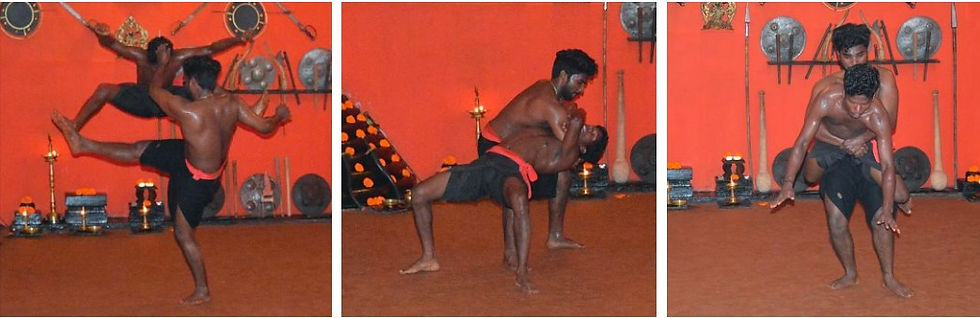
In Kalari Payattu, as in other arts, techniques include locks, strikes, and grappling moves. More uncommon is its use of cloth as a weapon. A simple length of fabric in an otherwise empty hand can enable a student to entangle an adversary and, once he’s restrained, bind his hands together.
LOWER BODY
Leg exercise is regarded as indispensable because a strong support system is needed for the body to maintain balance, stay mobile, and execute various offensive and defensive moves such as kicking and jumping.
The Kalari Payattu leg regimen includes movements that keep the limbs straight, work them at a multitude of angles, and swing them through the air in a variety of directions.
ANIMAL INFLUENCE
The eight animal postures are prized for their ability to teach students how to swiftly turn and twist their bodies. They were incorporated into the art after masters observed the movements of the elephant, lion, horse, pig, snake, cat, rooster, and fish.
These postures can activate muscles and nerves that are necessary during execution of the art — and they help keep the practitioner attuned to nature.
LEAPS OF FAITH
Kalari Payattu jumps recruit the whole body for maximum performance and are done in a series for maximum effect, which includes building balance and explosiveness. Not surprisingly, Kalari Payattu has been described as yoga in motion.
BENEFITS OF TRAINING
The Indian art does not propagate violence. Instead, it serves as a way to improve one’s self-confidence, which grows naturally from the ability to fend off an attack.
It is for this reason, as well as the fitness benefit that accompanies training, that the ancient martial art of Kalari Payattu has remained relevant in modern times.
Photography by Khursheed Dinshaw