
What It Is
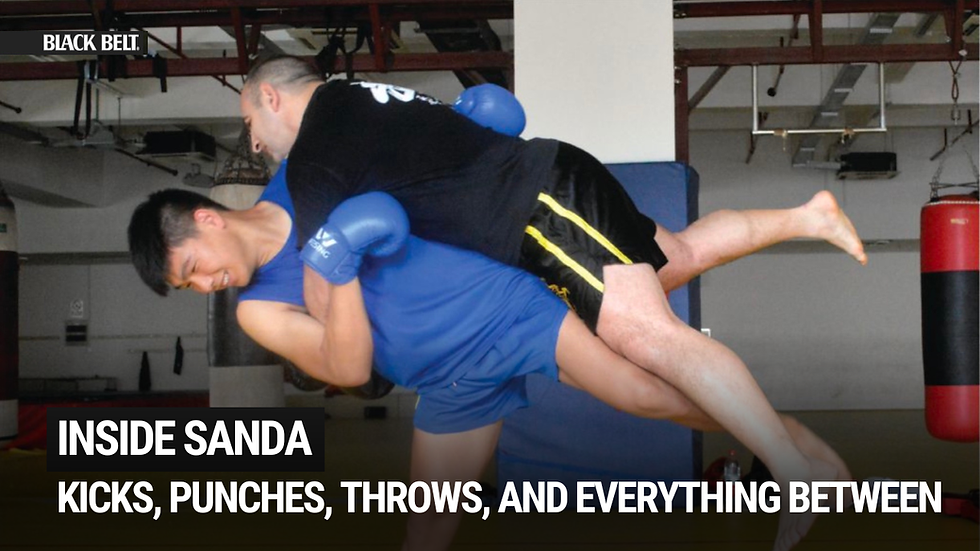
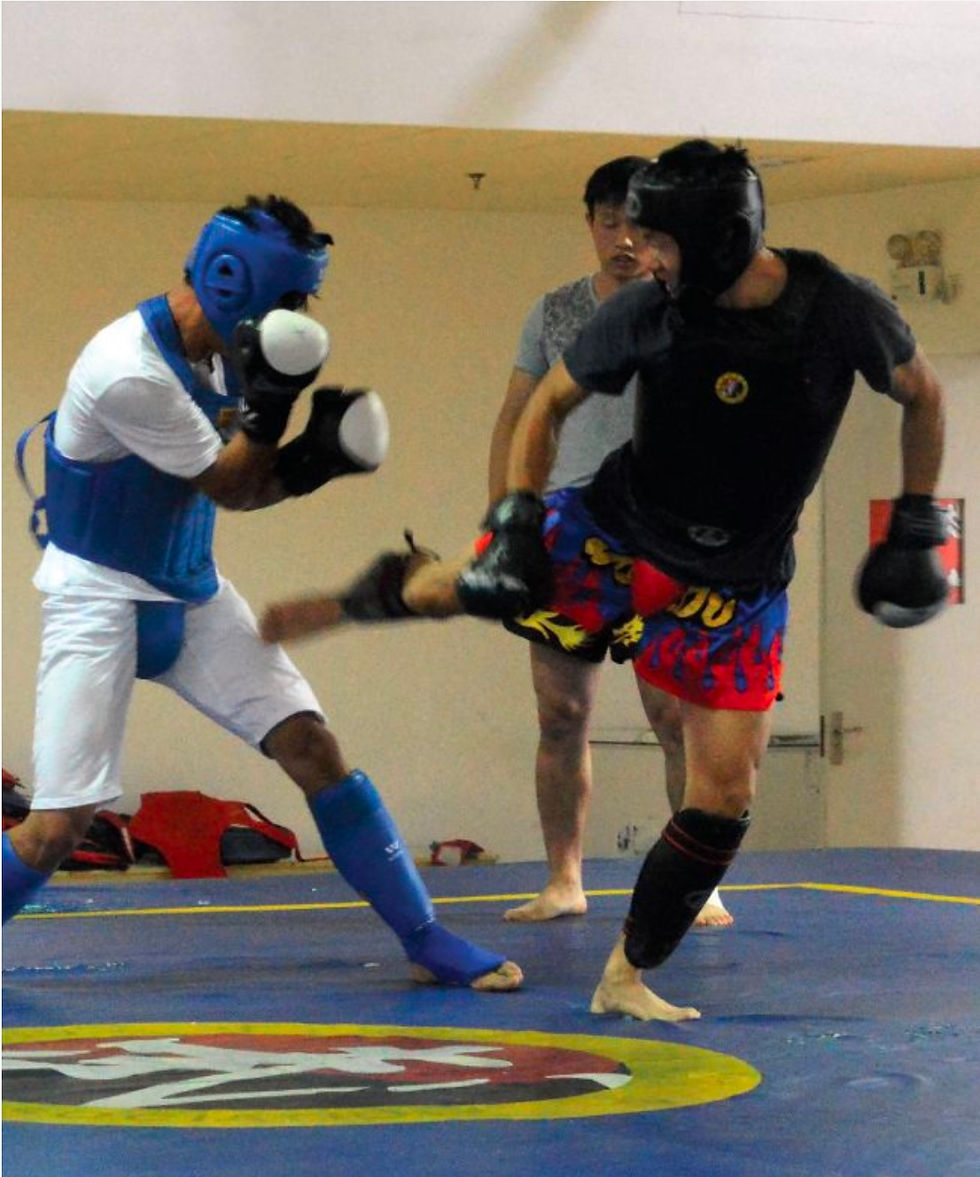
Strictly speaking, san da is a Chinese martial arts amalgam composed of kickboxing, throws and wrestling-style takedowns.
What It Isn’t
Some writers have referred to san da as “Chinese MMA,” but that’s inaccurate because it normally doesn’t include ground fighting or submissions. Furthermore, in competition, san da fighters are permitted to clinch, but they’re not allowed to hit while doing so.
Also What It Isn’t
Some people have dubbed san da “Chinese muay Thai,” but that moniker doesn’t do it justice.
Why?
Because in general, muay Thai stylists rely on just two leg attacks: the roundhouse kick and the push kick. Although other leg strikes exist in Thai boxing, most of the emphasis — and the scoring in the ring — can be attributed to those two moves.
In contrast, san da encompasses an arsenal of kicks not unlike what you’d learn in wushu. Unbeknownst to many martial artists in the West, most san da fighters in China earn their chops in wushu.
Firsthand Observation
When I trained at Shaolin Temple, most of the san da fighters I met had spent two years doing wushu before being allowed to take up san da. Hardcore fighters in the West might scoff at that notion, but wushu is far from a waste of time for them.
The training renders the practitioners more flexible and able to kick high and fast. That means the main task that lies before them once they decide to make the leap is learning strategy and gaining ring experience.
Emphasized Techniques
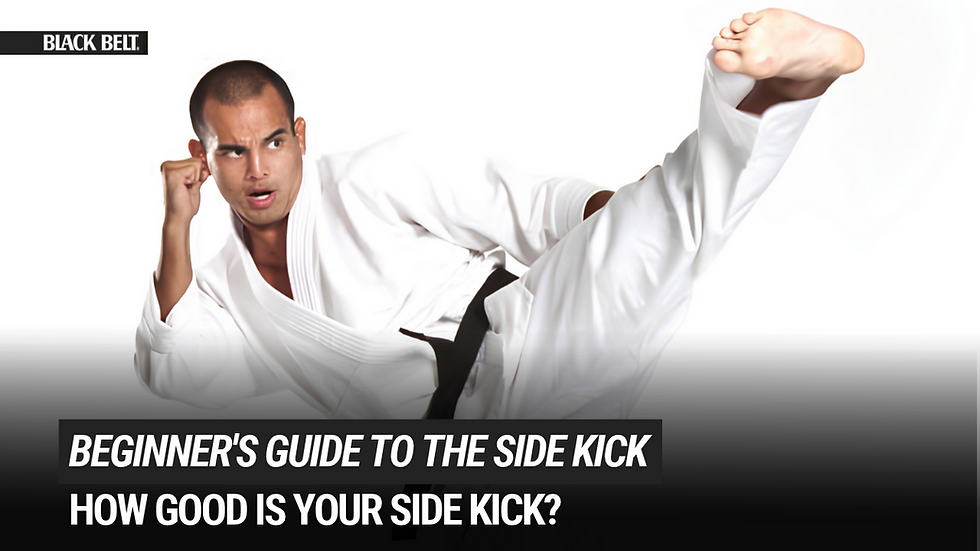
Just like the money kick in muay Thai is the roundhouse, the money kick in san da is the side kick. But because san da has a whole gamut of kicks to its name, you’ll also see roundhouses, spinning back kicks, front kicks and even ax kicks in competition.
Crescent kicks and some of the trickier taekwondo-style maneuvers can appear from time to time, depending on the background of the practitioner.
Scoring With Throws
The thing that really differentiates san da from muay Thai is the takedowns. San da bouts are scored on points, similar to the way Chinese wrestling is. Traditionally, throws were worth one to four points. Recently, however, the rules have changed, and now the one-point throws — moves in which the thrower goes to the mat with his opponent — no longer score.
Platform Fighting
In amateur san da bouts, four points are awarded for throwing an opponent off the lei tai platform on which the fighters meet. Things are different in professional matches, though, because the action unfolds in a boxing ring instead of on a platform.
That means athletes are prohibited from throwing their adversaries outside the competition area and, therefore, are ineligible to be awarded four points.
Rule Structure
The regulations under which pro san da stylists compete can vary from fight to fight. Some matches take place under ge do rules, which means “every way.” Knee strikes, elbow strikes and even grappling may be allowed in such contests.
Firsthand Experience
While attending Shanghai University of Sport, I took a course titled San Da Ge Do. I found the subject matter very similar to MMA in that the coaches allowed submissions and chokes. Occasionally, professional fights operate under rules permitting these techniques, but they usually don't — which has caused some insiders to argue for the creation of a unified set of regulations.
Evidence of Vagueness
In China, everyone who competes in san da ge do agrees that you can't fight on the ground too long, but no one seems to know how long is "too long." The only thing they agree on is that san da ge do isn't like MMA, in which athletes can remain on the ground for as long as they stay active. In most cases, the san da ge do referee will stop the action and have the fighters stand up after about five seconds.
Firsthand Fight
When my Shanghai University classmates and I took our final fighting exam in the San Da Ge Do class and I was able to get my opponent to the mat and choke or submit him, the ref allowed it. If I had tried to use a ground-and-pound strategy, he would have stood us up immediately.
Descendant of Chinese Wrestling
Most of san da's throws are based on moves from traditional Chinese wrestling. I say that because I've trained in both arts, and often I noted that the same techniques were present. The difference is that in one system, practitioners might grip their opponent's jacket, while in the other, they might grip with an underhook or wrap an arm around his head or neck.
Catching Kicks
Most of the world's martial arts teach a few techniques for catching an attacker's kick and sweeping his leg to take him to the ground. San da specializes in this tactic. Yes, ordinary takedowns are used, but the majority of throws follow the catching of a kick.
Firsthand Catch
During my initial year at Shanghai University, an estimated 70 percent of my san da training time consisted of having a pro fighter kick me while I attempted to trap his leg and execute a throw.
Time Limit
Under strict san da rules, once a competitor clinches or begins a throw, he has about three seconds to complete the move. Taking longer risks a referee intervention.
Who Should Study
If you're a striker, san da is a beneficial system to learn because the training will enable you to polish your leg techniques — and perfect your side kick. If you're an MMA practitioner, san da can provide valuable training in the fine art of kick catching, as well as in the ability to follow up with a throw.
Yes, other styles contain techniques designed to do the same thing, but in san da, the artistry rises to another level.