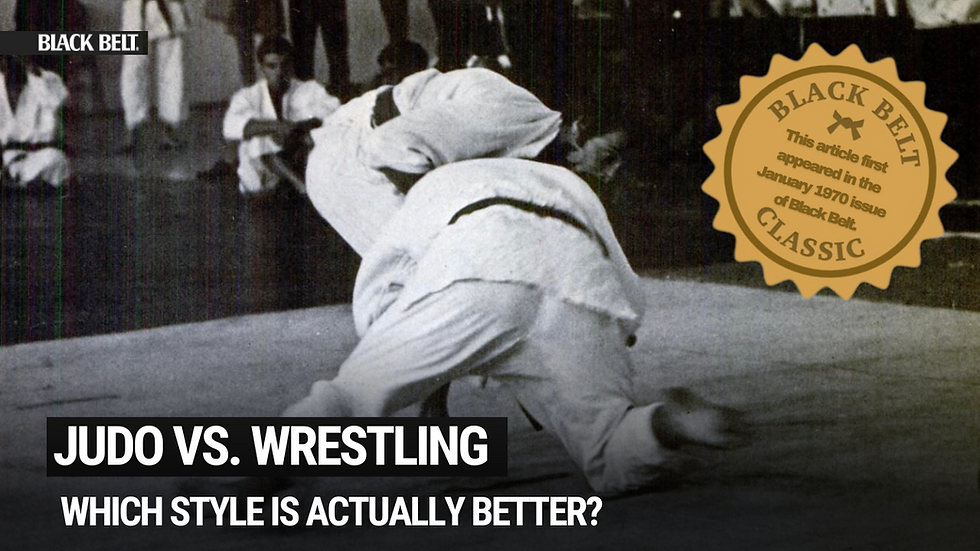

The wrestler — having quickly disposed of his first four judomen — stood before the fifth opponent, glaring like a wild animal about to pounce on his prey.
“Boo!” the crowds jeered! “That’s not judo!” “Do judo, not wrestling!” shouted another.
A woman spectator sitting near by commented, "Why do they let those guys in the tournament anyway? They don’t have any technique.”
By this time the spectators in the stands were becoming indignant over what was happening on the contest area. A wrestler wearing a judogi had just beaten four men and was still going strong.
Myron Miller stood before his fifth opponent, ready to go. The opposition looked gingerly across the mat at Myron and started to shake with fright. Myron was glaring at his opponent like a wild animal about to pounce. He was crouching his 200- pound, 5'7" frame, his hands in front of him extended as if to wrestle, his teeth gritting with one dark spot where a tooth had been knocked out.
And the look in Myron’s eyes spelled only one thing: Kill!
As both men bowed and met in the center, Myron took a vice-like grip on his opponent and proceeded to bodily lift him in the air. Myron’s opponent had a horrified expression on his face as he saw Myron’s hairy, sweaty chest being pasted to his own. Moreover, he was up in the air being held there against his will.
Prior to the match, Myron had been instructed that if he were to bodily lift his opponent above his shoulders he would receive a full point. He had done just that as he had one arm wrapped around the opponent’s neck and the other between the opponent’s crotch.
Still holding his kicking and squirming opponent, Myron turned towards the referee to claim his point. The referee, however, didn’t quite think the opponent was being held high enough. Myron by this time had had enough of this referee’s indecision and started to descend like a dive- bomber — bamm!
Ugh!
Ippon was finally called.
When Myron Miller had finally finished, he had beaten ten white belts and tied with the eleventh one.
The total time: 17 minutes and 45 seconds.
In spite of Myron’s great feat the feelings of the crowd were not with Myron. To the judo spectators it was as if they had been slapped in the face and told that strength had won out over skill. If the crowd had known, however, that Myron had only worked out in judo once prior to the match, they would have really booed him.
It was quite apparent that Myron had very little judo training. His gi was crossed over the wrong way and his belt was also tied wrong.
Rough House Tactics
Renzo Shibata, 1964 National 154-pound champion, upon seeing some of the techniques, kept repeating “That shouldn’t work . .. that shouldn’t work.” But they did. He was also very impressed by Myron’s strength. Between every “that shouldn’t work” statement he would add “chikara tsuoi ne!’ which means “He sure is strong.”
One spectator remarked, “Just wait until those guys (wrestlers) learn some technique. It’s going to be like a whole army of trained Baby Huey’s.”
Myron’s case is similar to those of his teammates and also of other wrestlers who try their hands at judo. Wrestlers are often times ostracized and looked upon as crude. The crowds’ displeasure comes from their allegiance to the aesthetic beauty of the flowing techniques of judo as opposed to the seemingly rough-house tactics of wrestling.
In the minds of the spectator, the one thought which prevails is “which is better — wrestling or judo?” To the wrestler, however, the main thought is of the sport; to win!
Only the most astute of judomen have been able to see the enormous possibilities that lay waiting to be cultivated from the field of wrestling. Here can be found men who are dedicated to a physical-contact sport; men who have been conditioned and strengthened in the best of physical ways and inner- motivated to do what is asked by all coaches of all sports — win! win! win!
The only thing left to do is to channel their energies into accepted judo ways and techniques.
Kenneth Kuniyuki has this to say of wrestlers. “They are physically strong and will probably make fine judomen once they learn technique. Both wrestling and judo have their fine points. Wrestlers entering judo should try to learn them. I think the fear that most judo men (coaches) as well as wrestling coaches have is that a third type of sport may be born of the combination of the two.”
In viewing the controversy which has resulted from wrestlers entering judo, there are certain questions which seem to arise: Is is good or bad that wrestlers are coming into judo?
If it is good, why is it good?
If it is bad, why is it bad?
In the estimation of this author the entry of wrestlers into judo is the shot in the arm which has been long overdue. The following pages are devoted not to see which one is the better of the two sports, but rather to better understand the differences in both and to see how we might be able to benefit from each one.
As Hal Simonek, head wrestling coach at Cerritos Junior College so aptly put it when asked which one was the better, wrestling or judo, “I don’t think one can really say which of the two would prevail. They both have their likenesses and, yet, they both have their differences.
In a match situation it would depend on whose rules you were going to play by and the condition of the two contestants. But the important thing is not to see which one is better, but rather to see how they can compliment each other.”
Grading System
Once a judo man was asked what degree he thought a sumo wrestler should receive if he were to transfer over to judo. His answer was, “If he is in the top ranks (maku-uchi) he should receive no less than a fourth degree black belt. Moreover, it wouldn’t even be out of place if some sumo wrestlers received a sixth degree to start out with.”
As ridiculous as one might think this statement is, it has a lot of sense to it. It would be hard to picture a big, burly, rugged, 250-pound sumo man in a judogi wearing a white belt! Furthermore, it would look a bit conspicuous as he started up the line beating all the white, brown and black belts.
As much as many would hate to admit that anything could win over their respective sports, most judo men are no match for a professional sumo man, even if the judo man is a black belt of world com- petition caliber.
With respect to wrestling and judo, a similar situation occurs. Wrestlers of national contest caliber in their own sport are given white belts and are told to compete against other white belts who have had no wrestling experience, let alone very much judo experience. Naturally, against white belts and even some brown and black belts, a wrestler who has had five to 10 years of wrestling experience has the advantage.
With the joint cooperation of the Cerritos College wrestling team, headed by Hal Simonek, and the Hollywood Welcome Mat Dojo, headed by Mickey Crouch, a program was commenced on March 23, 1969 to test the adaptability of wrestlers entering into judo. The win-loss chart, below, illustrates the successfulness of the program :
WIN-LOSS RECORD
Name Wins | Losse s | Draws | Number of Tourneys | Number of Practices | |
JIM WEST | 30 | 3 | 5 | 7 | About 60 |
MYRON MILLER | 14 | 0 | 3 | 2 | 6 |
BOB SHEPPARD | 11 | 0 | 3 | 3 | 30 |
BILL STROVE | 11 | 1 | 2 | 3 | 3 |
KATSUJI NERIO | 5 | 0 | 2 | 3 | 4 Years |
BEN OHAI | 2 | 1 | 0 | 1 | 3 |
DENNIS SNELL | 1 | 0 | 0 | 1 | 1 |
STACY CODY | 1 | 0 | 1 | 1 | 3 |
RON KENWORTHY | 1 | 1 | 0 | 1 | None |
BILL RICHARDSON | 1 1 | 1 | 0 | 1 | 3 Months |
GLENN KUBOTA | 0 | 0 | 1 | 1 | 5 |
allen Albright | 0 | 0 | 1 | 1 | 3 |
TOTALS | 77 | 7 | 18 |
This chart is from a six months’ study of the adaptability of wrestlers entering into judo. The program began in March 1969 and ended in August. Within this six months’ period (the project that was carried on in Nanka — Southern California Judo Federation), three wrestlers did exceptionally well:
MYRON MILLER, who in his first team tournament wore a white belt and literally chased a second degree black belt all over the mat area only to end up with a tie, was the 1967 regional Olympic trial runner-up as well as an all-American rugby player. He has a master’s degree in physical education with a a straight “A” record.
BOB SHEPPARD, who is probably the best-skilled of the three, is constantly doing uchikomis in an effort to become, as he puts it, “slick". After his fourth month in judo, he won the Gerrie Merit Trophy, which is awarded to the best technician in the Nanka-sponsored tournaments, as well as his third degree brown belt. He won the Big Eight collegiate championship in 1961 while in school and is presently a graduate student at California State College at Los Angeles.
JIM WEST, who is the most spirited of the three as he never ceases to talk, eat and sleep wrestling and judo, has done well as a wrestler, winning the Southern California wrestling championship and also placing third in the 1967 regional Olympic trial. He is still a student at California State College at Los Angeles and is constantly on the dean’s list. As for his prowess in judo, he has been raised to second degree brown belt (nikkyu) within a five-month period. (See chart below.)
BATSUGUN (EXCEPTIONAL PERFORMANCE PROMOTION)
Name | Wins | Draws | Losses | Time in Judo | Tournament | Date | Promoted To |
MYRON MILLER | 10 | 1 | 0 | 1-tourney experience; never practiced judo before. | Seinan Invitational | 4/13/69 | Sankyu (3rd Brown) |
JIM WEST | 5 | 1 | 0 | 2 Months | Sawtelle Invitational | 5/18/69 | Sankyu (3rd Brown) |
BOB SHEPPARD | 7 | 1 | 0 | 3 Months | Oxnard 8/03/69 Municipal Games | Sankyu (3rd Brown) | |
JIM WEST | 7 | 1 | 0 | 5 Months | Oxnard 8/03/69 Municipal Games | Nikkyu (2nd Brown) |
It is most probable these three wrestlers and any others who might enter judo would find themselves black belts within two years, possibly a year. Wrestlers undoubtedly have proven themselves physically, and also possess the mentality and ability to lessen the cultural gap.
Japanese American Cultural Conservatism
A visitor from Japan once remarked, “It is amazing to see how well the Japanese culture is being kept here in the United States. Whereas Japanese in Japan are becoming Westernized, Japanese in America are proud of their heritage, and religiously try to maintain old cultural habits. I find many first and second-generation Japanese in the United States are more Japanese than are the Japanese in Japan.”
The statement made by the visitor from Japan can also be applied to the present situation in American judo. While Japanese in Japan have forged ahead and modernized their judo, Japanese Americans have become stagnant, trying to maintain the traditional judo of Kano’s time.
Although it is important and necessary to maintain those traditions which aid us in being better people it is also important to revise or discard those ideas which would hinder the progress of judo.
In Japanese judo, changes in training practices have occurred to revolutionize the art. Weight training and sambo are com- mon words to a Japanese judoman today, but American judo- men show little interest in either weight training or sambo.
Oddly enough, it was an American who first introduced the use of weights as a means of bettering one’s tournament record. It was his contention that a strong big man, having more muscle power, would win over a strong small man. The credit for weight training and the inclusion of a special room for this inside the Kodokan goes to Donn Draeger.
American judomen’s first knowledge of Russian sambo comes from another American who wrote of the incredible agility and adaptability of sambomen to judo.
Andy Adams in the February 1967 issue of Black Belt explains how Japan was almost beaten by a group of Russian sambo men. The Japanese were quick to see sambo’s merits, and now even Japan has a sambo federation with judo men participating in the sport and doing quite well. Nobuyuki Sato, world light heavyweight judo champion, 1967, is a good example.
In America, unfortunately, neither weight training nor sambo are used extensively to supplement one’s judo training. Some dojos frown upon weight training and scorn sambo or wrestling, saying “That’s not a part of judo.”
In the plight for the maintenance of traditional ways, judo in America is slowly losing its place in world standings. Major Philip Porter recently announced that U.S. judo has dropped
from the sixth-rated judo nation to a ninth rating. This was evidenced at the world championships where none of the U.S. competitors placed in any of the six weight categories. Perhaps it’s time to get some help from somewhere.
Borrowed Ideas
The idea of borrowing techniques from other sports is not anything new. Professor Kano was constantly borrowing ideas from other sports and adding them to judo. Robert Smith in his book A Complete Guide to Judo writes of how Kano studied wrestling and successfully used kataguruma on his opponent. Kataguruma in wrestling is known as the “firemen’s carry.” Most likely, many other techniques such as “morote-gari” (double leg dive) and “usiro-goshi" (suplex) and others
were incorporated into judo.
Unlike the traditional American counterpart, Kano’s judo is an ever-changing sport. Professor Kano, being an educator, was constantly looking for ways of improving his sport by borrowing the good points from other sports.
Perhaps that is why he sent 10th degrees Mifune and Nagaoka to Uyeshiba sensei to study aikido so they might have a wider understanding of the martial arts.
Also in 1933, Kano persuaded Kotani sensei, now a ninth degree, to learn wrestling and compete in the 1933 Olympic Games. Kotani sensei placed sixth in the games after one month’s training with Pop Moore and his two sons, Roy and Mel Bruno, two wrestler-judo men.
Professor Kano also borrowed ideas from Professor Funakoshi Gichin, and invited him to demonstrate and teach karate to students at the Kodokan.
It is little wonder judo has been able to grow as it has. With the ability to accept rather than go against, Kano took all the useful parts of the other martial arts. If Kano were alive today he would probably still be borrowing ideas from other sports.
It takes a big man to say “I want to leam from you,” especially if your name happens to be “Kano.”
But, then, he was a big man with big ideas.
Psychological Differences
Wrestlers entering into judo are also big men, champions in their own right, and yet they have the courage to try out their prowess and learn, even at the expense of being booed, hissed and jeered at. Some of the reasons for the displeasure and incompatibility of the wrestlers and the spectators come from the psychological differences.
As a judo man, a wrestler is confronted with many differences in thought patterns. In wrestling, the techniques are not praised on their aesthetic appeal but, rather, on their pragmatic uses.
A case of one champion wrestler illustrates this point: Jeff Smith, when asked how he had won his last match, replied “I’m not sure, but I think someone called it a ‘hair-gosh’ or something!”
The technique Jeff was referring to was a harai-goshi. If a judo man were to have won a major tournament with a beautiful throw you could be sure he would find out the name of that throw and cherish it along with the memory of the throw itself.
Although everyone in the auditorium praised the aesthetic beauty of his last throw, Jeff couldn’t care less. All he knew was he had won.
One famous American judo man also shared Jeff’s belief when he said, “I don’t care if I win by default or by any other means. Twenty years from now you can be sure that the loser’s name isn’t going to be on the records. And people won’t ask you how you won. The only thing they’ll know is that you did win.”
Frank Lloyd Wright once said “Very early in life, I had to choose between hypocritical humility and honest arrogance.” Like Cassius Clay, he chose to be honestly arrogant. Wrestlers in a sense are the same way. They will boast of their wins and say “I beat him.”
A judo man, contrary to this procedure, learns early in his judo life to remain silent and not to speak of his victories unless questioned about them, this attitude coming from the Oriental thought that “Those who speak don’t know; those who know don’t speak.”
Of course the latter attitude of a victorious, but humble, person is one which is culturally more palatable. Nonetheless, deep down inside ourselves we sometimes live vicariously those lives which we ourselves want to live and are unable to live. Perhaps it’s like criticizing the Presidency and saying “If I were President, I would do such and such!”
It’s hard to say which is the better way of thinking, but in sports most of the better athletes tend to adopt Theodore Roosevelt’s policy, “Walk softly and carry a big stick!”
The biggest difference between judo and wrestling comes from their philosophies. Both are derivatives of a combative-type program. But whereas wrestling was devised as a means of combat with its ultimate aim in winning, judo was devised by an educator with the purpose of benefitting oneself through practice of an art.
The words which come to mind at this time are, “Mada ningen ga dekitenai,” which means literally, “As of yet, he is not a human,” which can be interpreted by Western minds as, “He has not yet attained the character of a perfect being.”
In the Orient, a lot of emphasis is placed on a person’s perfection of character, and Kano developed this concept for judo, believing man should strive toward:
1. Self-perfection
2. Mutual welfare and benefit
3. Maximum efficiency with minimum effort
Physical Differences
On the American scene wrestlers are usually far better conditioned than are judo men.
Dale O. Thomas, a great American wrestler, states there are four areas that need to be developed in wrestling: muscular strength, muscular endurance, circular-respiratory endurance and neuromuscular condition.
To develop these areas, Coach Thomas uses every available method at his disposal: running, running bleachers, interval training, wrestling and weight training.
In American judo, how many of these methods are used?
If a survey were taken of methods of training for contest judo in local tournaments, there would be very few dojos using any of the above mentioned methods to supplement their art. It isn’t hard to see why wrestlers out- muscle their judo opponents.
The only saving grace in American judo is in the upper divisions of the black belts: it becomes increasingly harder for good wrestlers to win without knowledge of good judo techniques. Most good judo men will supplement their own, personal workouts with running, weight training and even wrestling. The lower white and brown belt divisions usually do not go to the trouble of training to really win as do the upper degrees of top notch competitive black belts.
If judo in America is to progress, there is a need to understand and accept those parts of other sports that are applicable to our own. Let us not forget judo is for everyone, and that includes wrestlers from whom we have so much to learn.