Updated: Aug 24, 2025


My Time With Professor William K.S. Chow
It was April 1986, and I was piloting a rental up a long hill in Honolulu. Just as I started to doubt the directions, I topped out and spotted the church. The structure was dark and silent, almost looking abandoned, but nearby stood another building, the fellowship hall. The lights were on, and cars were in the lot. I parked and nervously approached the open door, a briefcase containing my letter of introduction and some photos in hand.
I stepped inside, trying not to attract undue attention. I scanned the room for the man I’d come to meet for the first time but failed to find him. There was one guy, close to 30 years old and dressed in a kung fu uniform, and a younger man, wearing a white gi and a yellow belt. Another eight to 10 men were in street clothes. All appeared to be Hawaiian.
They descended on me with scowls on their faces.
“What are you doing here?” one of them asked. “This is a private class.”
“I came to meet professor William K.S. Chow,” I said. “Is he here?”
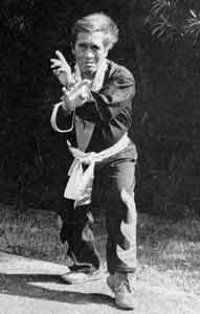
The sea of bodies parted, and one of them pointed to an old man hunched over a table. He was only a few feet away, but I hadn’t noticed him. Looking up, he resembled the Indian actor Chief Dan George in The Outlaw Josey Wales.
“There is the professa,” one man said.
Unexpected Reaction
I approached Chow and bowed, then put down my briefcase and pulled out the letter of introduction from Ron Alo, a former student of his. I also presented him with a photo of the two of them taken several years before at Ralph Castro’s tournament in California.
“I’m a brown belt in the Alo Hawaiian kenpo karate system on the mainland, and I would like to take lessons in kara-ho,” I said quietly. “My wife got a job as a nurse, so we moved here from Kansas just yesterday. We’re staying in a hotel on Kuhio Street.”
Chow read the letter, then looked at the picture.
“Yes, I know this man — and I no like him!” he said as he pounded the table.
Immediately, all the men surrounded me. I pleaded with Chow to hear me out, but he walked away and the angry circle ordered me to leave. I pulled up the chair Chow had just vacated and plopped down.
“I will leave if the professor tells me to leave,” I said defiantly.
The men took turns kicking my chair and telling me to stand up. I ignored them and put on my toughest face, trying to hide my fear. They finally gave up. Jacob, the guy in the kung fu uniform, whispered in Chow’s ear. The master simply nodded and clapped his hands, and the class began.
Cold Shoulder
I was invisible to them for the next three hours. I learned that the only other actual student there was Walter, the yellow belt. The others were former students and friends.
At the end of class, they all walked past me on their way out the door, a couple of them kicking my chair again. They turned off the light and left, and I stood up and followed them out. I’d never been so disappointed in my life.
Feeling like I’d been set up, I called Alo as soon as I got back to the hotel. My story made him hysterical.
“Why are you laughing?” I asked. “He just met me, but he really hates you!”
“No, he doesn’t,” Alo said. “That’s just how he is. If you don’t visit him every few months, he gets upset, but he doesn’t quite understand that it’s not easy to take a trip to Hawaii. Just go back to the next class; it will be OK.”
“Go back?” I shouted. “They’ll kill me.”
“No, they won’t — well, probably not,” he said, snickering.
About-Face
Two days later, I returned to the fellowship hall. As I stepped inside, I was greeted by Jacob and Walter, both of whom were wearing big grins. They rushed to meet me.
“Hi, glad you came back,” Jacob said, shaking my hand.
He and Walter were the only ones present besides Chow. The master walked over to me — and even he was smiling.
“The professa would like to have that picture of him and Alo,” Jacob said. “We drove all over Kuhio Street yesterday trying to find you, looking for your car. The professa wanted that picture — and to tell you that you can come to class.”
Chow approached and shook my hand, grinning. His huge mitts engulfed mine — each finger was almost as big as my wrist. I presented him with the photo, and he smiled at it.
“You brown belt on the mainland, you white belt in Hawaii,” he said. “Got it?”
“Yes, professa,” I said, bowing and trying to enunciate the way they all did, accenting the fess. It came out goofy, and Chow grinned at me. But I didn’t care; I was in.
Official Student
Although my wife made good money as a nurse, the cost of living in Hawaii was high, and I had to go to work. My profession in those days was singer in a country band. The band played a lot during the week, so my dream of being a dedicated kara-ho student was downgraded to showing up as often as I could. Many times, I’d arrive late and just watch the class. The student body was never larger than Jacob and Walter — and occasionally me.
When I’d observe class, Chow would sit with me and let me pepper him with questions. This access to the master icon was a blessing I’ll never forget. I learned a lot about his personality and his drive to be the best martial artist in the world, which is what he considered himself.
Aside from the $35 a month he received for teaching Chinese kara-ho kempo kung fu, which is what he called it in 1986, he made money as a masseuse. Those thick, powerful hands — which could and had caused destruction in others — also healed the aches and pains. I witnessed both skill sets.
One night, Chow was teaching finger techniques. Walter had been struck in the side of the neck, and the site instantly swelled and turned dark as blood rushed in. The master pulled out a bottle of homemade jow and massaged the spot for five minutes. The bruise and the pain subsided, and the class continued. Proud of his work, he grinned at me.
“What ingredients are in that jow?” I asked.
“Secret,” Chow said. It was the standard answer to many questions.
I saw — and felt — Chow’s skillful hands on another occasion while he was teaching self-defense sets. In this particular one, the attacker threw a hook, and I was supposed to duck under it, rise and respond with a hard uppercut to the stomach.
I performed the set with Chow, and each time I threw my uppercut into his gut, he said, “You must train harder, punch harder like real thing.”
Finally, he demonstrated on me. A blindingly fast uppercut hit me hard, right on target. It hurt but wasn’t crippling. Then it was my turn again, and, not wanting to be on the other end, I threw my best shot into Chow’s stomach, which was rock hard. Without even flinching, he said, “Tes, like that.”

Culture Clash
After the first week, I couldn’t afford to rent a car anymore, so I began taking the bus for 40 minutes and then walking for another 40 up that long hill in a bad area. I was yelled at, threatened and harassed by locals who didn’t want me in their neighborhood. They’d sic their pit bulls on me, then yank on the leash just before their teeth touched my flesh. Walking back to the bus stop was scary but a bit easier because it was dark, and as I jogged down the hill, they couldn’t tell if I was a stranger.
One night after class, Chow asked me how I was getting back to Waikiki. I told him about the long bus ride and walk. He was shocked.
“That’s a dangerous neighborhood,” he said. “They will kill you if they catch you.”
“I just tell them I am friends with the great professa Chow, and they all back away from me,” I joked.
“No,” he said. “We give you ride to your bus stop. Don’t want you to die.”
Another night after class, I told him about a scary event my wife had experienced in the mental ward of the medical center. A mentally disturbed patient had tried to stab her with a pencil. She’d maneuvered to keep furniture between herself and the attacker until help arrived and he was subdued. Horrified, Chow ordered me to go to the hospital the next day and beat up the guy.
I thought he was kidding at first, but he was serious.
“Professa, this man is a mental patient,” I said. “He doesn’t know right from wrong, and they’re trying to help him.”
“Doesn’t matter,” he replied. “He took respect from you, so must go beat him up tomorrow. Don’t come back to class until you do.”
That was a Thursday. I called every day until the next class on Tuesday, hoping to make him understand. When his wife Patsy would answer the phone, she’d say, “It’s Jim. …” After a second, she’d come back on the line and say, “He wants to know if you took care of the thing.”
I’d tell her no, and she’d say, “He doesn’t want to talk until you do.”
When Tuesday finally came, the first thing I heard when I walked through the door was, “Did you do it?”
“No,” I said. “I can’t because my wife will get fired. But I will go with you anywhere and let you pick out someone and I will fight them — in a bar or in the park or in another karate school.”
He sighed in disappointment, then said, “Get in line.” Just like that, it was over.
Imminent Demise
One night after class, I returned home to find that my wife had purchased plane tickets back to Kansas. Homesick, she had decided to move back without consulting me. I tried to talk her into sticking it out for one year as we’d agreed, but it was no use. She had tickets for both of us and our 5-year-old son.
When I told Chow the bad news, he said, “Tell her she can’t go.”
“I tried, but she’s not like that,” I said. “She is strong-willed.” He shook his head. “In my house, I wear the pants,” he said. “You need to wear the pants.”
In those days, we shared the pants. I told him I didn’t want to go but had no choice. He told me if I wanted to remain in Hawaii and learn kara-ho, I could stay with him. I couldn’t believe it — the great professor Chow offering me a place to live. I said I’d think about it.
Ultimately, I decided I couldn’t remain on the island and have my son so far away. When I told Alo, he explained that Chow’s son was incarcerated at the time but due to be released soon.
“He won’t like you living there, and you will have to fight him if you stay,” Alo said.
That reassured me that I’d made the right decision. With much regret, I left Hawaii and the professor and returned to the mainland. We spoke on the phone at least once a month, and I sent him money as often as I could.
He passed away the following September, and I continued to send money to his wife until I received a phone call. Sam Kuoha said I should stop my remittances because he was taking care of Patsy while she was in hiding.
“Hiding from what?” I asked.
“There are many kempo masters who think they should take over the professor’s system, and they’re angry that he chose me,” Kuoha said. “She has received death threats, and I am protecting her.”
I don’t know that I believed all that, but I was glad Patsy was being taken care of. In the ensuing months, I reflected on my lessons with the master and how many of his drills and fighting philosophies I had absorbed. Although they’re now part of the system I teach, they’re not the kara-ho that I learned from the professor during my time in Hawaii.
That was a one-of-a-kind martial art that was practiced and taught by a legend named William K.S. Chow.