Updated: Mar 10
On my way to California’s Central Coast to interview a 57-year-old male martial artist who paints his toenails, I got bogged down in construction traffic, which gave me no nutritional option but to eat the only thing I could scavenge from my glove box: an energy bar that boasted “protein from real crickets.”
That should have steeled me for anything that was about to come, but it didn’t.
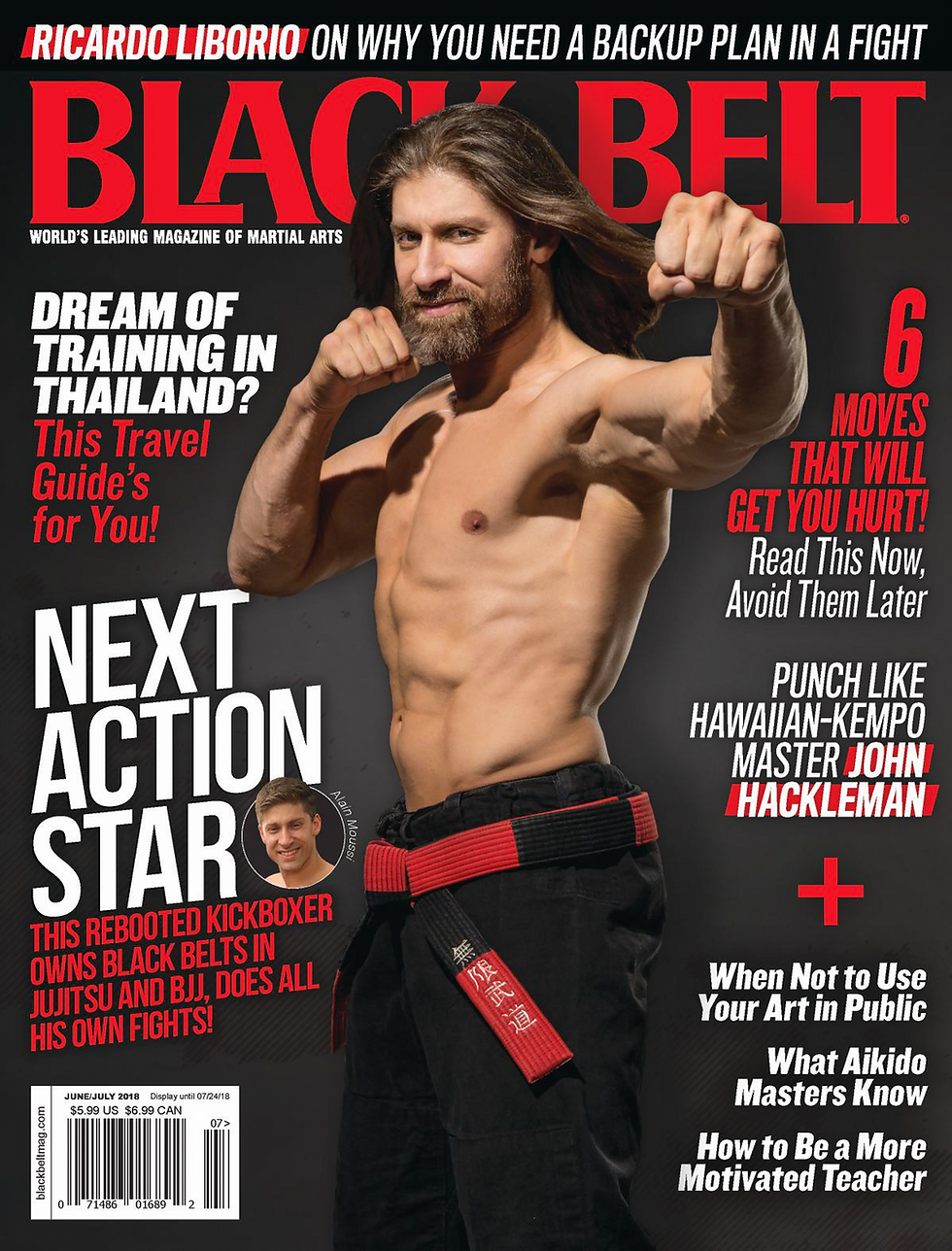
Once I pulled into The Pit, John Hackleman’s dojo in Arroyo Grande, and started chatting with the gruff martial artist — who happens to be a registered nurse — my incredulity grew so much that if my mind had a jaw, it would have been hanging like that of a kid watching his first Bruce Lee movie.
Before I left, I'd reached what for me is a rare realization: If I lived closer to The Pit, I’d sign up for lessons.
"Bite him like a dog - a dog that wants to stay alive!"
Those simple words, spoken during the explanation of a self-defense technique, sum up the no-fangs-barred fighting philosophy of John Hackleman, former kajukenbo student and current master of Hawaiian kempo. The fight-dirty manifesto is unexpected coming from the mouth of the man who coached UFC standout Chuck Liddell to play fair in the cage.
In effect, the words illustrate the sport-vs.-street dichotomy that has been John Hackleman’s life.
LIVE CLEAN
Hackleman was born in New York but moved to Hawaii when he was 4. Within a few years, the storm clouds started gathering in paradise. “I knew there were a lot of fights going on, and I knew I'd be in a lot of them since I was white and had long blond hair,” he said.
His pre-emptive action? Whip out the Yellow Pages and find a martial arts school.
The youth’s attention gravitated to an intimidating photo of Walter Godin. “He was one of the toughest guys on the island, although I didn’t know it at the time, and a master of kajukenbo, a street-fighting art from Hawaii,” Hackleman explained. “I went down and talked to him. He said he’d been in and out of prison, but that didn’t matter to me.
“He said it would cost $20 a month to train with him, so I went home and told my mom I needed a check for $20. That was the only check I ever gave him. I never paid again, and he was my sensei from 1970 until he died in 2001.”

Godin conveyed to the youngster what would become the cornerstones of his fighting philosophy. “He taught me so much and shaped my personality,” Hackleman said. “I wanted to be just like him — except for the bad stuff, of course, but I knew the difference because I had a pretty good moral compass from having been brought up right by my parents.”
The boy desperately wanted to be respected like Godin was, and when it came to school bullies, he figured being feared a little would be nice, too. “So I started hanging out with Walter Godin,” Hackleman said. “He didn’t push me to do any of the things that had gotten him in trouble. What he did do was teach me the art of kajukenbo.”
TRAIN HARD
Soon after he had a grasp of the basics, Hackleman started fighting in local karate tournaments. “I liked competition, but I didn’t like all the rules I had to follow,” he said. “When I was a little older, I pulled my hamstring while training. I told Godin what had happened, and because he was very pragmatic and I was a kicker, he said, ‘Go to a boxing gym and train until your hamstring is better.’”
The sensei set things up for his charge. “I went down to a ghetto boxing gym in the middle of a housing project,” Hackleman recalled. “Before I knew it, I was scheduled to fight in the Police Athletic League. It was like the mini-Golden Gloves; they called it the Silver Gloves. And I discovered that I liked it.”
By the time his hamstring was healed, Hackleman had acquired an arsenal of hand skills from the pugilists. “When I went back to my sensei, I was a different guy,” he said. “I wasn’t just a kicker anymore. I wanted to punch and brawl in sparring matches. Godin loved it.”
Even after his leg had returned to 100 percent, Hackleman stayed the course, eventually developing formidable hands. “I went all the way to Golden Gloves and won that in my state,” he said. “When kickboxing came around, I fought in that, too. Then in 1975, they had the World Series of Martial Arts in Hawaii. It was anything goes. I was 16, but I lied about my age and entered — and wound up beating an adult with an elbow strike. Back then, I'd fight in any genre that came around. Mainly, though, it was boxing and kickboxing.”
Hackleman never abandoned his kajukenbo, however. He put in a solid 10 years under Godin’s wing until patriotism inspired him to change course. “The Iran hostage situation started in 1979,” he said. “I thought we were going to war, so I enlisted in the infantry. That’s where I needed to be because my dad was a West Point graduate, and he was infantry.”
As luck would have it, Hackleman’s first duty station was Honolulu’s Schofield Barracks, practically in his own backyard. Then Ronald Reagan was sworn in, and Iran promptly released the hostages. In a way, Hackleman felt like the air had been let out of his balloon.

“I went to my first sergeant and said, ‘I joined because I thought there was going to be a war, but there’s not. I don’t want to hang out here for another three years,’” Hackleman recalled. “And he was like, ‘Well, you signed up for it … but you're John Hackleman, aren't you?' The first sergeant happened to be from Hawaii and knew I’d won the Golden Gloves. Then he said, ‘I've seen you fight — why don't you join the Army Boxing Team?’”
Hackleman scored a tryout, courtesy of that first sergeant, and he won a spot on the team. For the remainder of his enlistment, all he did was box. “I can honestly say I fought for my country and bled for my country.” (laughs)
On a more serious note, his military service no doubt helped him polish the hand skills that would take him to the top of the martial arts world. It also paved the way for a post-Army stint not only as a pro boxer but also as a kickboxer.
“I hit really hard and won a couple of titles, but I wasn’t at the top of boxing,” Hackleman said. “I did make it to the top of kickboxing and won world titles, but back then, you didn’t have to be that great [because it was such a young sport]. The competition just wasn’t there. I enjoyed competing, but martial arts was still my passion.”

FIGHT DIRTY
When Hackleman’s enlistment ended, he yearned to return to his passion. “But I couldn’t teach martial arts and call it kajukenbo because I didn’t want to do the kajukenbo forms,” he said. “So I changed the name to Hawaiian kempo — with an ‘m.’ I was free to get rid of the kata. I took out other things I thought were ineffective and added things from my own experience as well as things I learned from other arts. Yes, I stole a lot of stuff. I’ve also had a lot of stuff stolen from me. It’s a common thing in martial arts.”
One of the first skill sets Hackleman grafted onto the Hawaiian-kempo curriculum was takedown defense. “I did that even though a lot of stand-up guys thought it was a waste of time,” he said. “‘Just punch him!’ they used to say, but I knew that wouldn’t work all the time. I disagreed with them because I’d fought with guys who just took me down like that!” (snaps fingers)
His takedown-defense methodology, now a hallmark of Hawaiian kempo, grew out of his experience on the street, as well as his interpretation of what other masters like Brazilian jiu-jitsu’s Ricardo Liborio and Mario Sperry had shown him.
“I really focused on the importance of the hips and lateral movement,” Hackleman said. “The takedown defense I developed worked very well for me and my students.” It still plays a vital role in his system because it’s essential to surviving on the street, he added.
To take his ideas to the masses, Hackleman moved to Southern California in 1985 and began teaching the four pillars of Hawaiian kempo — striking, wrestling, jiu-jitsu and conditioning — in his backyard. A year later, he founded The Pit.
In 1991 he relocated to Arroyo Grande and once again was forced to spread his fight gospel in his backyard. “And then came Chuck,” he said.

Chuck Liddell was young and in the mood to throw down. Knowing a good thing when he saw it, he hooked up with Hackleman, and together they fine-tuned his game. Once Liddell was entrenched in The Pit, other fighters followed. Once Liddell began winning, the backyard dojo quickly reached capacity. “We became known as an MMA gym,” Hackleman said, “but basically I just wanted to teach people martial arts.”
That realization and his burgeoning success with the MMA crowd prompted Hackleman to abandon the backyard operation and open a real gym that was large enough to cater to more than just fighters. “I wanted to make teaching martial arts my full-time job,” he said. “It took off, and I didn’t have to work as a nurse anymore. I’m not rich by any means, but I have a pretty good life and I’ll have a pretty good retirement. Most important, I’m happy doing what I love.”
One of the keys to Hackleman's success has been the message that dirty fighting reduces the need to learn a defense for every possible attack. “You don't have to become proficient at escaping from a lot of grappling holds because of biting and gouging,” he explained. “Say someone clinches with you. You don’t have to know a defense against that because you can just stick your finger in his eye. If he gets you in side control or the mount, all you have to do is break your posture and bite him anywhere. He’ll let go.”
The big exception to that rule is the rear-naked choke, he added. “You can’t bite your way out of this one. Once he gets it on, you're done. So we do learn a few specific escapes. Similarly, if someone comes at you with a running double and manages to slam your head into the ground, you’re not getting out of it. Which is why you have to be able to defend against a takedown.”

DON’T LET ANYONE TAKE YOUR LUNCH MONEY
The modern Pit curriculum, as John Hackleman envisions it, has two parts: the kids’ component and the adults’ component.
“For kids, the No. 1 thing is confidence,” he said. “That’s developed through physically training in martial arts, not through talking about confidence. Part of it is knowing they can get a bully off them if they wind up on the bottom in a fight at school. We teach them never to bully, of course, but also never to be bullied.”
It’s essential for those who teach youngsters to remember that if a bully jumps a kid at school, you don’t want that kid gouging out the bully’s eyes, he said. “You also don’t want him pounding the bully’s head on the concrete. In the schoolyard, fights are usually over once the bully gets hit or taken down.
“It’s all about dominance. If kids are more dominant on the playground, they don’t get picked on. They don’t have to strut around, but they do have to be dominant enough to keep bullies away.”

Adults need no-holds-barred physical skills in addition to the ability to exhibit confidence. “There's no dominance on the street; there's life or death;' he said. "When someone jumps you, it's not because they're bullying you and trying to take your lunch money. It's because they're trying to kill you."
That harsh reality necessitates a harsh response, Hackleman said. "You need to separate them from their consciousness. If that means knocking them unconscious so you can get away, fine. If it means killing them, so be it.
If you think they're not trying to kill you so you don't really have to fight back, your adrenaline will never respond the way it has to. Then they might get in that one punch, and you might fall and have your head bounce off the concrete.
There's no referee - so they soccer-kick you until you're brain-damaged or dead."

Despite the different teaching modalities, he repeats the same catchphrase with his kids, his adult students and his fighters: "I tell them, 'Don't let anyone take your lunch money.' It goes back to my roots growing up in Hawaii. We used to get a quarter for lunch, and there were kids who would come up to us and say, 'Hey, haole, give me your lunch money!' One of the reasons I started martial arts training was I didn't want anybody to take my lunch money.
"Now it's a metaphor for kids not letting anyone bully them. It's also for adults to remind them to not let anyone hurt them. In a relationship, it means don't let the other person take advantage of you. In the cage, it means don't let your opponent take your title or ranking."
Living clean, training hard, fighting dirty and not letting anyone take your lunch money is the theme that permeates all the training that takes place at The Pit.
It's also the philosophy that guides John Hackleman and his students in life.
Photography by Cory Sorensen