Updated: Nov 29, 2023
Africa is the largest and most culturally diverse continent on the planet. Unfortunately, it is also the continent we are the least exposed to in the West. While we recognize the differences in Asian cultures, be it India, Japan, Thailand, China, Mongolia, Russia etc. – we often think of Africa as just… Africa. We look at it as though it is all the same, when in reality there are over 3000 distinct ethnic groups in Africa, with over 2000 languages.
Egypt, Nigeria, Morocco, Kenya, Tanzania, all African countries, and all radically different. That’s to say nothing of the many different cultures within countries that are grouped together now, only because of the lines between nations that were drawn by Europeans during the colonial era. Africa is rich with a wide variety of martial arts, of which we see nothing about. Today we’re going to take a brief look at a few of them.
Nguni Stick-Fighting
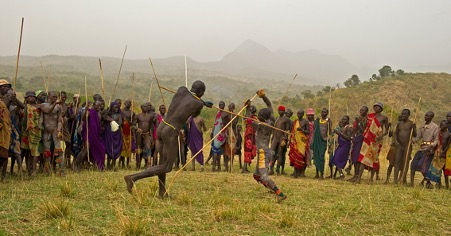
This South African art, also known as Zulu Stick Fighting, is practized by Nguni men and teenage boys. Those who are familiar with Filipino martial arts will probably recognize a lot from NSF. Each fighter is armed with two sticks, one used primarily for offense and the other used for defense.
The offensive stick is really more of a club, with a weighted ball at the end. The same hand that holds the defensive stick, also holds a small shield to protect the hand from strikes. Like a lot of armed martial arts, the reality of the fight is a lot grittier than what you may initially picture. While the name of the game is to club your opponent with the stick, it’s not just attacking and defending with said sticks. Fighters will grab each other, clinch, push, shove and unlike HEMA and Kendo competitions where the fighters have plenty of protective armour, in Stick Fighting, no such protection exists. The results, predictably, can be quite bloody.
The defending stick does a lot of the work for you, so long as you’re competent, as there is very little reason to move and parry as you would with a style like kali, or Krabi krabong. Instead you can hide behind the defending stick and be ready to block and counter attack. Attacks can often look flaily and uncoordinated, but this has less to do with a lack of skill and more to do with the awkward way you have to swing in order to make contact. The nature of the defensive stick means that it’s often more efficient to change the angle of your attack mid swing to creep around your opponent’s defence, rather than trying to smash through it with a traditional swing.
In Nguni culture, it is customary that during wedding celebrations, the bridge and grooms’ male guests compete against each other. While emotions will always run high during a fight, the practise is less about asserting dominance and more about building comradery and respect amongst the fighters. As a rather humorous result, wedding crashers are known to appear just looking for competition and are usually welcomed.
Dambe
When I told my friend, a fellow martial arts enthusiast, I was writing this article, the first thing he said was ‘like Dambe?’ Originating in Nigeria, West Africa, Dambe originates from the Hausu people. At first dambe had me a little bit puzzled. The fighters have one fist fully wrapped in rope, transforming it into a solid brick to smack with. The other hand is free, and from there you will see both fighters stand almost fully side on to each other, pawing with their lead hand and looking to land the wrapped hand.
It was puzzling because I couldn’t fully understand why this would have come about as opposed to regular bare knuckle boxing that you see in styles like Lethwei or Kard Cheuk Muay Thai. It was only after watching Nguni stick fighting that I started to see the similarities between the two, prompting further research.
Dambe as a style harkens back to the same sort of armed combat that we see in Nguni stick fighting. The lead arm serves as the ‘shield’, keeping distance, defending and grabbing to set up blows, whereas the rear arm acts as the weapon, but instead of holding a weapon itself, the rope transforms the fist into a solid club. With that in mind it becomes a lot easier to understand how this seemingly unusual sport was born.
Despite the rear hand looking imposing, it’s the front hand where the fight really happens. The fights are methodical, using patient hand fighting that you would normally associate with wrestling to clear a path for the ‘spear’ hand. A fighter might slap the opponents guard away, or outright just grab their opponents wrist to shut them down.
Though rarer to see, kicks are permitted in dambe and wrestling was also once allowed. On its surface it looks like it will be little more than a brutal street fight, but there is a clear art and history to this Nigerian style of boxing.
Senegalese Wrestling
Wrestling exists in every culture. Whether it’s Judo, Sumo, Shuia Jiao, Mongolian Bokh, Greco Roman Wrestling or any other of the hundreds of styles – we collectively as a species understand that wrestling is the simplest and most efficient form of fighting.
Wrestling is so universal that it’s also very rare that you will take up a new style of wrestling, and not immediately understand what you’re going to do. Wrestling is practically a universal art with the only real differences coming from specific styles allowed throws and grips. So it should come as no surprise that Senegal has it’s own wrestling style.
Senegalese wrestling, also known as Laamb en Wolof, like a lot of folk wrestling is contested outside, but while a style like Mongolian bokh is performed in a field – Laamb is contested in sandy arenas, often alongside Dambe matches.
Unlike the majority of wrestling styles, it can allow for strikes, in addition to takedowns. This results in some brutal displays of bare knuckle dirty boxing, as fighters club each other in the clinch, while working for takedowns.
Aside from a knockout, a win is determined when a wrestler falls. A fall is counted as the head, back or buttocks touching the floor, or alternatively when there are four points of contact with the floor. For example a wrestler can be brought onto one knee, but it would not be a win, the wrestler can continue to wrestle up from that position, but if they were brought onto their hands and knees, the contest is over.
Unlike dambe and stick fighting, Senegalese wrestling as actually quite big business. While stick fighting and dambe are more a social sports that communities gather around, wrestling is a huge spectator sport that will be watched in arenas more like sumo, or bokh.
These are of course, only three of countless African martial arts. It’s very easy to think of martial arts as purely an East Asian thing, as we are generally not exposed to African marital arts, and with European martial arts we often take them for granted and forget they exist. As Africa grows more and more influential on a global scale, it’s possible that we may see its martial arts grow in exposure and popularity. If it does, it will be fascinating to see which one rises to the top.