Updated: Oct 30, 2024


I once asked a high-ranked friend, “What is a shodan? How do you know if a person is a first-degree black belt — or a second or third degree? Does it depend on whether he or she can defeat certain other practitioners of the same art?”
My friend couldn’t answer the question with any conviction. I’d brought it up because I was a member of several promotion committees, each of which had its own criteria for shodan. Even within the same organizations, differences existed.
Furthermore, I’d noticed that there were many American brown belts who easily could defeat Japanese black belts. Once judo practitioners reached nidan and sandan, it was a different story, I’d found. There seemed to be more Picasso art than Newtonian science to the way high-level judoka got promoted, and I was confused.
The following are some thoughts on what I still consider a perplexing subject.
QUESTIONS
Obviously, being promoted is not just about winning, but what causes us to equate higher rank with higher physical ability? Why are we obsessed with higher rank when we don’t even know what it represents or whether we are truly eligible? Does the belt-ranking system even have value?
Before Jigoro Kano and the Meiji Restoration, there was jujitsu. Back then, a person practiced in an ordinary kimono, usually a hakama and an uwagi. Because of the times — Japan was throwing out the old and bringing in the new, primarily from the West — anything related to its feudal past (kenjutsu, karate, jujitsu and so on) was slated for elimination.
Incidentally, this was the time period depicted in Tom Cruise’s The Last Samurai.
This is also when Kano stepped in to save the day. His interest in education, physical culture and English, coupled with his love of judo and his political connections, helped preserve the martial arts of Japan. His English skills afforded him access to Western ideas that were favored by the government. Among them was the importance of sport as a means of developing a nation’s citizens.
From the mid-1850s to the 1880s, Japan saw an onslaught of “new” sporting events, including ice hockey, baseball, basketball and football. They illustrated the importance of planning, skill development, teamwork, courage, quick thinking and discipline. Kano believed that judo, then regarded as a feudal martial art, could be transformed into a sport — if it was packaged differently. (Interestingly, this is how many Japanese martial arts of this period were preserved.)
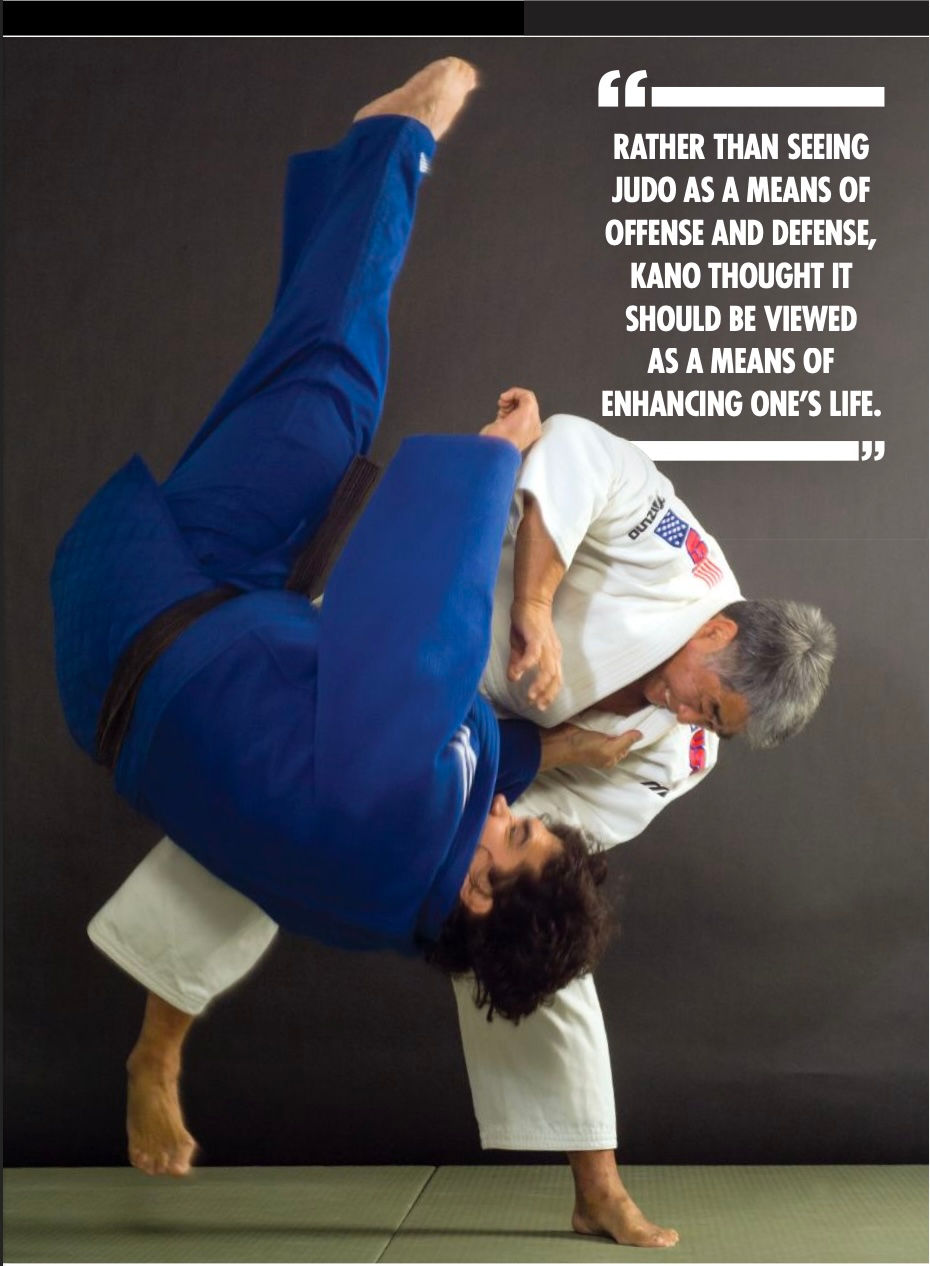
Rather than seeing judo as a means of offense and defense, Kano thought it should be viewed as a means of enhancing one’s life. He promulgated his maxims of self-perfection, mutual welfare and benefit, and maximum efficiency with minimum effort.
He said there were three levels at which an individual could train in judo: for self-defense, for cultivation of body and mind, and for the betterment of society. Kano also changed the look of judo. He developed the standard workout uniform, or judogi. In line with the Western notion of sports clothing, his concept used pants rather than a hakama. The new top was made of weaved material and resembled the coat worn by Japanese firemen. The uniform was off-white, and the pant legs and sleeves were shorter than what we wear today.
The most dramatic change Kano effected was the belt. Until 1884, there were two colors in use: white to denote a beginner (or mudansha) and black to denote an advanced practitioner (or yudansha). After 1884, the belt was regarded as an outward manifestation of the level one had attained through hard practice.
Other martial arts followed suit and implemented similar belt-ranking systems. Before the changeover, jujitsu students were awarded certificates with titles like chuden, okuden, menkyo and kaiden.
Certificates, however, cannot be easily displayed. Kano’s replacement offered a visual incentive for students to work toward: the black belt. The very first black belts in the world were awarded to Tomita Tsuneyoshi and Saigo Shiro in August 1883.
REGULATIONS
As judo membership grew, higher ranks were deemed necessary.
The first fifth dan went to Tomita in 1888. In 1898 the first sixth dan was awarded to Yamashita Yoshitsugu and Yokoyama Sakujiro. The first 10th dan was given to Yamashita in 1935 in a posthumous promotion by the founder. The official criteria for promotion were established.
Candidacy would be judged on the following (paraphrased from Kodokan Council Regulations, printed in Judo Nenkan, 1925):
Candidates lacking in character will not be promoted even if they meet the other requirements.
If candidates are of good character and train diligently, applying their judo skills and knowledge to daily life, and they make achievements through judo, this may compensate for technical inadequacies to a certain degree.
The assessment of judo techniques will emphasize posture, balance and poise.
Candidates for shodan or above must show how they place importance on their judo experience.
After Kano died, the council continued, but World War II caused promotions, at least at the higher levels, to slow down. They didn’t return to normal levels until after the restrictions Gen. Douglas MacArthur had placed on the practice of martial arts were lifted. Despite the setbacks in Japan, judo flourished in other parts of the world.
Europe, the Americas, Asia and Oceania developed their own promotion systems, catering to local needs but mimicking the precepts put forth by Kano: technical proficiency, knowledge of judo theory, continuing education, the use of judo in one’s daily life and character.
COMPLICATIONS
In the United States, judo thrived in areas where many first- and second-generation Japanese lived. In general, it didn’t become popular with “ordinary” Americans until after World War II when servicemen returning from Japan searched for places to continue their practice. Much of judo was under the control of first-generation Japanese, who saw the art as a cultural possession rather than an athletic activity.
Most rank promotion was linked to the Kodokan. Not until the mid- to late ’60s was a more objective system implemented, making it easier for non-Japanese to be promoted. While the system worked well for lower ranks (sandan and below), in America, the ranks of fourth degree and higher were and still are missing pieces of the puzzle.
Promotions up to third degree are comparable to those in other organizations and based in large part on competition. If a sandan is losing to another organization’s first degrees, something is wrong — but adjustments easily can be made.
But what of promotions given to older judoka who started later in life and did not have the opportunity to compete at a high level and build a history? Are they not helping in the development of judo? Suppose a person was to receive a sandan because of time in grade and his or her efforts as a leader.
Would this be acceptable? For ranks higher than sandan, it was held, the person had to be of exceptional quality and dedication in order to be equated with a competitor who’s a fourth or fifth dan. After all, this is about judo, and judo deals in proficiency. Or does it?
Now, things begin to get muddled. For all the champions we’ve produced over the years, we haven’t churned out many who went on to become leaders during or after their competitive years. Judo organizations have not done enough to provide opportunities or incentives to encourage growth beyond tournament victories.
Only haphazardly are those who compete and stay on in various capacities elevated for “time in grade.” What is perplexing is that the time-in-grade standard is often applied to those who don’t have a serious competitive record but have stayed on and contributed to the running of the organizations.
So now what does it mean to be a higher rank? It doesn’t always follow that the higher the dan, the more proficient the person is in judo. In essence, rank is sometimes regarded as payment for organisational skills and/or services rendered.

The public might believe that the higher the belt rank, the more stellar the participant. But again, the perception of proficiency is predicated on a person’s competitive record and not on who’s been around for a long time or who has friends in high places. Unfortunately, the issuance of inflated rank lessons the quality of all rank.
The International Judo Federation, in an attempt to belatedly control rank, issued a proclamation that it will be the only body to confer ninth dan and 10th dan. Furthermore, it said it will recognize only those ranks issued by national governing bodies — in the United States, that would be USA Judo. However, USA Judo has an agreement with the other two large U.S. organizations that all three will honor each other's ranks.
Things would not be so bad except for the fact that the United States has more high-ranked black belts with less skill and knowledge than most European countries. The USA just might have more ninth degrees than France. To put this in perspective: France has 500,000 practitioners while America has 25,000.
Further examination of the French way is warranted. In France, rokudan (sixth degree) is the gateway to “high rank.” To attain it, a large hall that will accommodate four to six mat areas is required. The candidate vying for promotion must perform before a panel of higher-ranked people.
First, the candidate selects a technique such as ouchi gari and demonstrates at least 25 different ways to execute it. Next, the candidate selects a kata and demonstrates it. There is also a presentation of one’s theory of judo, a written examination, and a demonstration of how one would conduct a judo lesson.
The examination is an all-day affair that’s often prepared for a year in advance. The result is that each person who’s promoted to sixth degree is a proficient judoka capable of meeting high standards. It’s little wonder France has 500,000 registered members.
Solutions
This essay would be meaningless if it didn’t look honestly at our promotion system. The truth may hurt some who respect and honor it, but unless certain issues are brought to the fore, judo in the United States will not progress.
Integrity
Mel Appelbaum once wrote the following to a friend: “The topic of promotion is not a simple matter. High-dan grades reflect significant expertise and contribution to the sport and must be administered by high dans with integrity. On the lower-dan levels, competition is the main path to promotion.
Promotion procedures must be fair and consistent and not influenced by the payment of money, as in the way some in the past have literally sold rank and disgraced our sport. It is similar to those claiming doctorates and using the title doctor from degree mills and online degree factories. It diminishes the value of all degrees.”
In the past, rank has been bought, and this still happens. It might stem from an outright bargained-for exchange or from a more sophisticated trade involving donations, dinners, junkets, favors, services, and so on.
A follow-up question has been asked: Could it be argued that the money exchanged for rank truly serves judo in some way? After all, rank promotion is a source of income for organizations. In recent years, there has been a rise in the cost of promotions worldwide. This was most likely started by the Kodokan, whose promotion costs are very high—in the thousands of dollars.
Taking a cue from this action, at least one other organization increased its promotion fees as a means of raising money to fund its programs.
Equality
When contemplating this word, one thinks of two words: equal and quality.
When looking at seventh, eighth, ninth, and 10th degrees from Japan, Korea, France, Germany, Holland, and England, to name a few powerhouses, can we say that our recipients are equal to theirs? Have our candidates competed and practiced at a high level? Are they held to high standards? Have they done as much as, say, Neil Adams or Nobuyuki Sato to promote judo?
Adams is an eighth dan and Sato a ninth. Granted, these two men are of exceptional quality and are at the top of the rating scale, and perhaps America, because of its situation, should be given some slack.
Still, in spite of the need for incentives to encourage judoka to stay on, rank as a currency should be individually deliberated and weighed against social needs.
Role-Model Consistency
At a meeting once, a high-ranked member of a promotion committee proposed to elevate another member to a rank equal to his own. This would not have been out of the ordinary except for the fact that there was no prior submittal of promotion forms.
As such, there was no written record of past performance, kata ability, or character. Yet the promotion was approved. Meanwhile, other candidates were not passed because their applications lacked minor things like the listing of a single kata.
The following year, the person who was promoted proposed that the person who had nominated him should now be elevated to the next rank. Yes, this may have been deserved, but it, too, came with no paperwork.
Should not those who lead, lead by example? Or should the strong be allowed to do what they want and let the weak suffer what they must?
Rank Inflation
In the 1950s, a sixth-degree black belt was a rarity.
Today, it’s fairly common.
At the current rate of escalation of promotions, America could see its ranks swell with high dan holders. There have been 10th-dan promotions, and more are eligible for 10th dan because they have sufficient time in grade.
In the end, a rank certificate is only a piece of paper. It brings no increase in income, no added fame, no extra power.
High rank is just a confirmation that a group of high ranks has confirmed that a person meets the organization’s criteria. Usually, if the group and/or its criteria are of low quality, the rank doesn’t mean as much.
For example, if your promotion committee consists of sixth degrees who’ve never competed at a high level or served in a leadership role and they’re voting to promote you to seventh, eighth, or ninth degree, it won’t mean as much as it would if a group of seventh, eighth, or ninth degrees promoted you.
Even then, should a seventh or eighth dan be voting on whether to elevate someone to ninth or 10th dan?
Aspirations
As I conclude this essay, I’m reminded of a U.S. Navy admiral whose shame was so great after he was discovered wearing an undeserved campaign ribbon that he committed suicide rather than face his peers.
I am in no way advocating this type of behavior for judo; I’m merely pointing out that for some people, honor is a life-and-death matter. While judo is not the military, this nonetheless raises a question: What motivates people to want to claim credit for going down a path they haven’t traveled?
That takes us back to the question, what is a black belt?
For an answer, let’s look outside the box. Forget who wears the belt; look at who devised the system. What might this person’s motivations be for wanting a rank grading system? I believe Kano understood the need for order, hierarchy, self-esteem, and the human need to fulfill goals.
The black-belt rank system does all these things and more. It perpetuates the sport by meeting the needs of its participants. However, maintaining excellence in the system and under changing social conditions requires training, knowledge, judgment, integrity, and dedication.
Jigoro Kano understood change. That’s how he changed the perception of the martial arts from an activity of destruction to an activity of character building. That’s how he changed the norm from wearing street clothes to wearing uniforms with visible belts. And it’s why he later added five rank levels with concomitant requirements—so interest in training could be maintained over a lifetime.
For Kano, judo was a work in progress. Had he lived to the present, he surely would have devised a better measure of competency than time in grade. Today, he would look at elements of judo that are likely to increase membership, boost performance, and enhance understanding and acceptance.
For example, he might determine that it doesn’t make sense to elevate individuals who’ve merely accumulated time in grade, who, in essence, did nothing but wait for the years to pass.
Perhaps he would conclude that it makes more sense to promote people who have been certified in ancillary endeavors like biomechanics, exercise physiology, refereeing, tournament directing, and so on. I don’t know for certain.
What I do know, however, is that judo leaders around the world should come together and take action to create a system that would make Jigoro Kano proud.