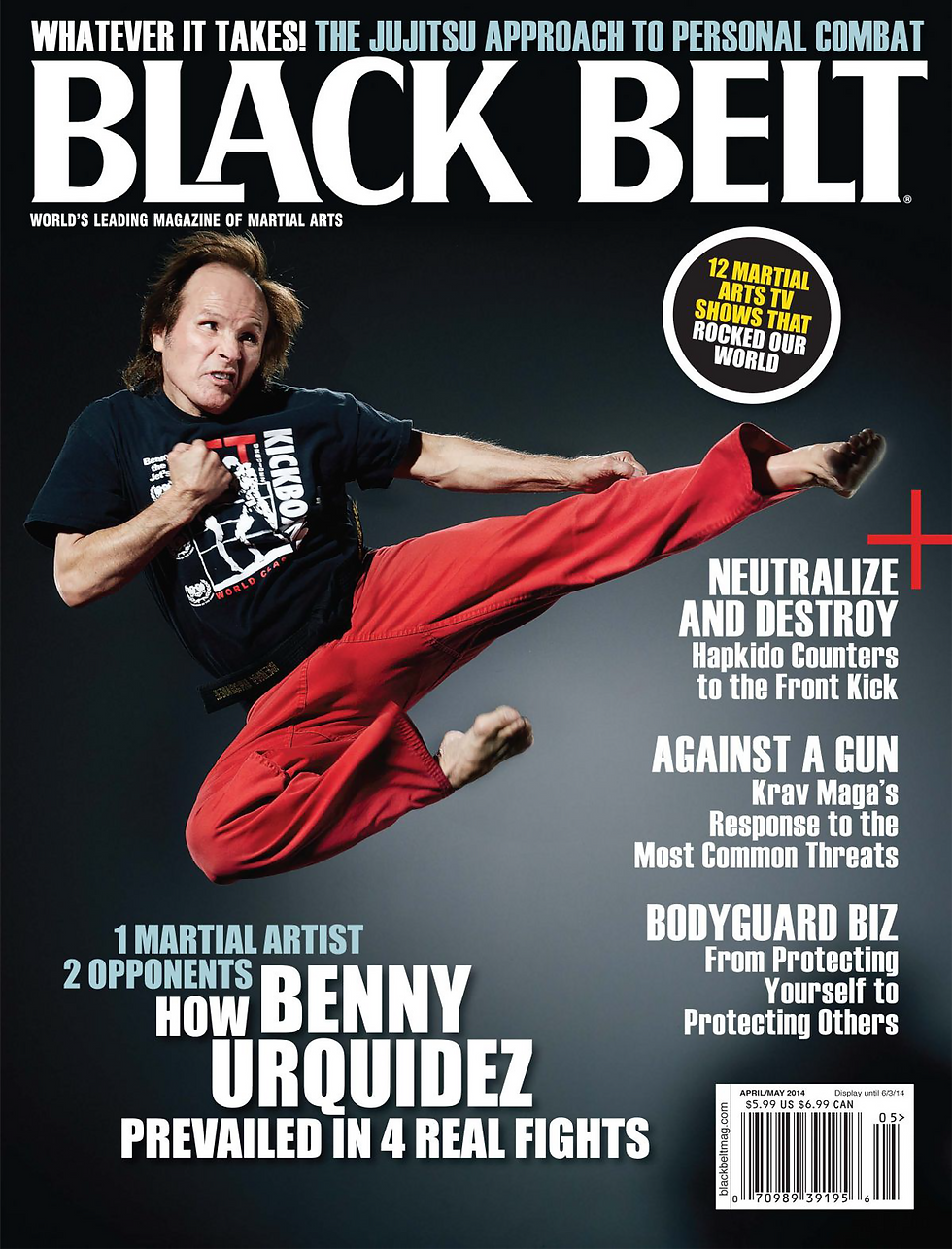
Photo by Cory Sorensen
Few martial artists have not heard of Wally Jay and small-circle jujitsu. A member of the Black Belt Hall of Fame, Jay wrote much about the art he founded, as have numerous others. What many people aren’t aware of is the development of the system that’s taking place under Leon Jay.
by John Mellon
As you may have guessed, Leon is Wally Jay’s son and successor. He maintains the superior mechanics for which his father was famed while continuing to refine the art in a way his dad would have approved of.
I first got to know Wally in the mid-1980s and Leon a few years later, and over the years, our conversations often centered on the futility of change for change’s sake. Each martial artist made it clear that developing technique is a process of evolution. If there’s no functional gain associated with an alteration, it doesn’t count as real development.
The difficulty for many students in the 21st century involves reconciling the classical martial arts with the practicalities of modern life, including changes in lifestyle, urban population density, and differences in the types of weapons and attacks one might face. Few instructors are able to teach us to walk that tightrope between tradition and innovation. Leon Jay, however, is doing just that. Even better, he’s honest enough to acknowledge that he’s on a long learning curve.
To assess his qualifications, you have to know his background. Leon was born in Alameda, California, in 1955. His father was Chinese-Hawaiian, as is his mother Bernice, who also has English ancestry. Despite his famous father, it was never a foregone conclusion that Leon would inherit small-circle jujitsu. The son had to earn his rank and his inheritance the hard way. In addition to his education in small-circle judo and jujitsu, which started at age 2 courtesy of his father, Leon pursued other arts. He earned a first-degree black belt in Kodokan judo and taekwondo, as well as a third degree in kodenkan jujitsu, the system of Henry Okazaki, his father’s original sensei.
Leon was appointed headmaster of small-circle jujitsu a few years before his father passed away in 2011, with a mandate to continue evolving the system. As a teacher, he’s more explicit regarding the strategy and tactics of the system and how they have continued to develop.

“People make a lot of assumptions about small-circle jujitsu — they think it’s all finger
locking and palming and little else,” Leon says. “The truth is that it’s a complete jujitsu system with all that entails, but like any other style, we have our own characteristic fighting style and approach to combat.
“My dad would just pluck a punch or kick out of the air, but that was because he could, and he could because he had trained in boxing and other arts prior to and alongside his jujitsu and judo. The average person will struggle to do that without that same breadth of training, so we make sure that is present for the student.
“If there is such a thing as a typical small-circle stylist, I would say we would prefer to operate as a counter-fighter, allowing our opponent to commit and then punishing them for it. We train for that by teaching the students a referencing system that gives them multiple ways to punish and then capture a limb. More importantly, it allows them to intelligently select the most likely technique to fit the situation.
2
“Once we have contact, we concentrate on not only being efficient in our mechanics but [also on] being able to adapt to resistance. No matter how tight or how painful a locking technique is, the opponent will habituate to the discomfort, and then the resistance is coming. We circumvent this by maintaining each lock for only a few seconds before moving to another, which is why transitional flow was such an important concept to my father. Taking an opponent through several locks in sequence — with no opportunities to escape — is psychologically demoralizing. “We usually finish with a throw — the ground is another weapon, after all — then we either walk away or pin. Throwing also allows us to use the opponent as a weapon when more than one attacker is involved.”
Leon had already begun to investigate Okinawan karate’s pressure-point fighting and Filipino arnis through his exposure to his father’s friends George Dillman and Remy Presas, who as a group regularly gave seminars as “The Big Three.” Presas was a particular favorite of Leon’s, and he became a significant mentor to him. Wally already used a number of pressure points, found by trial and error, to enhance the mechanics of the small-circle system, and Dillman was able to name and explain the theory behind the refinements Wally had discovered. Presas loved to mix the small circle into his superlative stick work, and he and Wally shared an obsession with the flow of technique.
As Leon traveled with his father on his seminar circuit, he befriended many other teachers associated with Wally’s partners. When he wasn’t on the mat assisting his father, Leon would be behind the scenes experimenting with those martial artists. Many of them became future collaborators, and just like his dad, Leon is quick to give credit where it’s due.
“I take the same view as my father: I wouldn’t be where I am now in my journey if it hadn’t been for the quality of many of my teachers, mentors, training partners and students,” Leon says.
“Back in 1990, Ed Lake, who I met on The Big Three seminar circuit, invited me to teach seminars with him independently of my dad,” he continues. “That was a turning point for me as a teacher. We spent a month touring the U.S. in Ed’s car, teaching every couple of days. In between, we talked endlessly of how to combine what we were learning about pressure points with the already refined mechanics we had in small circle. Ed passed away, and I still feel his loss today. He was a great friend, an inspiration
and a collaborator.”
“Small circle has always been a small art in terms of number of practitioners, but that’s because our technical standards are high, and we like to have a great deal of input to the development of a teacher,” Leon says. “And that’s not going to change anytime soon. We’re about to relaunch small-circle concepts, which is a program to allow other stylists to acquire some of the core mechanics and skills of the art without having to convert to studying the whole system.
“In the meantime, we are expanding cautiously in the U.S. We have some wonderful teachers associated with the system who are taking an active role in promoting small circle.”
Leon says he’s also trying to return small-circle judo back to the prominence it once had. “Personally, due to old injuries from an automobile accident, I can’t really perform the art to showcase it adequately, but two of the really great judoka my father trained, David Quinonez and Brad Burgo, are still doing it and refining it continually.
They’ve started to teach at all our camps, which is wonderful because small-circle jujitsu wouldn’t exist without small-circle judo. It was my father’s proving ground for the art; it’s where he developed and pressure- tested many of his principles and his technical developments.
“I don’t think we can go forward without bringing that part of the art back into its rightful place at the core of the system alongside finger locks and the like. It’s our roots, and you should always appreciate where you come from.”
John Mellon is the co-founder and joint headmaster of Small Circle Concepts. He also holds
teaching ranks in many martial arts and is the founder of the Munen Muso Ryu and Pindochin
systems.