If you’ve ever had a conversation with someone who has actually taken the life of another person — even when it was morally and legally justified — you probably know it doesn’t work the way it does in the movies.
Violence, especially when it’s close and personal — and even when it isn’t fatal — tends to affect people in a profound way. A thief or attacker confronts a potential victim or alert bystander, and the lawbreaker ends up injured, incapacitated, or dead. We hear about incidents like this in the news all the time.
What we generally don’t hear about is how the “good guy” reacts afterward. People who have participated in violent encounters often experience problems, sometimes mild and sometimes severe: sleeplessness, anxiety, nausea, an inability to concentrate. Therapists see symptoms like these constantly, and in some cases they can affect a person for the rest of his or her life.
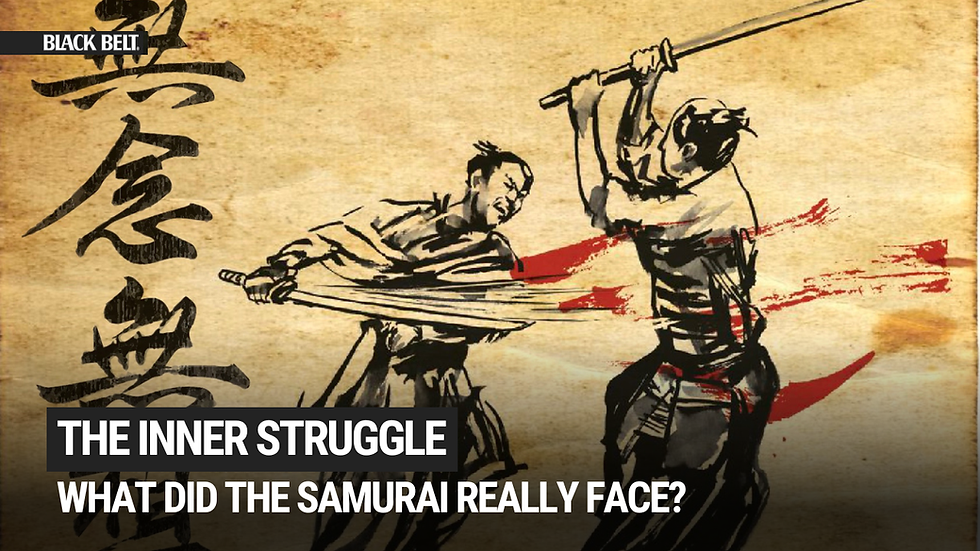
Our image of the samurai is often that of the stereotypical hero — fearless in battle and cold-blooded beyond comprehension. In Japanese tales, his character is described as iwao no mi, “a body and spirit like a rock.” Nothing fazes him. He is completely in control. All that blood and death? He is indifferent.
The truth is that the classical warriors of Japan had passions and feelings just like anyone else in any other age. Moreover, given the influence of Buddhism — with its emphasis on nonviolence and strict prohibitions against killing — the samurai’s role would have created deep internal conflict. During periods of warfare especially, they had to confront this dichotomy and live with the consequences of having taken lives.
It is safe to say that post-traumatic stress disorder (PTSD) did not originate in the modern era. Samurai faced it much the same way 21st-century veterans do.

We know about their struggles primarily through methods preserved in many classical ryu, which address the psychological damage associated with violence and killing. These traditions often included rituals and exercises intended to provide a form of psychological release from guilt.
For example, one school taught a technique in which the foot of a fallen enemy was pierced to allow his spirit to depart peacefully. Others used incantations drawn from esoteric Buddhism, chanted to ease the burden of having killed. In at least one tradition, training included kata sequences interspersed with movements that traced a mandala-like pattern on the floor — practitioners physically “drawing” a symbol meant to influence their mental state on both conscious and subconscious levels.
Some of these rituals were remarkably sophisticated, generating powerful psychological effects for warriors who believed deeply in protective and healing deities. Most details were kept secret within each ryu, underscoring how important they were.
Evidence of this inner conflict also appears in the writings of classical warriors. Miyamoto Musashi (1584–1645), often imagined as an emotionless killing machine, described a method of striking called munen muso — “no thought, no preconceived plan.” He advised students to “strike from the Void.”
Modern scholars interpret this as spontaneity: reacting naturally in combat. But there may be another layer. If there is no conscious intent to kill — if the action simply arises from the Void — then responsibility for the opponent’s death becomes philosophically ambiguous. It becomes something that “just happened,” a natural consequence of events.
Of course, Musashi may also have been searching for a way to rationalize his own actions.
Similarly, Yagyu Muneyoshi (1529–1606) wrote that once one penetrates the ultimate nature of swordsmanship, “the blade and other weapons will have no place.” This can be read as a moral teaching — but also as a means of reframing violence. It is as if he is saying: I am still on the path toward ultimate understanding; the killing I have done is merely part of that journey.
Clearly, rationalization and the search for meaning in violence occupied the minds of Japanese warriors.
Of course, we cannot directly compare modern society to that of the samurai. In pre-modern civilizations, brutality was far more commonplace than it is today. During Japan’s centuries of civil war, death and violence were pervasive realities, and members of the warrior class witnessed horrors that are rare in modern life.
Nevertheless, martial artists today should think deeply about death, violence, and their implications for training. These are sobering concepts — which is precisely why they deserve honest reflection.