There’s a good chance that if you’re reading this, you’re a teenage boy. Young men your age are naturally drawn to the martial arts. You’re growing more powerful physically. You like challenges. You’re attracted to the danger that’s involved in practicing a fighting art. Karate and other such disciplines are perfect for you.
Additionally, the arts tend to appeal to people like you because they offer a way to fight injustice, to have the power to stand up for your ideals. That’s good because it reinforces the belief that you have the ability and determination to make the world a better place. However, such aspirations are frequently more complicated than you might wish. It’s also important to understand that idealism and bravery are not always enough. You also must have perspective. For those reasons, it’s worth remembering the young men of the Byakko-Kai.
Young Samurai in Japan’s Last Civil War
JAPAN’S BOSHIN WAR (1868-1869) was a civil conflict, one of the last in which the samurai fought. It came about because some samurai clans were angry that the Tokugawa shogun was modernizing Japan, opening the country to trade. The Tokugawa used the Emperor Meiji to give legitimacy to its cause, presuming to act on his authority, while the protesting samurai also claimed to be working to restore imperial rule. It was a confused mess, frankly, with each side insisting it was doing what was best for Japan and claiming imperial support.
Caught in the middle was the Aizu clan, which controlled what’s now Fukushima prefecture. In 1862 the Aizu sent an army to Kyoto to protect the emperor from his enemies, most notably the Satsuma, who, while claiming to support the emperor, were actually working to undermine the authority of the Tokugawa shogun. The Satsuma and other allied clans defeated the Aizu, who were forced to retreat from Kyoto. The Satsuma followed, besieging the castle town of Aizu-Wakamatsu, the stronghold of the Aizu clan.
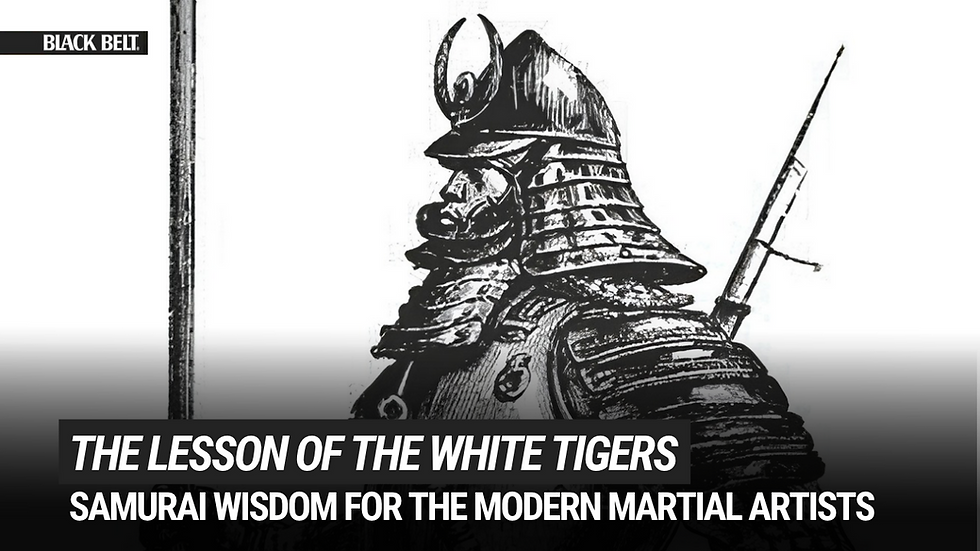
For the protection of its town, the Aizu relied on four samurai units, named after the spiritual guardians of the four directions: the Black Turtles, Blue Dragons, Red Sparrows and White Tigers. The White Tigers, or Byakko- Kai, were a reserve unit composed of boys ages 15 to 17. With the Tokugawa shogun’s troops rapidly advancing on the castle, the White Tigers were sent out in a last-ditch effort to save the fortress. The other units had already been pushed back and scattered by government troops. The Byakko-Kai took positions in a swampy wooded area and fought in a driving rain, but it, too, was eventually routed.
A Tragic Mistake in the Name of Samurai Honor
THE UNIT BROKE APART. One contingent of 20 samurai from upper-level warrior families was separated from the rest of the group. In the rain and fog, the young men retreated to a safe position atop a hill that overlooked the castle. The fog cleared later that day to reveal their worst dread: The castle was in flames. Greasy black smoke billowed over what had been their home. It meant that their families were dead, their clan extinguished. Twenty boys huddled on top of the hill, knowing their way of life was gone.
They elected to commit junshi, a form of disembowelment designed to show loyalty to lord and clan. It was a brutally painful way to die. Each boy performed the gruesome task, and all but one died in horrible pain. Iinuma Sadakichi had used his sword on himself, but he survived. Rescued by a farmer, he lived to tell the story of the doomed young men of the Byakko-Kai.

Their sacrifice might seem romantic and brave. In a way, perhaps it was. But here’s the thing: The castle wasn’t burning. The town around the castle was on fire; the fortress and all those inside were safe. Like the same sorts of men who would, less than a century later, strap themselves into bomb-stuffed planes and dive into American ships in the Pacific, the “sacrifice” of the 20 was pointless. They thought they saw something. It turned out to be false.
No doubt the Byakko-Kai members believed in what they did, but they wasted their lives. They had the same limited perspective on life that young people today have. While they believed in the desperation of their situation and the nobility of their actions, they didn’t see the whole picture. Their view from atop the hill was much more limited than what they thought.
The Martial Arts Lesson: Courage Without Perspective
THE CAUSE OF JUSTICE, of righting wrongs, of taking a position out of a sense of duty and loyalty—these sentiments are often expressed in dojo kun, oaths that are recited or posted on the wall. Although you should take them seriously, you must remember that rushing into action or making decisions in the heat of the moment without considering the whole picture, without being sure of what you’re doing, are things karate teaches you to avoid.
It’s impossible for a young person to pursue the way of karate without becoming more mature. When you’re on that path, you simply need to have enough awareness to know what you don’t know. Be patient. Be humble enough to know you have much to learn about karate and about life. Karate offers a unique perspective on life. Follow it long enough to experience that perspective.