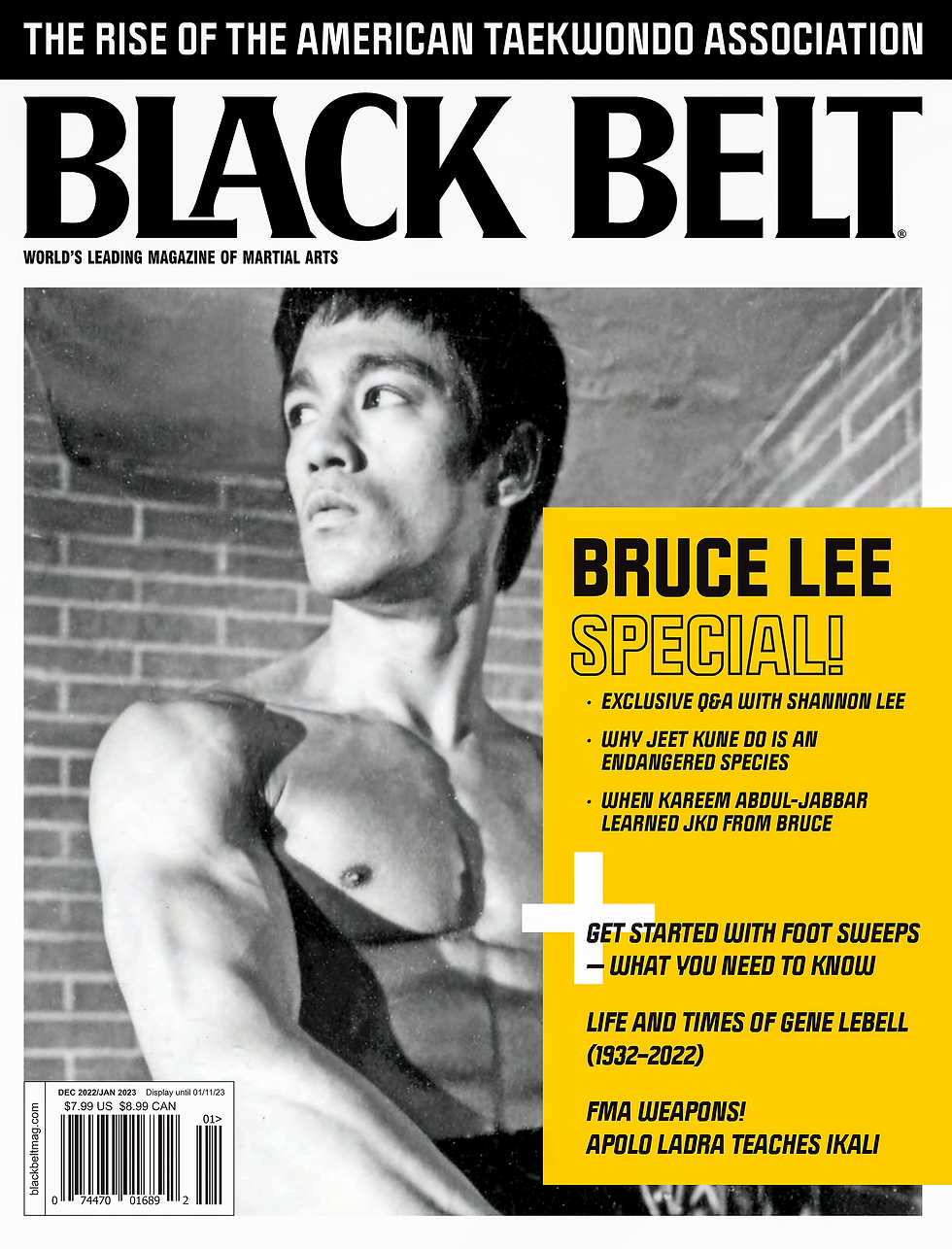
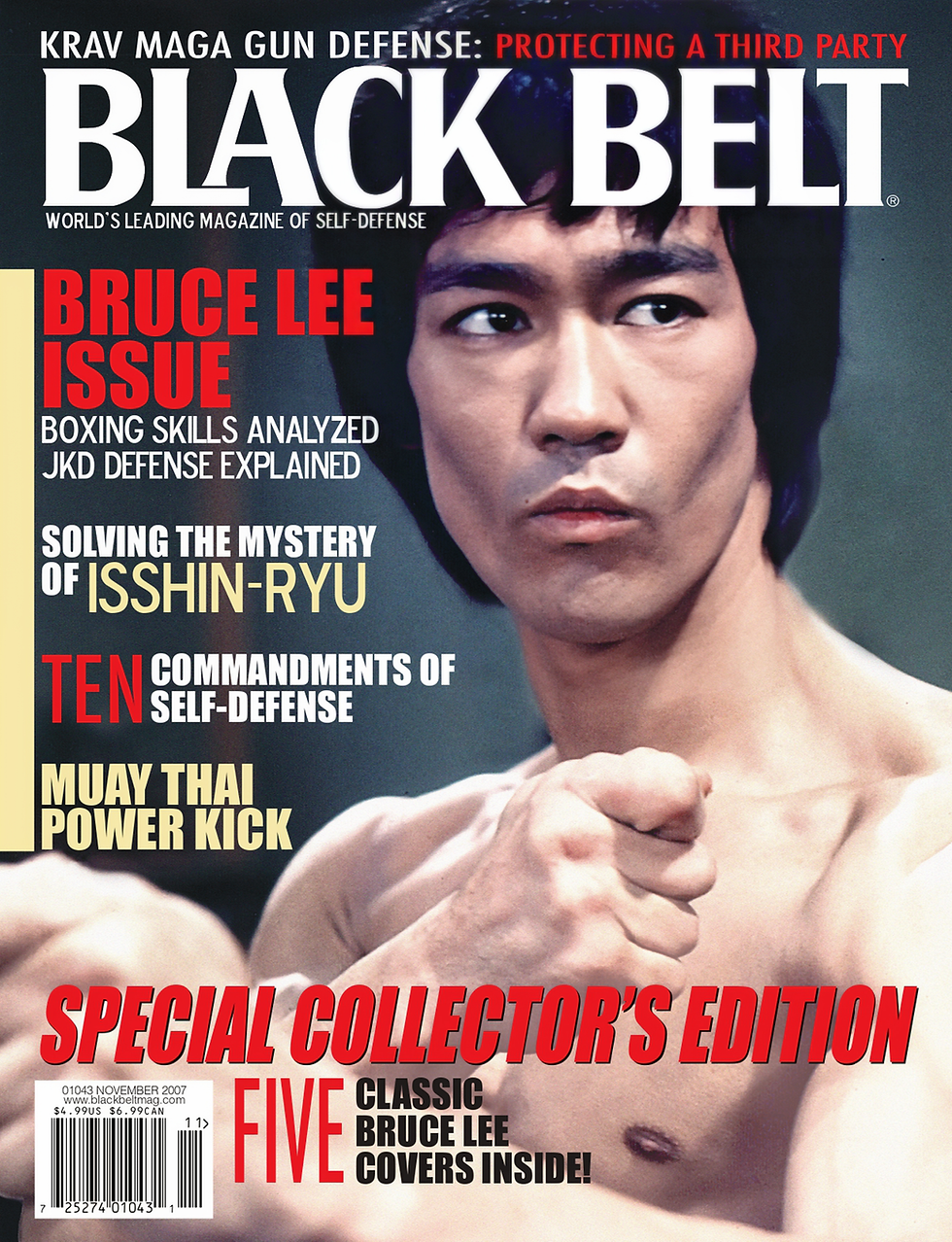
Since Bruce Lee’s death in 1973, books, documentaries and magazines have used every adjective to describe his screen presence and martial arts abilities.
Numerous facts related to both facets of his career get repeated over and over. Yet little has been written about Lee’s formative years—when he was a boy, then a teen and then a young man.
Example: Did you know that once in America, Lee served his country by joining an Army ROTC program? Read on for more.
ENTER THE FISHERMAN
The setting: China in 1917.
Japan has gained several footholds here, but in the rural village of Shende, the only thing on teenager Moon Chuen’s mind is the pittance he earns to support his mother and siblings.
He catches fish by hand, then walks for two hours for a chance to sell them to local restaurants. Thin and dressed in tattered clothes but full of spirit and a booming voice, Moon is offered a job as a check caller at one of the restaurants he sells fish to. He’s tasked with singing out each customer’s tab to the cashier.
One day, an opera star who’s in the restaurant hears Moon’s voice and makes him his protégé. Moon soon moves to Hong Kong and becomes one of the premier opera singers of his time.
With financial help from the Chinese-Dutch Sir Robert Ho Tung, Dr. Sun Yat-sen manages to succeed in his revolution against the Manchus by establishing the Republic of China in 1911. That same year, Tung’s brother and his German-Irish wife give birth to Grace Ho.
While in her teens, Ho moves to Hong Kong and lives under the watchful eye of Tung, who happens to enjoy opera. One night, Ho accompanies Tung to a performance, where she becomes enamored with the troupe’s young lead singer, Moon, who was recently renamed Lee Hoi-chuen (Hoi-chuen meaning “sea stream”) by his mentor. They fall in love and get married.
Fast-forward to 1940, the year of the dragon. Japan has invaded China. Oblivious to the dangers that are growing in their homeland, Hoi-chuen’s opera troupe is touring America. On November 27, 1940, a freak, hurricane-like deluge hits San Francisco, where Hoi-chuen is performing at the Grand Avenue Cabaret Theater.
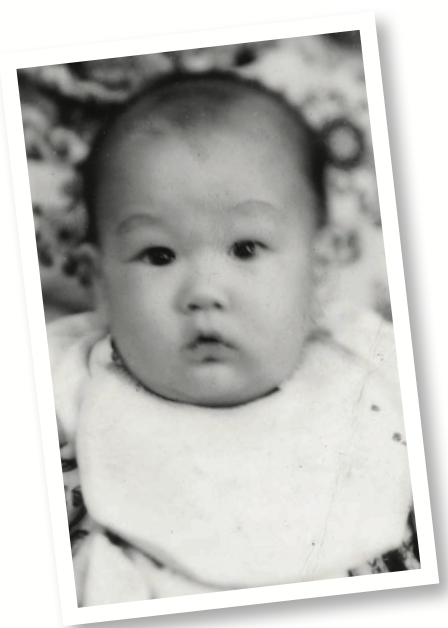
At the hour of the dragon, his son is born at Jackson Street Hospital in Chinatown. His name is Lee Jun Fan—meaning “Lee, protector of San Francisco”—but Dr. Mary Glover, the obstetrician who delivers him, names him Bruce.
Born amid pouring rain, not to mention the fact that his father’s name and first occupation (fisherman) were related to water, Bruce would seem to be linked to H2O. In Asia, such links aren’t viewed as coincidence—as you’re about to see.
GETTING HIS FEET WET
By 1946, Communist China and Nationalist China (Taiwan) have almost achieved peace. Bruce is the only Lee child who accompanies his father on the Red Junks, boats so nicknamed by the Cantonese opera troupes that use them to travel to gigs in villages along the rivers of Canton.
Choi Yuen-cheung, the son of one of Hoi-chuen’s opera performers, begins palling around with Bruce. The two often ride water buffaloes in villages where the troupe is performing. Choi, being older, acts as young Bruce’s protector, making sure the non-swimmer never tumbles from his wild ride.
Every now and then, Choi wades into the water with Bruce on his shoulders, giving the smaller boy a chance to experience the rush of the current and the watery malevolence.
One day, Choi decides to teach Bruce how to swim. After a few lessons, Bruce is feeling confident, and they float out to deeper water. Choi lets go of Bruce and is distracted by a buffalo entering the river. When he looks back at his friend, he’s gone. Choi frantically swims out to where he thinks he went under. Bruce pops up, and his guardian plucks him out of the river. From that time on, Choi (aka Unicorn) is Bruce’s best friend. He appears in two of Bruce’s early films.
Because of this traumatic experience, Bruce would never swim again. However, his association with water would soon resurface.
ACTING THE PART
When communism envelops China, the Lee family flees to Hong Kong, where Hoi-chuen’s fame makes him an ideal candidate for film—which ultimately opens doors for Bruce. Chun Kim, a rising filmmaker and friend of Hoi-chuen’s, casts Bruce in his first lead role in Kid Cheung (1950), which is directed by Chun’s friend Fung Fung.
Even as a child, Bruce is a disciplined actor—he literally sleeps on the set next to where his scenes will be shot. When the director calls his name, he snaps awake, brushes his teeth and fervently delivers his lines, then goes back to sleep until it’s time for his next scene.
Unfortunately, young Bruce suffers from a stuttering problem. However, with his rapidly developing mental discipline, he conquers the speech impediment whenever the camera is on, eventually overcoming it entirely on his own. Chun is so enamored with Bruce’s dedication that, without knowing Bruce was born in the year and hour of the dragon, he nicknames him Lee Siu-lung (Mandarin: Lee Xiao-long), meaning “Little Dragon Lee.”
BRUCE LEE'S COMIC CONNECTION
Bruce’s introduction to the martial arts begins when, as a child, he rents kung fu comic books and is captivated by heroes who can fly, fight with great skill and wield fancy weapons. Many of the comics he reads focus on the heroes of Shaolin, who use their phenomenal combative abilities to battle the evil Manchus. Bruce likes drawing these characters, especially their facial expressions. His favorite subject is Guan Gong, China’s red-faced, long-black-beard-wearing kung fu god.
On his early film sets, Bruce knows certain people are afraid of praying mantises, so he sometimes finds the insects and puts them in front of their faces so he can watch them scream. Conjecture: Perhaps this love for the mantis inspired him to use them in the gambling sequence in Enter the Dragon and to include the short mantis form, which he does before beating up the Mafia thugs in the alley, in Way of the Dragon.
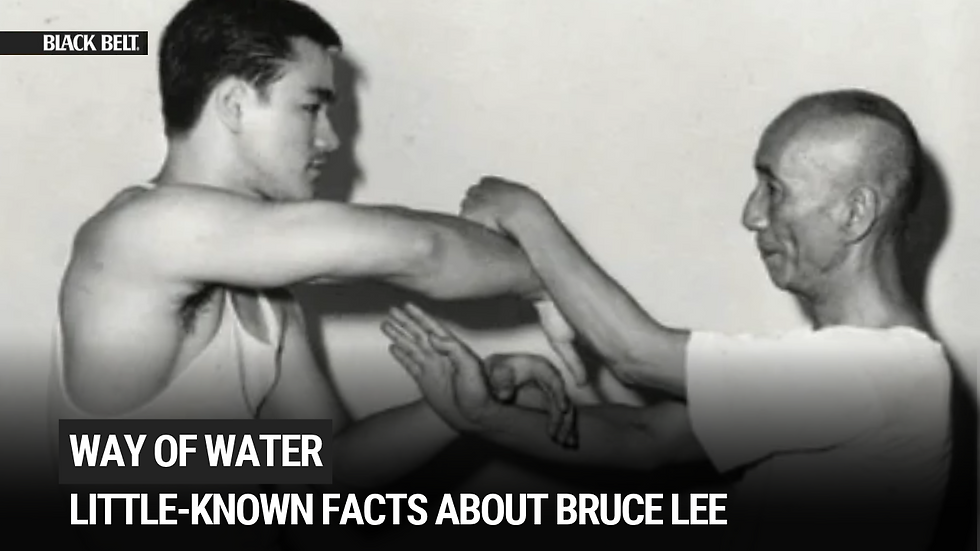
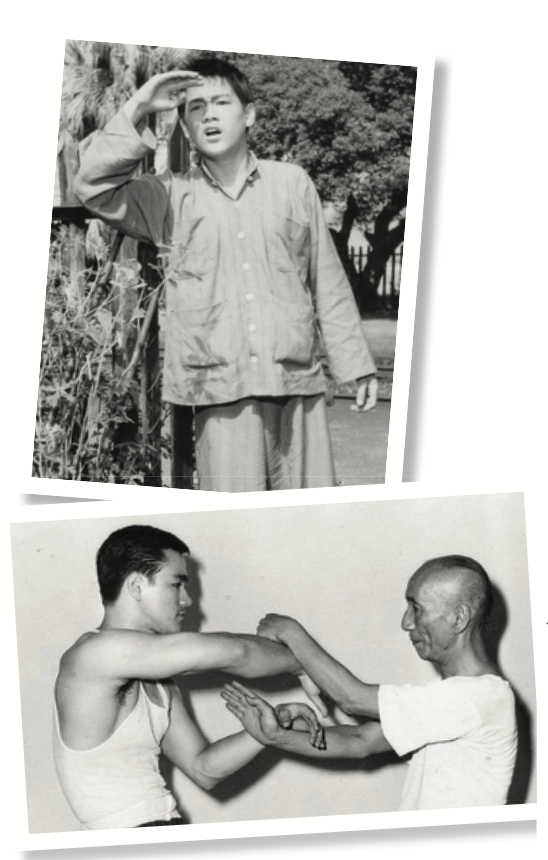
Bruce’s longing to be a kung fu hero guides him further toward the martial arts. According to his older sister Phoebe, at age 10, he sneaks off with a cousin and a classmate to practice choy li fut kung fu. Three years later, he begins wing chun under Ip Man (also spelled Yip Man). At home, Bruce likes to pose the body and arms of Phoebe and younger brother Robert in positions similar to those of a wooden dummy, after which he whacks away on them as if they’re training devices.
Because of his growing involvement with street toughs, Bruce views the martial arts as an effective means of self-defense. He’s in and out of Catholic schools, has run-ins with the law and is learning about the rough-and-tumble side of life in Hong Kong. His father decides that for the boy’s safety— and to maintain his American citizenship—Bruce must be sent to America.
Slow Boat From China
Before relocating in 1959, Bruce becomes introspective, perhaps because he has an inkling of the magnitude of the challenges that await him. Once again, he turns to the martial arts for answers. But how can he find answers to questions he doesn’t know? The following comes from Bruce’s brother Robert:
Despite Bruce’s fear of water, one day fate found him in a small fishing boat in the middle of a lake, alone and without a life jacket. With the boat drifting with the breeze, he calmly lies down and drapes an arm over the side, letting his fingers feel the cool water. A chill envelops his body, perhaps marking an epiphany. His eyes glaze over, and he loses himself in thought. In slow motion, he rows back to shore, to Robert.
Bruce opens up to his brother: “The breeze, the willows, the water—this is what martial arts is all about. You have to be like water to survive. It penetrates rock and is the strongest substance in the world.” His eyes opened to the importance of being like water, Bruce now has the strength to tackle anything. The concept would become one of his most famous philosophical tenets, one he goes on to share with the world.
He’s ready for America.
Hello, Hollywood
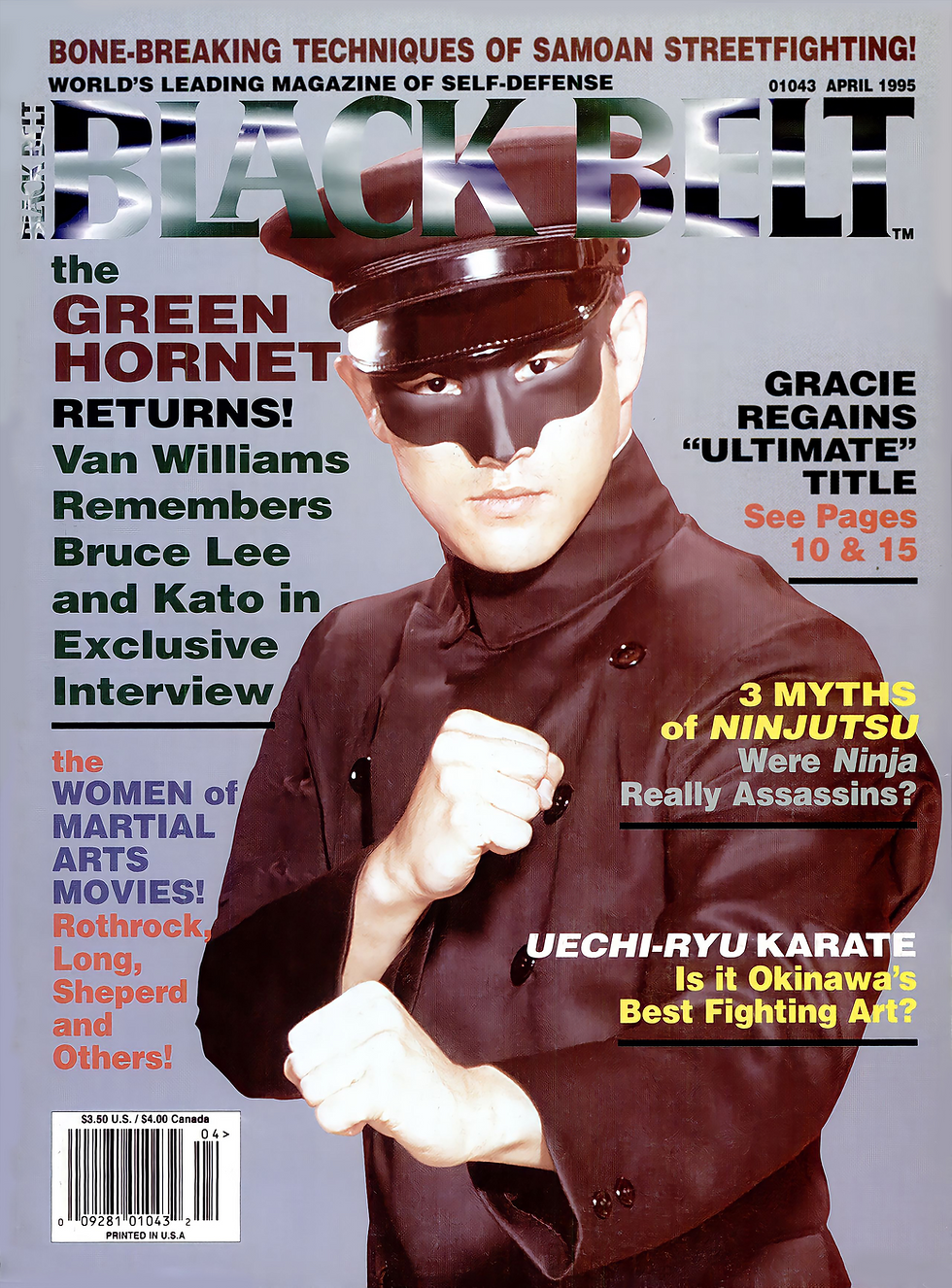
Across the ocean, Bruce makes pivotal appearances in the TV series The Green Hornet (1966-1967) and Longstreet (1971). His short role in James Garner’s film Marlowe (1969) is also memorable— interestingly, that role arises from Bruce’s work as a martial arts adviser for Dean Martin’s The Wrecking Crew (1969). In Crew, Bruce choreographs fight scenes between Nancy Kwan and Sharon Tate, as well as between Martin and martial arts legends Ed Parker and Joe Lewis. Trivia: Crew is also Chuck Norris’ film debut.
When Bruce decides in 1971 that he wants to pursue a film career in Hong Kong, he visits the set of the Shaw Brothers movie The Anonymous Heroes. He watches the fights and reportedly quips to the studio president, “Is that all you’ve got?”
What the unimpressed Bruce witnesses isn’t kung fu fighting but smash-’em-crash-’em film choreography. The raison d’être for the action scenes is to show audiences that when stars David Chiang and Ti Lung are romping around with stuntman craziness, bodies colliding and crashing through walls, they’re doing their own stunts. Perhaps if Bruce visited the set of Chiang and Lung’s next project, The Duel, his attitude about kung fu fights at Shaw Brothers would be different and he’d join Shaw Brothers instead of rival studio Golden Harvest.
When Bruce is finally allowed to make movies the way he thinks they should be, he avoids stunts and favors realism. The films that make him a hero are, of course, The Big Boss, Fists of Fury, Way of the Dragon, Enter the Dragon and The Game of Death.
Feng Shui
In his life and in his work, water is a recurrent theme, and strangely it is in his death, as well. Feng shui (meaning “wind water”) is the ancient Chinese art of arranging one’s surroundings to attract positive chi and enable it to flow smoothly in one’s body and environment.
Similar to the circumstances of his birth—that freakish hurricane-like deluge—Bruce’s end may begin on July 18, 1973, during an unexpected typhoon. Eerily, the winds cause a faulty feng shui deflector on the roof of his Hong Kong home to blow away.
He dies two days later.