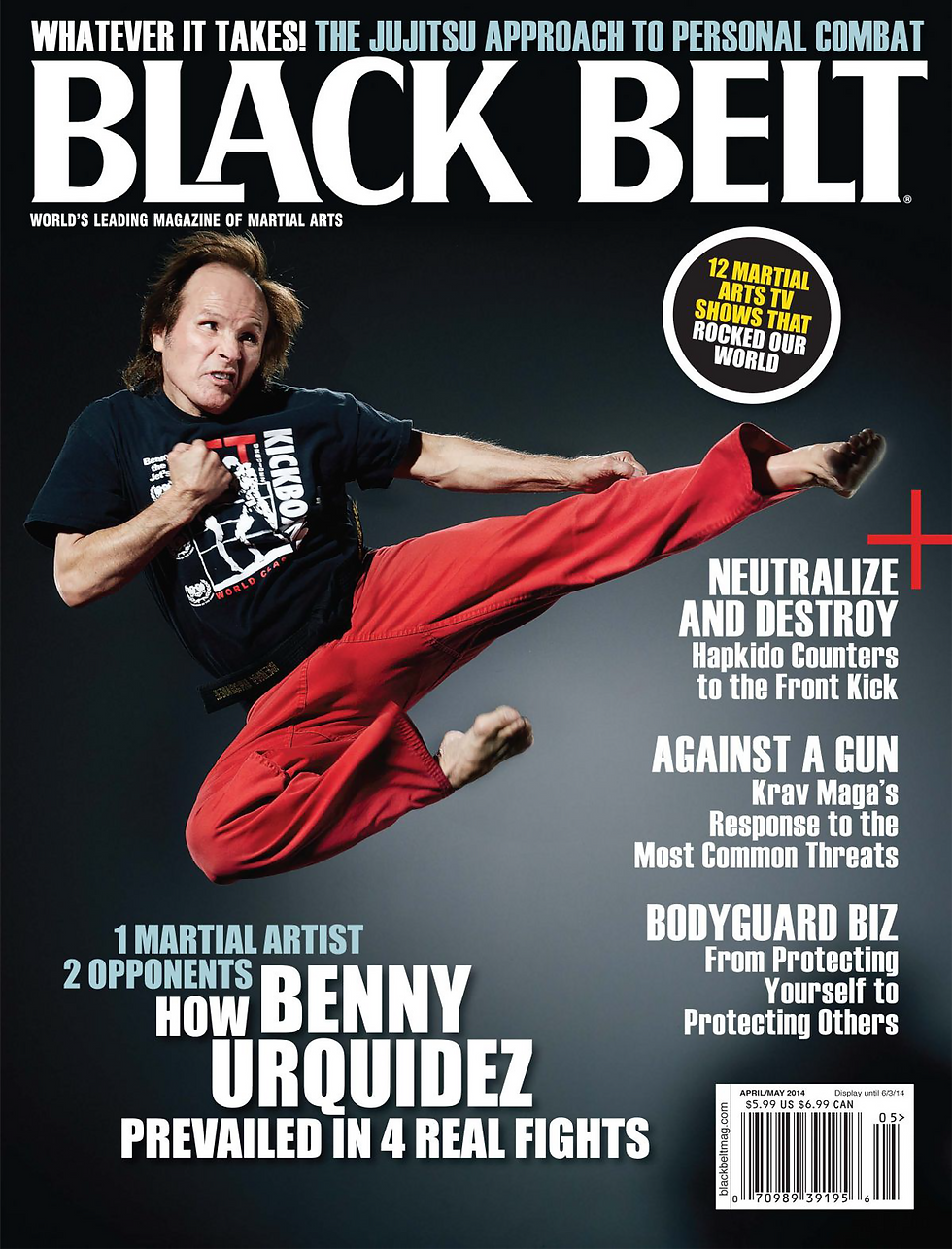
Here I was, standing in the ring with the greatest karate fighter in history. Not only the greatest karate fighter but also the first heavyweight world-champion kickboxer, I remember thinking. This man had trained with Bruce Lee, performed on The Tonight Show Starring Johnny Carson, even sparred with Muhammad Ali, and here I was about to go three rounds with him.
“When the bell rings, should I go out and whack him?” I asked myself. “He’s a legend and he’s over 50 years old — I don’t want to hurt him.”
The answer came quickly. The bell sounded, and we both advanced. I noticed that his fighting stance was the same as he’d used in his previous matches. His feet were firmly planted, and he moved with purpose. His right hand was held high, around cheekbone level, and his left hand was positioned near his waist, with his arm at a 90-degree angle.
Lewis wasn’t dancing around quite as stealthily as in the YouTube videos I’d watched and the DVDs I’d collected. After all, he was older now, and his sparring strategy had changed slightly. Nevertheless, he was dictating the pace. He was snorting like a bull, but in a rhythmic pattern — as if he were a steam engine, building up energy to finally make that first tug on a long string of railroad cars.
Suddenly, my head snapped back. My line of sight, which had been aimed at my opponent’s chest, was racing toward the ceiling. As I refocused on his chest, my mind started working again. I should have blocked with my front hand and countered, I figured. Instead, I’d just gotten nailed with the hardest jab I ever experienced. The punch was lightning fast and possessed the power of a telephone pole being shot out of a cannon, and it had landed squarely on my nose.
The switch in my head turned on. This guy may have trained with Bruce Lee and made himself into a legend, I thought, but now I need to hit him hard to keep him from killing me.
Such was my introduction to sparring with Joe Lewis. It happened to be my first test while training under him; fortunately, it wasn’t my last. During the many subsequent opportunities I had to work with him before his passing in 2012, I came to realize what a treasure he was. Earning my fifth-, sixth- and seventh-degree black belts from him was an honor and a privilege.
MASTER OF ARTS
Lewis made fighting sound easy, yet he could take a simple technique like a jab and teach an all-day seminar on its nuances, purposes, variations and history. Often he’d talk and talk, and I’d look at one of my fellow black belts and whisper, “I wish he’d just get to the sparring.” Being a young fighter who regarded sparring as the only way to learn what worked and what didn’t, I sometimes became impatient with what I viewed as overanalysis.
Of course, I grew to appreciate the Joe Lewis teaching method. He taught not just lessons for the ring but also lessons for life. Everything he’d learned from his combat tour in Vietnam to the wars he waged in the ring eventually became lessons for those he mentored.
When the editor of Black Belt asked me to winnow all that Lewis had passed to me into an article on the top 10 lessons, I knew it would be challenging. He was such a genius in so many ways that his wisdom could fill a book. However, I vowed to get it done. And as I learned from Lewis, in fighting and in life, there is no “try.” It’s either done or not done. You either win or lose — there’s no gray area.

LESSON 1 — FOR LIFE
CUM CORDE ET ANIMIS.
This Latin verse, which can be found on Lewis’ seal and every black-belt certificate he issued, translates as “with heart and spirit.” Anyone who’s worked with him for more than 60 seconds knows exactly why it’s there. Lewis embodied that notion. He taught all his black belts that we must be intentional about our strategy. We must stand up in the face of adversity, even when the majority wants to head the other way.
Lewis preached the importance of executing acts with profound conviction. He believed — and wrote in his training manual — that heart is what you fight to defend and the ego is what you fight to gain.
In the many conversations we had, Lewis made it clear that every fighter needs an “attitude technique,” one move that can serve as his or her go-to technique when things aren’t looking good. It should be something that works 99 percent of the time and can change the face of the fight, he’d say, and when you use it, it must be executed with complete conviction and intensity — with heart and spirit.
LESSON 2 — FOR THE RING
IT ONLY TAKES ONE.
Lewis told me more than once that when he competed, he didn’t need an elaborate arsenal. He needed just one technique, and for him, it was the side kick. He agreed with Bruce Lee, who advised us not to fear the man who does 1,000 kicks one time as much as the man who does one kick 1,000 times.
This meshes with Lewis’ advice about having an attitude technique. Watching his early fights, you can see that his side kick was unbeatable. In one match, he broke his opponent’s ribs — and then when the guy turned so he could continue fighting, Lewis used the same side kick and reportedly cracked ribs on that side, too.
All fighters should develop one technique until it’s unstoppable, Lewis said. Unfortunately, not everyone does because of the time commitment. He made the side kick his attitude technique by following the philosophy of Lee and practicing it up to eight hours a day.
LESSON 3 — FOR THE RING
RHYTHM IS KING.
The man who controls the rhythm wins the match, Lewis would say. He passed along that message in virtually every seminar, touting the importance of head rhythm, body rhythm and foot rhythm. Use head rhythm to fake or feint, he said. Use foot rhythm to draw an opponent in. Use body rhythm to jive and juke, making your opponent fire out of step, after which you counter quickly.
Rhythm control must be gained and maintained immediately after the first bell, Lewis taught. As I mentioned in the intro, he even possessed the ability to dictate rhythm using his breath.
LESSON 4 — FOR THE RING
WHERE THERE’S WEIGHT, THERE’S POWER.
Although Lewis’ defensive repertoire included many tools, he always emphasized that you must block in a way that provides the quickest and easiest option for a powerful counter. He’d speak of the need to shift 10 percent of your weight to the front or the rear during a block in preparation for your next technique. That way, you can absorb an incoming blow while minimizing the damage, then immediately shift your weight for the follow-up.
Such body shifting not only provides for absorption of energy but also ensures proper balance. Don’t allow an incoming technique to force your feet to reset, Lewis taught. If you have to reset, you can’t immediately fire back with efficiency and power.

LESSON 5 — FOR LIFE
BE TRUE TO YOURSELF AND YOUR FAMILY.
Lewis was known for not sugarcoating things. Whatever he thought, he usually spoke. This could be embarrassing, but often it was profound. He’d always follow those embarrassing moments with that Joe Lewis smile and say, “What’s so funny — what are you laughing at?”
He was true to himself regardless of what people thought or the media portrayed. He considered his black belts to be his family. We knew that if we needed him for anything, he’d be there. I remember him telling folks many times to not mess with his black belts, and we respected that. It made us feel good to know that the greatest fighter of all time had our backs.
LESSON 6 — FOR THE RING
UNDERSTAND THE OPPONENT YOU’RE FACING AND ADJUST YOUR STRATEGY ACCORDINGLY.
Whether the action is in the ring or on the street, Lewis advocated separating your adversaries into three categories: those who are more experienced, those who are more powerful and those who are faster. Then, he said, you should break down each one and design a strategy for victory.
Within each category are subsets based on whether the opponent’s style is emotional or physical, Lewis said. Physical fighters are easy to detect because they try to dominate with their body instead of their mind. In contrast, emotional fighters act from the heart. They’re more impulsive and unpredictable, and they’re more often in touch with their inner sense of rhythm.
LESSON 7 — FOR THE RING
FOOTWORK IS IMPORTANT.
Lewis taught that there are only two ways to fire a technique: from a position or from movement. For both, footwork is crucial.
A voracious student of fight films, Lewis owned a vast library of videos from around the world, including boxing, kickboxing and MMA bouts. He spoke often of how he and Bruce Lee would study films of Muhammad Ali. At many of his seminars, Lewis lectured on how Ali was a master of footwork and movement and, therefore, was able to keep his opponents off-balance.
Footwork is a versatile skill set, Lewis would say, because it enables you to accomplish five tasks in a fight: strengthen your position, entrap your opponent, reset, absorb an incoming blow and recover.
LESSON 8 — FOR LIFE
BEING A GOOD BLACK BELT MEANS BEING A GOOD COACH.
Lewis could assess a fighter’s ability quickly, then fine-tune that person’s good attributes even as he improved the weaknesses. Being a black belt under him meant striving to do the same for others — by helping them achieve the same things you’ve achieved.
As a world champion, Lewis taught all his students as if they were fighting for the title next week. He wouldn’t try to push his style on everyone. No one could mimic his style perfectly, he said, but they could benefit from what he knew about the fundamentals and therefore improve their fighting functionality in a short time. That’s why people like me would travel many hours just to spend one hour under his guidance.
LESSON 9 — FOR THE RING
STABILIZE YOUR TARGET.
Of paramount importance to martial artists who wish to control the rhythm of the fight and land effective blows is doing what’s necessary to make your target momentarily stable. Lewis spoke often about how Mike Tyson had lost his title to Buster Douglas because Douglas understood the jab and used it effectively to stabilize Tyson. A boxer’s primary stabilization technique is the jab, Lewis said. If you’re a kickboxer or MMA fighter, you also can use a jab side kick or stop-kick, or post a leg or jab as an obstruction.
Stabilization enables a fighter to display ring generalship. He or she can stabilize a target with footwork to manipulate distance, either hemming an opponent into a corner or posting the person against the cage.
The truth of this Lewis lesson was driven home for me when, after my mentor passed, I decided to test for black belt under Bill “Superfoot” Wallace. That’s when I witnessed the way Wallace would stabilize his opponents with a jab or a jab side kick. In a conversation, he reiterated what Lewis had taught about stabilization being the key to winning.
LESSON 10 — FOR LIFE
BE PREPARED AND INTENTIONAL.
One of the greatest lessons I learned from the legend was to never let an opponent get an advantage over me with regard to physical conditioning. It was part of Lewis’ mantra: Be prepared. I often share this with my students, explaining that I’ve fought in shape and out of shape, and after comparing the two, in shape is far better.
Applying this to the world outside the ring is simple: Life is a battle. On a daily basis, we must evaluate our plans, decide if this particular battle is against a southpaw, a croucher or a slugger, and then execute our plan. Lewis advocated having a strategy, being intentional about it and executing it as planned. That will maximize your chance of staying in the fight and finishing strong.
Staying in the fight and finishing strong is precisely what Joe Lewis did until the very end. And although he’s no longer with us, his legacy lives on in every black belt he promoted and every martial artist whose life he touched, whether through a seminar, a training manual, a DVD lesson — or a magazine article like this one.