Editor's Note: This interview originally appeared in our August 2012 issue. To read the rest of the magazine, be sure to subscribe to Black Belt+ and gain access to our entire digital archive!
Perhaps more than any other martial art on the planet, taekwondo is renowned for its kicks. Before I continue, let me insert this: If you think taekwondo’s kicks are primarily weak techniques designed only to score points in tournaments, you haven’t seen Hee-Il Cho in action.
Although he’s practiced the art for nearly 60 years, he never jumped on the Olympic TKD bandwagon, which means his kicks hearken back to an era when they were pure self-defense. They pack power, they penetrate and they punish. Follow the advice he offers here, and yours will do the same.
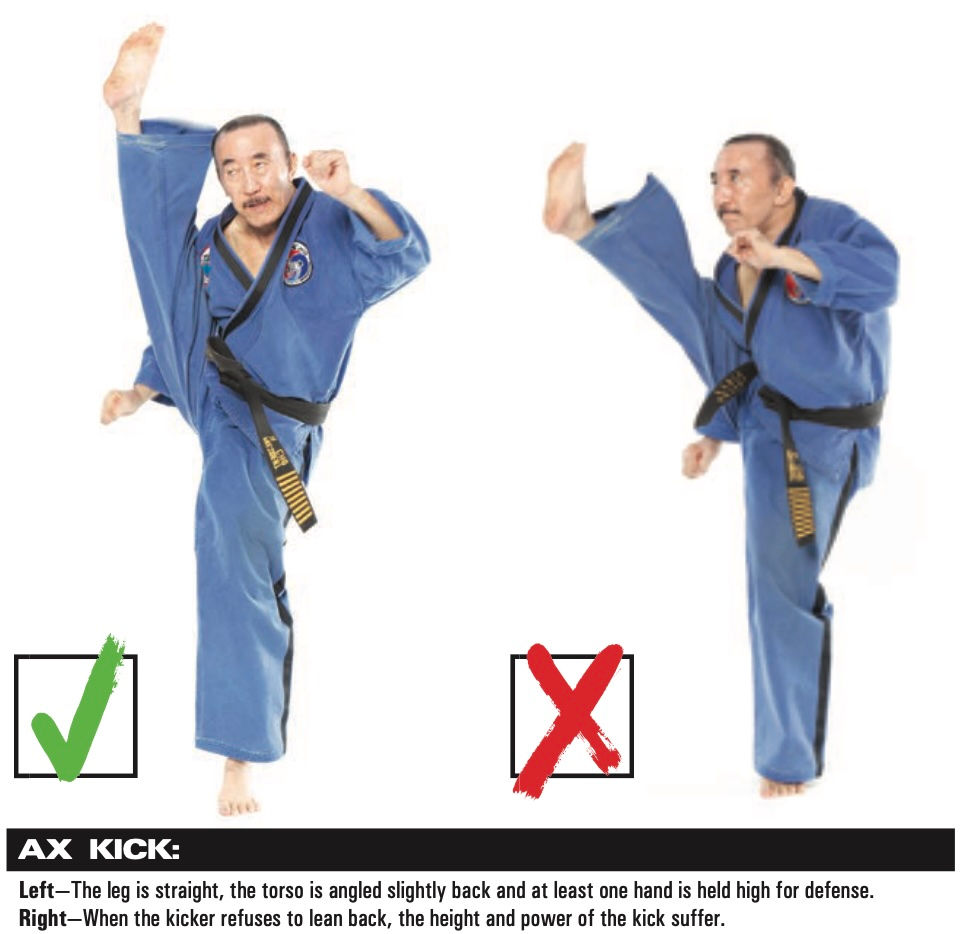
AX KICK
Don’t: “Many people try to use only their leg for this kick,” Cho says. “They try to pick it up without putting their hips into the motion. They drop both their hands, which may be OK in a tournament where they don’t use a lot of punches, but if they do it on the street, they can get knocked out.”
Do: “Lean your upper body slightly backward as you jerk your leg down after raising it,” he says. That will enable you to activate opposing muscles in your back. “It also will let you reach a few inches higher and farther out with the kick because you’ll be pushing your hip forward at the last minute. Your other hip will go backward at the same time.”
Hit: The striking surface depends on how far away your opponent is, Cho says. “You can use the bottom of your foot to hit his face. You can use your heel—or your calf, if he’s really close—to hit his collarbone. The important thing is to not be locked in to one way of doing it and thinking you have to hit with a certain body part.”
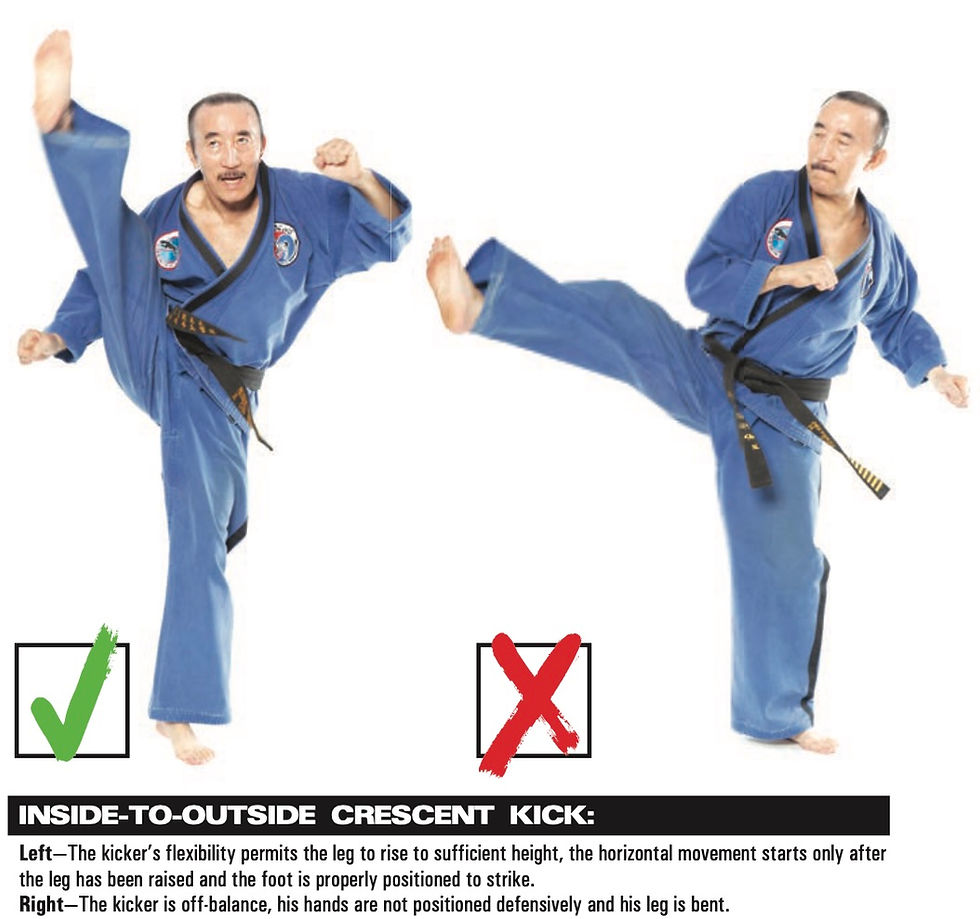
INSIDE-TO-OUTSIDE CRESCENT KICK
Don’t: “People often try to initiate the circular motion of this kick from the very beginning, which means they end up using only their leg to generate speed and power,” Cho says. “Another problem is they think the head is the only target.”
Do: To make this crescent kick work, treat it like an ax kick, Cho says. “Raise your leg first and then start swinging it along that curved path. Use your hips and waist for torque. Most of the time, your leg will be straight for the entire kick, but don’t think it has to be that way. There might be a slight bend while it’s moving upward, which can make it faster to snap it out and hit someone who’s close.”
Hit: “Once again, you have choices,” he says. “You can use the edge of your foot or the outside bony part of your ankle. Up close, you can even hit with the outside of your lower leg. It’s best to aim for the head, but the kick also works if you hit the solar plexus, chest or groin, especially with the edge of the foot.”
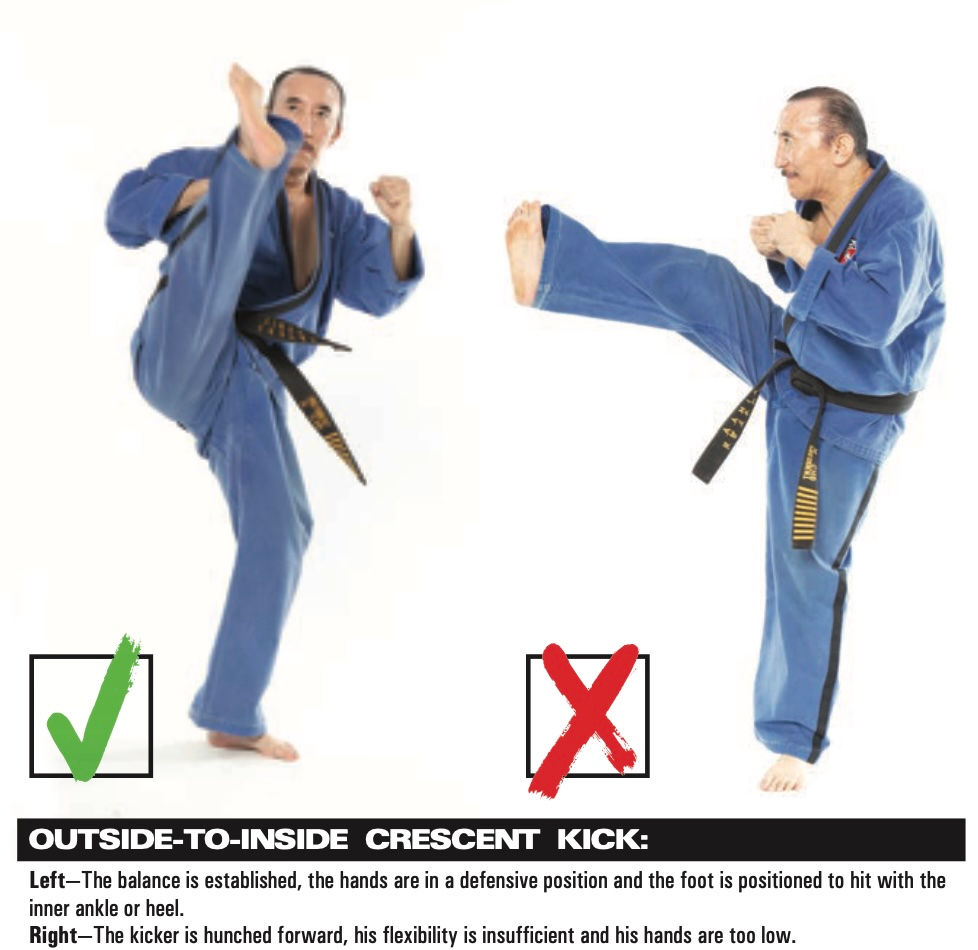
OUTSIDE-TO-INSIDE CRESCENT KICK
Don’t: The most common problem Cho has seen is starting the circular motion as soon as the kicking leg leaves the ground.
Do: “Raise your leg before initiating the swing,” he says. “Go up, across and then down—similar to the ax kick. That will make this crescent kick strong and fast.”
Choose: Whether you use the outside-to-inside crescent kick or its inside-to-outside brother depends on your opponent’s stance and orientation. You’ll want to make the majority of your attacks to the front of his body. If you’re in a right lead and he’s in a left lead, that means an outside-to-inside crescent with your left leg or an inside-to-outside crescent with your right leg will work best. “Of course, he can see both kicks before they make contact, so it’s easy for him to block,” Cho says. “If you want to come in from his blind side, use an outside-to-inside crescent with your right leg.”
Hit: No matter how you implement it, strike with the bottom of your foot or the inside anklebone. “If you hook it a little bit by bending your leg just before you make contact, you can use the side of your heel,” he adds.
Bonus: That hooking, by the way, creates a technique that’s sometimes called the inner hook kick. “It’s a fast strike that uses the heel to hit the body or sweep the leg,” Cho says. “It’s often used as a lead-in for a side kick.”
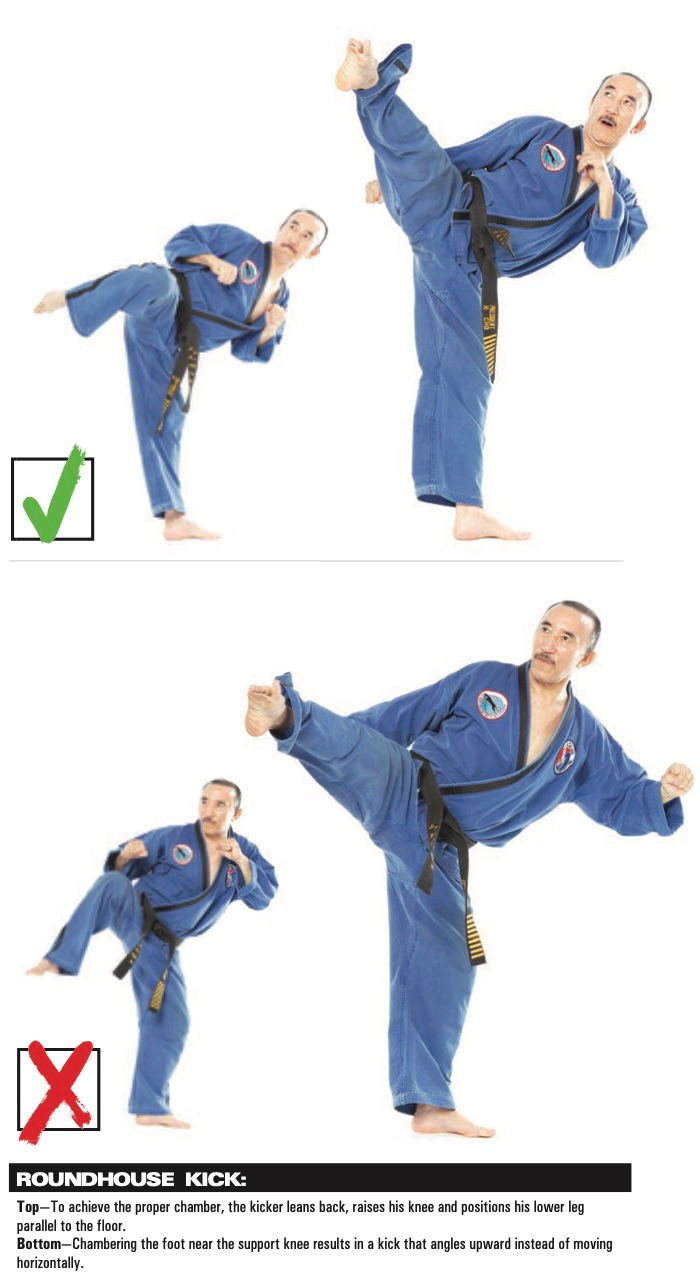
ROUNDHOUSE KICK
Don’t: “If you fail to chamber your leg properly, it will look like you’re doing the roundhouse with a straight leg,” Cho says. “The problem is, you’ll be kicking in a mostly upward direction as opposed to across. Another problem is people often divide the kick into segments—they separate the pivot, the chamber, the leg extension and so on.”
Do: “Bend your knee when you chamber the kick,” he says. “Make the lower portion of your leg parallel to the floor—you’ll need hip flexibility to do that. Make sure your foot travels roughly horizontally with one hip moving forward and the other backward. That will give you power and speed. All that power, by the way, comes from the pulling-pushing motion, which should be smooth and natural. As you improve, the chamber and the pivot will happen at the same time.”
Hit: The traditional method entails striking with the ball of your foot for self-defense or breaking purposes, Cho says. “In that case, chamber your leg with your foot angled and toes pulled back. Nowadays, however, many competitors can hit just as hard with their instep—even though they’re not thinking ‘one-strike kill.’ They chamber with their foot and toes extended.”
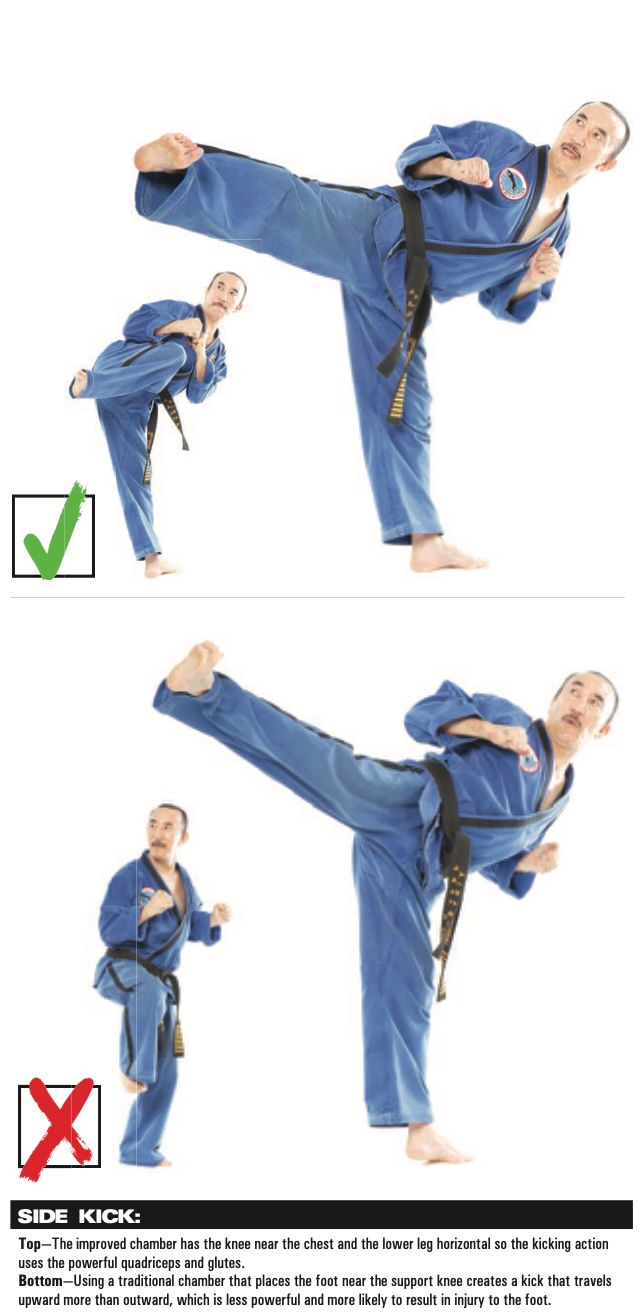
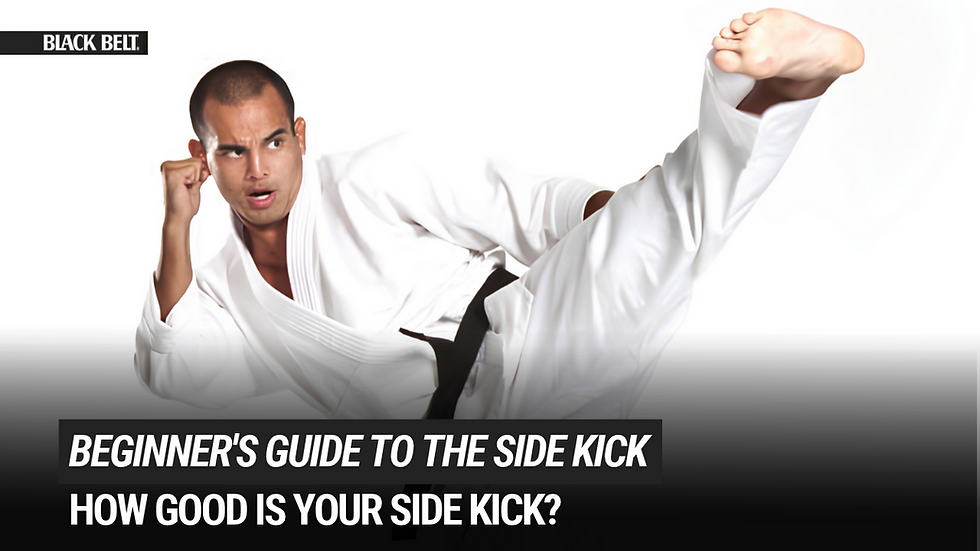
SIDE KICK
Don’t: “The chamber is the most common problem,” Cho says. “The traditional way is to raise your foot and place it near the knee of your support leg. For the beginner, lifting the leg only to knee level may be easier to accomplish; however, this method may lead to raising the foot upward into your opponent’s elbow, which can injure your instep or toes. While an incorrect chamber may be initially easier, it is not as effective—it’s much like punching with your fist near your hip instead of near your shoulder.”
Do: For the improved chamber, place your knee as close to your chest as possible and your foot high with your lower leg parallel to the ground, he says. “Then the kick becomes like standing up from a squat. Using those muscles allows you to generate the most power. Forget about that traditional chamber in which your foot first goes to your support knee; instead, go right into the improved chamber. Don’t be afraid to lean back while doing this.”
Hit: It’s OK to use your heel or the edge of your foot, but most of the time, it’s the bottom of your foot that gets the job done, Cho says. “For breaking, though, it’s definitely the heel.”
Bonus: “Using the improved chamber, you can execute a side kick into the body of an opponent who’s much closer,” he says. As the master always reminds his students, winning is all about being flexible—mentally and physically.
Photos by Robert Reiff