top of page

Bruce Lee and Flexibility

Bruce Lee and Flexibility

Bruce Lee and Flexibility

No matches found.

  View all results

Black Belt Mag on WhatsApp
Two martial artists in white gis practicing a throw in a dojo. Text reads "EXPERT ADVICE FOR ALL MARTIAL ART TEACHERS!" on black.
Black Belt Plus

You've Learned Your Kata. Now It's Time to Modify Them So You're Better Prepared to Defend Yourself Against Any Adversary!


When facing a real attack, creativity and quick thinking are critical for survival. The problem is that, in moments of stress, most people tend to fall back on a single, familiar response—whether it’s worked in the past or not.


This tendency is one of the main challenges martial artists must overcome, and the goal of martial arts training is to help you avoid it. Training in martial arts is designed to develop your ability to solve a variety of tactical problems during a crisis.


This process cultivates several key attributes, with mental flexibility being the most important. Interestingly, traditional self-defense arts help foster this mental flexibility through kata.
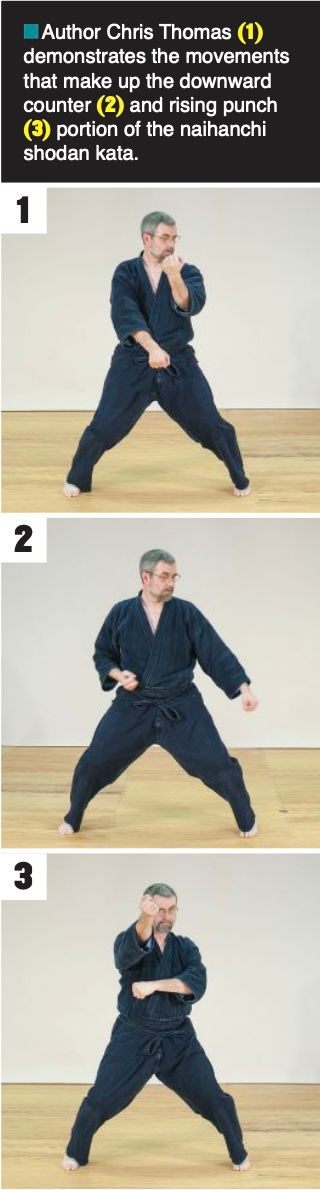


A man in black martial arts attire demonstrates kata moves in three panels, performing downward counter and rising punch in a dojo.


Combat the Old Way

Kata have been a core element of martial arts training for hundreds of years. What makes them such an effective learning tool is often what’s overlooked in many modern schools today, where forms are treated like a mere curriculum requirement.


However, classical kata are composed of actual self-defense techniques based on solid fighting principles.


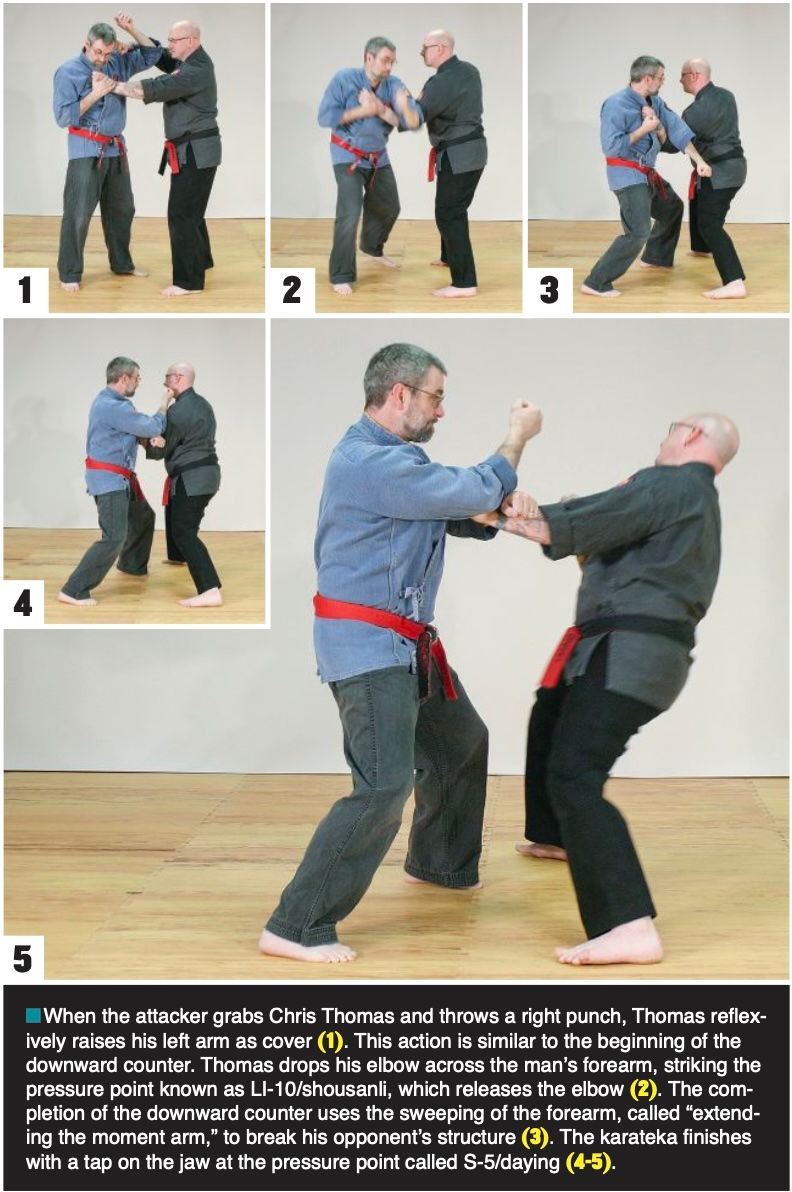
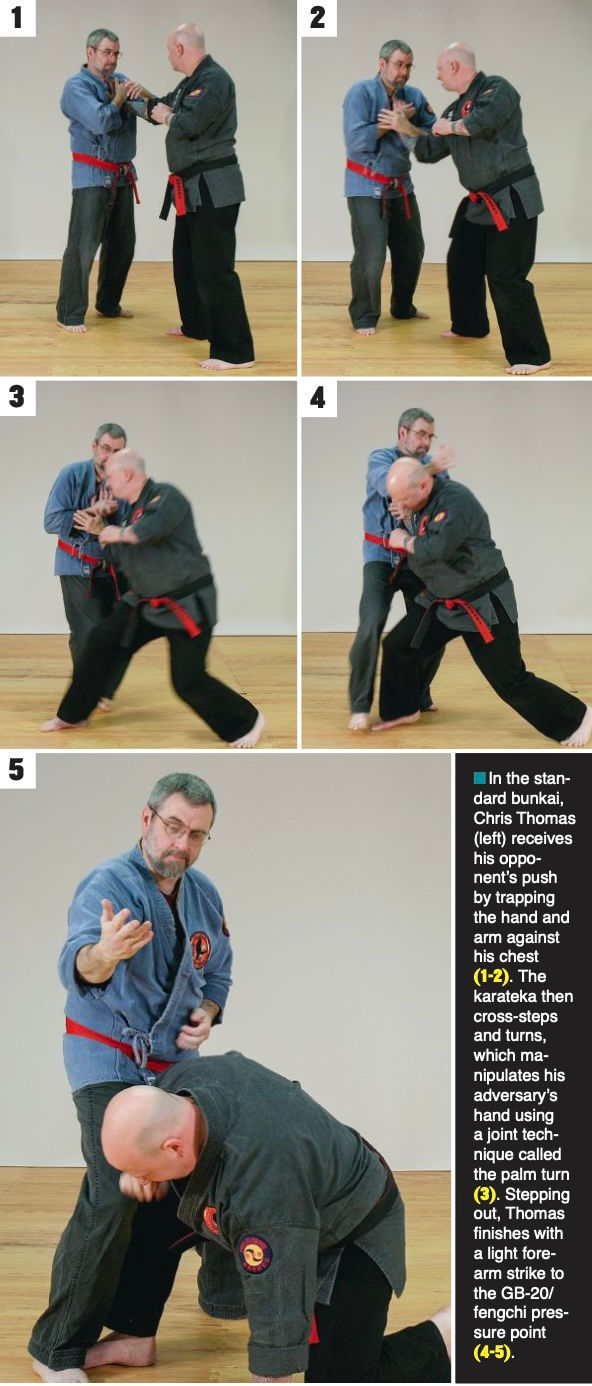
To truly improve your proficiency, you must begin to practice your forms “for real.” This means not only performing kata solo but incorporating bunkai—two-person applications practice—into your training.


Two martial artists practice techniques in sequence on a wooden floor, photographed from multiple angles. They wear red belts. Text explains moves.

Some practitioners claim to practice bunkai, but they’re missing the mark if their practice involves defending against stylized attacks that don’t mirror what they might face in a real-world encounter. Similarly, they’re misled if they rely on distance and anticipation in response to these stylized attacks.


True bunkai involves applying the movements from kata to real forms of aggression.


Note: To test whether you're practicing true bunkai, have your training partner attack with intensity and realism. If your response doesn’t work under these conditions, it’s probably not true bunkai.


Changing Tradition

When kata training is approached correctly, you begin to uncover a simple, realistic, and usable interpretation for every movement in the form.


Each movement is linked to a real-world response to a likely attack, and the kata are generally taught with the assumption that the attacker is roughly the same size as the defender.


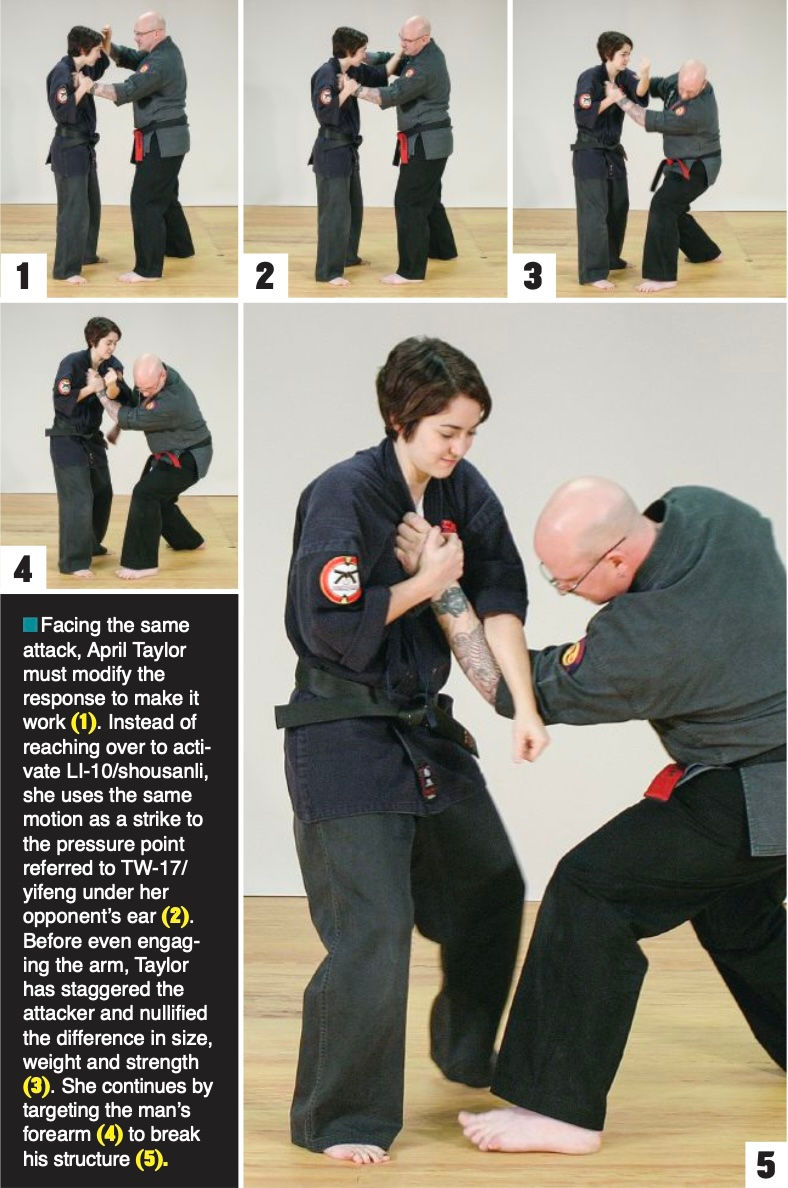
But what if you’re a 5-foot-6-inch, 125-pound woman training in a dojo filled with 6-foot-tall, 200-pound men? Clearly, the standard techniques may not always be effective as taught.


This is where kata training’s true value lies. The first key is understanding that kata are practical and that their practicality is fully expressed through realistic bunkai. The second key is recognizing that effective bunkai is ultimately about understanding and applying the underlying principles of a technique. In other words, mastering one kata move gives you one solid technique, but understanding the principles behind that move opens up a thousand variations.

Two martial artists in black gis demonstrate a self-defense technique in a dojo, focusing on joint manipulation and pressure points. Text instructs the sequence.

So, how can kata be taught and practiced in a way that maximizes both usefulness and conceptual understanding?


The answer lies in giving yourself permission to think creatively about forms and to develop a variety of bunkai that work for you. You need to be free to experiment in the dojo.


A martial artist performs Naihanchi Shodan kata in three steps on a wooden floor, wearing a black gi with a red emblem, showcasing focus.


Experimenting with Kata

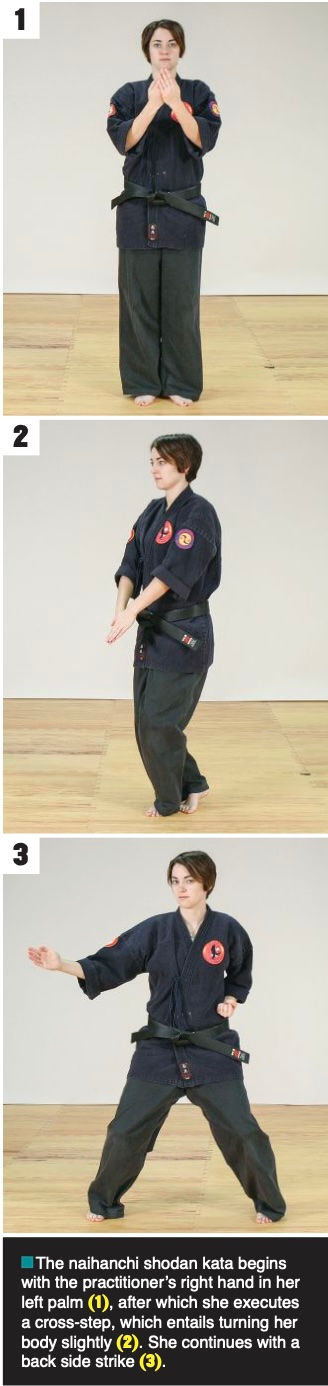
There are many ways to experiment with kata to make it more applicable for self-defense. A simple method to get started is to change the timing and emphasis of movements. Take the downward counter (gedan-uke), for example.


The typical emphasis is on the downward strike, but if you instead focus on the beginning of the movement when your hand comes up near your opposite ear, you may discover another striking action hidden within the form.


In this case, your downward counter isn’t a low strike moving away from your body—it becomes a rising strike directed toward your body.


Another way to experiment is by working backward: Start with bunkai you already know and apply it to a different-sized or differently-abled opponent. Pay attention to any modifications you could make to execute the technique more effectively. Once you’ve identified a useful modification, try applying it to your solo kata performance.


The key is to allow yourself to think freely and creatively. Experimenting with kata becomes a form of self-expression, which leads to creative thinking and the discovery of new self-defense principles.


This, in turn, helps you develop the skills to solve tactical problems and devise effective solutions when facing stress or danger.

Two martial artists in blue and black uniforms demonstrate a defensive technique sequence in a dojo, involving joint manipulation. Text describes moves.

Not Abandoning Tradition

Some traditional practitioners may resist the idea of modifying kata, fearing that it implies abandoning the "orthodox" form, which is central to many martial arts philosophies. However, modifying a kata doesn't mean you’re discarding tradition. In fact, it's a valuable practice to first learn the orthodox kata, then perform a personalized version of the same form.


There’s also concern among some instructors that allowing students to personalize the art could create confusion. But imagine the benefits if students were taught to think critically and creatively on their own, rather than simply parroting the teacher’s movements.


They would gain much more from each class, especially when struggling to make a technique work. Instead of following rigid forms, students could modify movements to find alternative methods that suit their own abilities. This freedom to adapt could solve a number of common dojo problems.


For example, students often think there's only one "right" way to perform a movement, but this can lead them to force the technique through sheer strength, sacrificing proper form.


When students are encouraged to adapt techniques to their own body mechanics, they begin working independently to improve their overall martial skills.
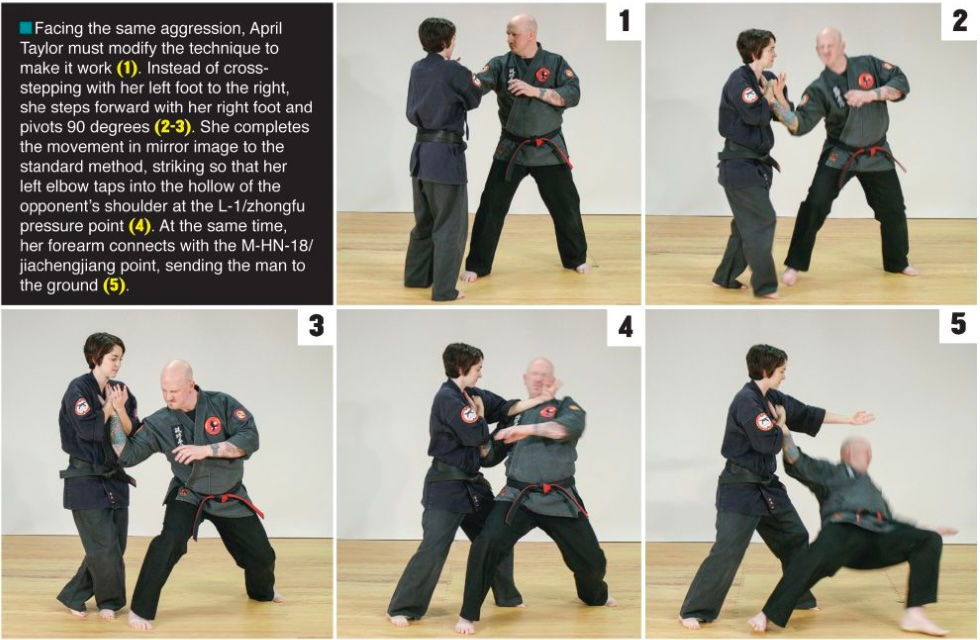

Five images show martial artists in black uniforms demonstrating a self-defense technique on a wooden floor. A woman takes down a man.

Solving Additional Dojo Problems

Another common challenge in many dojos is the gender disparity—karate is often a male-dominated activity, especially among adults.


Yet, if you look at kids' classes, the gender mix is much more balanced. Why do some girls quit karate as they get older?


There’s no single cause, but one contributing factor is that girls aren’t taught how to adapt techniques to work for their bodies. Early on, when boys and girls are about the same size, most techniques work for everyone.

However, as they grow older and the disparity in size becomes more apparent, girls may find they can no longer muscle their way through techniques against larger male partners.


Unfortunately, many instructors don’t have the time to teach every student a different variation of each technique to make it work for them. This is where the freedom to experiment with kata becomes invaluable.


By allowing students to modify their kata, especially in bunkai, girls (and anyone else who might face size or strength challenges) can adapt their techniques and continue to train effectively.


A bonus benefit of this approach is that it also helps resolve the issue of training partners who may not always attack “helpfully,” especially when the male partners try to overpower female students.


When students have been taught how to modify their kata for different circumstances, they are better prepared to adapt to unpredictable situations while still utilizing the framework of the kata.


For students who embrace this approach, kata becomes a dynamic tool, something that can be manipulated and shaped to fit a wide variety of combative circumstances. These students will be better prepared to think on the spot, adapt their techniques in real-time, and improve their sparring skills by learning to think outside the box.


In a self-defense situation, they’ll be less likely to freeze when a standard technique doesn’t work. The most important skill in combat is the ability to think clearly—and kata, when practiced creatively, is the perfect tool for developing that skill.


April Taylor is a 31-year-old practitioner of Ryukyu kempo, a 5-foot-6-inch, 125-pound woman who trains routinely with 200-pound men. Chris Thomas is a long-time martial artist whose articles have appeared in Black Belt magazine since 1981. He’s also April’s father.



More From Traditional Arts
Rectangle 24

3 Historical Self Defense Methods for Becoming a More Alert Martial Artist

Rectangle 24

Johnny Elben vs Fabian Edwards Added to "Battle of the Giants" Main Card for October 19 on PPV

Cover Story Throwback: Colonel Nattapong Buayam

Cover Story Throwback: Colonel Nattapong Buayam

Forged in Okinawa: The Journey of Arcenio Advincula

Forged in Okinawa: The Journey of Arcenio Advincula

Inside San Da: Kicks, Punches, Throws, and Everything Between

Inside San Da: Kicks, Punches, Throws, and Everything Between

Jeet Kune Do’s Kickboxing Phase: How Joe Lewis Took Bruce Lee’s Concepts Into the Ring

Jeet Kune Do’s Kickboxing Phase: How Joe Lewis Took Bruce Lee’s Concepts Into the Ring

Bruce Lee's Gift of Freedom

Bruce Lee's Gift of Freedom

Rectangle 24

Cage Warriors 177 & Cage Warriors 178 Final Card and Broadcast Times

Rectangle 24

3 Historical Self Defense Methods for Becoming a More Alert Martial Artist

Rectangle 24

Celebrating Keith Cooke’s Birthday: Top 5 Must-Watch Movies of the Martial Arts Legend!

Rectangle 24

Updated UFC Rankings | Week of September 16, 2024

Rectangle 24

Secrets Revealed: Jean Jacques Machado on Taking Your Brazilian Jiu-Jitsu to the Next Level

Latest

Secrets Revealed: Jean Jacques Machado on Taking Your Brazilian Jiu-Jitsu to the Next Level

3 Historical Self Defense Methods for Becoming a More Alert Martial Artist

Updated UFC Rankings | Week of September 16, 2024

Johnny Elben vs Fabian Edwards Added to "Battle of the Giants" Main Card for October 19 on PPV

Celebrating Keith Cooke’s Birthday: Top 5 Must-Watch Movies of the Martial Arts Legend!

Author

Publishing Date

Read Time

Share

April Taylor and Chris Thomas

February 12, 2025

1

5 MINS

Link Copied

SAVE ARTICLE

More From Traditional Arts
Rectangle 24

3 Historical Self Defense Methods for Becoming a More Alert Martial Artist

Rectangle 24

Johnny Elben vs Fabian Edwards Added to "Battle of the Giants" Main Card for October 19 on PPV

Cover Story Throwback: Colonel Nattapong Buayam

Cover Story Throwback: Colonel Nattapong Buayam

Forged in Okinawa: The Journey of Arcenio Advincula

Forged in Okinawa: The Journey of Arcenio Advincula

Inside San Da: Kicks, Punches, Throws, and Everything Between

Inside San Da: Kicks, Punches, Throws, and Everything Between

Jeet Kune Do’s Kickboxing Phase: How Joe Lewis Took Bruce Lee’s Concepts Into the Ring

Jeet Kune Do’s Kickboxing Phase: How Joe Lewis Took Bruce Lee’s Concepts Into the Ring

Bruce Lee's Gift of Freedom

Bruce Lee's Gift of Freedom

Rectangle 24

Cage Warriors 177 & Cage Warriors 178 Final Card and Broadcast Times

Rectangle 24

3 Historical Self Defense Methods for Becoming a More Alert Martial Artist

Rectangle 24

Celebrating Keith Cooke’s Birthday: Top 5 Must-Watch Movies of the Martial Arts Legend!

Rectangle 24

Updated UFC Rankings | Week of September 16, 2024

Rectangle 24

Secrets Revealed: Jean Jacques Machado on Taking Your Brazilian Jiu-Jitsu to the Next Level

Latest

Secrets Revealed: Jean Jacques Machado on Taking Your Brazilian Jiu-Jitsu to the Next Level

3 Historical Self Defense Methods for Becoming a More Alert Martial Artist

Updated UFC Rankings | Week of September 16, 2024

Johnny Elben vs Fabian Edwards Added to "Battle of the Giants" Main Card for October 19 on PPV

Celebrating Keith Cooke’s Birthday: Top 5 Must-Watch Movies of the Martial Arts Legend!

900x150px - v1 1

MAGAZINES

Learn More

Untitled.png
Untitled.png
image
image

BLACK BELT +

MAGAZINES

2021 - 2023

0605BBC1_page-0001.jpg
image
image
image
image
image
image
image
image

2021-2025

2011-2020

2001-2010

1991-2000

1981-1990

1971-1980

1961-1970

2020 - 2011
2010 - 2001
2000 - 1991
1990 - 1981
1980 - 1971
1970 - 1961
3 - Article Page

Stop Freezing Under Pressure: The Simple Trick That Transforms Your Kata Into a Self-Defense Weapon!

Historic All-African Showdown, Arab MMA Legend's Return, and Undefeated Stars Collide!

image 14

Porttitor rhoncus dolor purus non enim praesent elementum. Eget dolor morbi non arcu risus quis varius. Posuere ac ut consequat semper viverra nam libero. In ornare quam viverra orci sagittis eu. Tristique risus nec feugiat in fermentum posuere urna nec. Tempus quam pellentesque nec nam aliquam sem et. Convallis a cras semper auctor neque vitae tempus quam pellentesque. Sollicitudin ac orci phasellus egestas tellus rutrum tellus pellentesque. Sed egestas egestas fringilla phasellus faucibus scelerisque eleifend donec pretium. Sit amet porttitor eget dolor morbi non arcu risus. Justo eget magna fermentum iaculis eu non diam phasellus. Sit amet luctus venenatis lectus magna fringilla. Neque vitae tempus quam pellentesque nec nam.

Tellus orci ac auctor augue mauris augue neque gravida. Tempus imperdiet nulla malesuada pellentesque elit eget gravida cum sociis. Id eu nisl nunc mi ipsum faucibus vitae aliquet. Duis convallis convallis tellus id interdum velit laoreet id. Vulputate mi sit amet mauris commodo quis. Semper viverra nam libero justo laoreet sit amet. Eget nullam non nisi est sit. Nibh cras pulvinar mattis nunc sed blandit libero. Ac felis donec et odio pellentesque diam volutpat. Quis varius quam quisque id diam vel quam elementum. Felis bibendum ut tristique et egestas quis ipsum suspendisse ultrices. Id diam vel quam elementum pulvinar etiam non. Non consectetur a erat nam at lectus urna duis convallis.

Est pellentesque elit ullamcorper dignissim. Consectetur a erat nam at. Blandit libero volutpat sed cras ornare arcu. Iaculis urna id volutpat lacus laoreet. Tincidunt ornare massa eget egestas purus viverra accumsan in. Viverra ipsum nunc aliquet bibendum enim facilisis gravida neque.

Vitae turpis massa sed elementum tempus egestas sed. Quam lacus suspendisse faucibus interdum posuere lorem ipsum. Viverra justo nec ultrices dui sapien eget. At risus viverra adipiscing at in tellus integer feugiat. Elementum eu facilisis sed odio morbi quis commodo. Arcu cursus vitae congue mauris rhoncus aenean. Auctor elit sed vulputate mi sit amet mauris commodo quis. Lectus sit amet est placerat in egestas erat imperdiet sed. Eu mi bibendum neque egestas congue quisque. Sit amet luctus venenatis lectus magna fringilla urna porttitor. Pretium vulputate sapien nec sagittis aliquam malesuada bibendum arcu. Sed ullamcorper morbi tincidunt ornare massa eget egestas purus. Pharetra vel turpis nunc eget lorem. Morbi blandit cursus risus at ultrices mi tempus imperdiet nulla. In metus vulputate eu scelerisque felis imperdiet. Elementum pulvinar etiam non quam lacus suspendisse. Sem fringilla ut morbi tincidunt augue. Id venenatis a condimentum vitae sapien. Varius quam quisque id diam vel.

Nec feugiat in fermentum posuere urna nec tincidunt praesent semper. Aliquam nulla facilisi cras fermentum. Quam elementum pulvinar etiam non quam lacus suspendisse faucibus interdum. Neque vitae tempus quam pellentesque nec. Interdum consectetur libero id faucibus nisl tincidunt eget nullam. Mattis enim ut tellus elementum sagittis. In fermentum et sollicitudin ac orci phasellus. Est sit amet facilisis magna etiam tempor orci. Lacinia at quis risus sed vulputate odio ut. Egestas egestas fringilla phasellus faucibus scelerisque eleifend. Nunc pulvinar sapien et ligula ullamcorper malesuada proin libero. Aenean vel elit scelerisque mauris pellentesque. Gravida arcu ac tortor dignissim. Ac tortor dignissim convallis aenean.
The greatest glory in living lies not in never falling, but in rising every time we fall.

Nelson Mandela

bottom of page