Much Emphasized, Yet Least Discussed
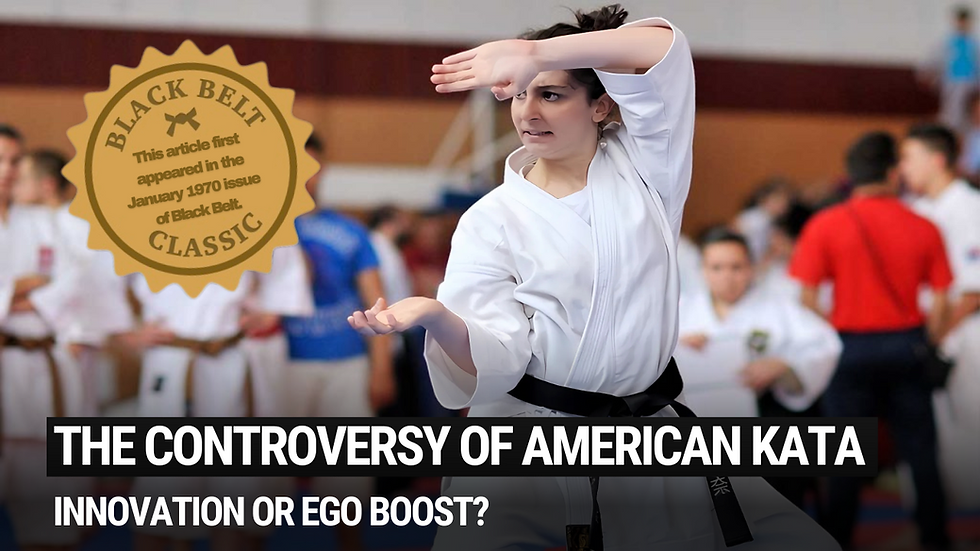
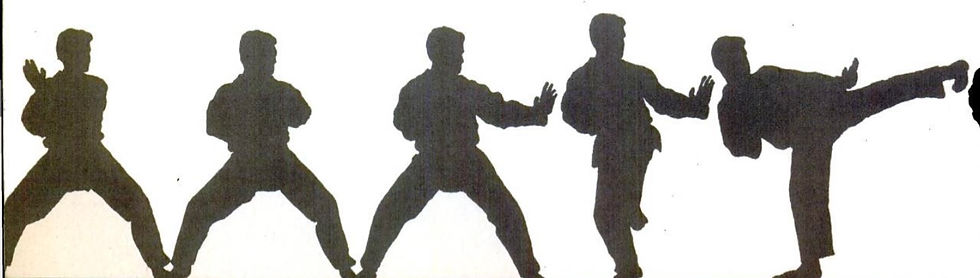
One of the most emphasized yet least talked about karate techniques is kata—the dance-like series of stances and moves used to master form, agility, and speed.
Recently, kata has been spotlighted by controversy; not as to its intrinsic value, but whether new forms finding their way onto exhibition floors can be considered of serious value to the world of karate.
To the spectator, kata is a ballet-like form of shadow boxing that can be rhythmic and as powerful as modern dance. Within the past few years, kata has undergone mutations that have given it a distinctly American flavor.
A steady flow of kata competitors has demonstrated a definite trend away from traditional forms. Some practitioners have even gone so far as to use tomahawks and loin cloths to emphasize the Americanization of kata.
The Divide Between Traditionalists and Reformers
To the karateka steeped in the Oriental genre of kata, these "American pioneers" seem to have taken liberties without fundamental concern for kata, nor with enough karate background to create or originate new forms of this technique. Traditionalists believe these reformers didn’t know enough about kata to begin with, so they had to improvise to avoid looking bad in their students’ eyes.
On the other hand, reformers attempting to implant their own systems of kata into the American karate scene argue that their American kata was created for the individual needs of Westerners, taking into account height, weight, arm, and leg reach.
The proponents of new kata seem to feel this is the natural course toward the Americanization of any sport, believing the U.S. public cannot assimilate a foreign art without such modifications.
The Black Belt Survey Results
In a recent exclusive BLACK BELT survey discussing the value of these "unique" forms of kata, leading sensei polled responded with a three-way split. Of the replying sensei:
30% felt American kata had value and basis in karate
30% stated it definitely had no value nor basis
Another 30% qualified their answers with a yes-no response
The remaining 10% had "no comment."
Voices from the Karate Community
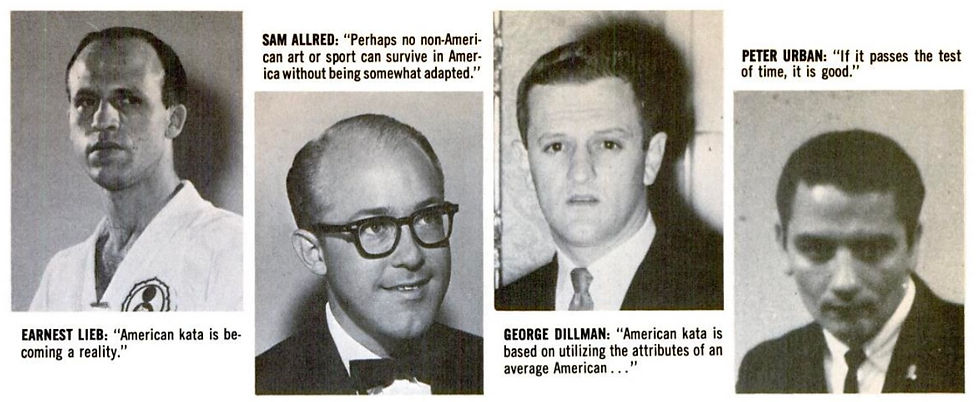
Earnest Lieb of the American Karate Association strongly believes American kata holds significant value: "They are designed for individual needs. Since Americans are made up of all sizes, kata should be designed for different individuals, not for the majority with the hope all persons are alike."
Lieb adds, "American kata is becoming a reality. After all, why do Korea, Okinawa, and Japan have the right to develop their own when the originality and development took place in China?"
Duke City’s Sam Allred aligns himself with this view, saying, "Perhaps no non-American art or sport can survive in America without being somewhat adapted for the cultural, mental, and physical aspects of the American himself. The efforts of many Americans are already being strongly felt insofar as their 'Americanizing' influence on technique and competition are concerned, both in judo and karate. These American karateka with sufficient training, knowledge, experience, and creativity to develop kata will surely make contributions which will properly promote karate as an accepted American activity."
Detriment or Contribution?
However, Allred emphasizes: “This is not to imply American kata could be generally superior to Oriental kata, which has taken many years to evolve. Kata, developed by sensei to substitute for their lack of knowledge of already-existing kata, seeking to drastically change or eliminate Oriental concepts, can only be a detriment to karate in America.”
From Pennsylvania George A. Dillman places himself squarely in the yes column and agrees with Lieb on one point: “I think the most direct comparison would be between the body structure of the American and the Oriental karate player. American kata is based on utilizing the attributes of an average American, i.e. height, weight, arm and leg reach; Oriental kata emphasizes speed and agility.”
Prefacing this statement, Dillman explains “I feel the value of American kata is the demonstrated interest and participation the American karate player feels toward the art. America is the only ration outside of the Orient where a determined effort is being made to create new, individually styled American kata. This reflects how great an impression and in-road karate has made on the American public.”
New York-based Peter Urban uses a few analogies to agree in concept with Lieb, Allred and Dillman: “Inferior American products are no more insignificant than inferior Oriental products. If it passes the test of time, it is good. In general, it seems an Oriental kata has been improved in America in precisely the same way American and German optic and electronic developments have been improved in Japan.
It is the performance of kata by the individual performer that determines the quality and not just the construction of the kata itself. We speak English in America, but it is not the same English spoken in Great Britain. Yet, for all intents and purposes it is the same language and we can communicate. It is the same with kata.”
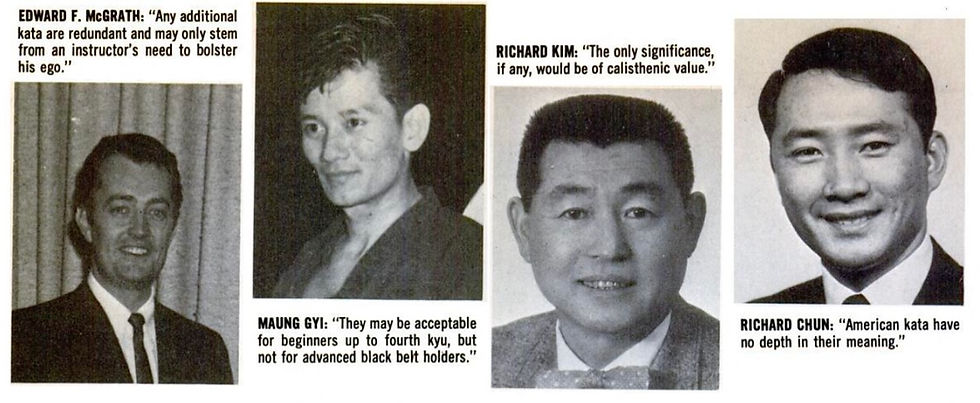
Contrasting the pro arguments, Edward F. McGrath agrees “American kata I have seen has merit in one factor: it is designed for our times and bodies.” However, McGrath disagrees with new forms of kata because timing and individual adjustments to kata “can be accomplished through proper interpretation of the Oriental kata to fit individual physique and moves.”
Thoroughly down on the reformists, McGrath feels the new kata forms have no significant value other than a means of self- expression: “Kata brought from the Orient embodies every block, punch or kick which could effectively be utilized against a single or multiple attack. Therefore, I feel any additional kata are redundant and may only stem from an instructor’s need to bolster his ego. We have already lost too much respect and good manners which accompany tradition.”
Maung K. Gyi of Millfield, Ohio agrees in principle with McGrath but he emphasizes smooth transition, proper construction and kinetic balance: “I had an opportunity to watch about 30 or 40 kata in numerous karate tournaments which were created by some American instructors. I am sorry to say I was terribly embarrassed. They may be acceptable for beginners up to fourth kyu, but not for advanced black belt holders.
“I spotted lack of proper transition from one movement to another and lack of proper construction of techniques — hands and feet, and lack of balance in the kata themselves.”
Using a grammatical analogy to define kata, Gyi states: “To me kata is like poetry in motion. Correct syntactic, grammatical, sentence structures, and appropriate words are needed to convey a central theme.
American-created kata have too many themes, often represented by inappropriate words and loose transitions. If there is this lack of balance in grammatical composition, sentence and syntactic structure, the reader is quite confused as to its meaning.”
Richard Kim, sensei from San Francisco, feels reformed kata may have some value, but: “The only significance, if any, would be of calisthenic value; from that viewpoint, any exercise is better than no exercise at all.”
Feeling some American sensei may be presumptuous in their attempts to evolve new kata, Kim reminds them, “Only a meijin can create a kata. A meijin is one who has gone beyond the highest degrees of proficiency in his art. He is one who has achieved kensho. He is more than an expert or a specialist. There are no meijin in America and the last karate meijin was Funakoshi Gichin.”
Going up to a metaphysical plane, Kim defines kata as “a unique method of religious practice with the aim of bringing the student to a direct intuitive realization of reality. It is meant for the body to be forged into a total instrument for realization of the ‘Absolute Mind’. Kata is not a manifestation of logical reasoning as Americans have superficially mistaken it to be.
Kata brings the student by degrees, by complete transcendence, emancipation, total penetration and identical attainment to ‘Do’ or ‘Tao’. Since the master cannot transmit his kensho, he uses kata to bring the student to the same state of ‘illumination’ he has attained.”
In an apparent attempt to counter Kim’s metaphysical phraseology, NYC’s Urban comments, “American instructors utilize systematic logic and creative imagination to produce kata, music, art or technology, the same as other masters. It has been said Western Man cannot achieve nirvana nor satori and Oriental ethnic backgrounds are the best for the martial arts. What archaic nonsense!”
Discounting the philosophical argument entirely and dissecting American kata technically, Richard Chun of New York concurs with San Francisco’s Kim on the meijin point especially. “If kata are made-up by qualified masters who can devote a great deal of time to research and create new forms, then they may be useful. But American kata has no depth in their meaning because they are not made up by qualified masters.”
Pointing out drawbacks to both traditionalists and reformists, Chun states simply: “Oriental kata is very often too conservative and traditional. There are too many hand techniques and not enough foot techniques in form. But American kata lacks training, speed, balance and gracefulness; often looking like it was made only for combative purposes.”
Although many sensei responded with a yes-no answer, in the main they were negative to kata’s embryonic seeds of change.
However, Ki Whang Kim of New York and Jhoon Rhee of Washington, D.C. kept an open view to new forms based on sound philosophy and technology. Ki Whang Kim’s definition of kata, in this writer’s opinion, is explicit and exceptional.
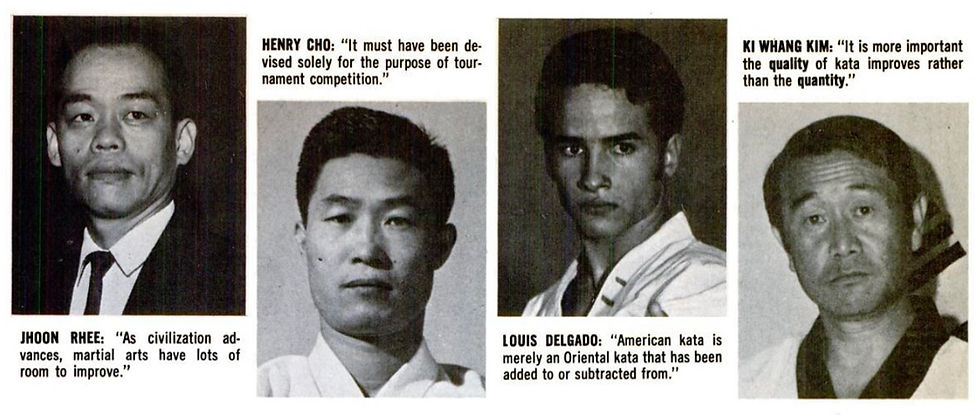
In Jhoon Rhee’s opinion, “As civilization advances, martial arts have lots of room to improve. So, in the future we may need some improved forms, either by Americans or Orientals. It does not only have to be Orientals. But what I have seen so far has been merely duplication of existing movements with different combinations.
Albert Gotay of Queens, New York, feels in some cases kata created by Americans does have significant value: “Although American kata appears to have been created merely for convenience, I have seen others that are outstanding. Kata is not created but merely evolves as the natural product of years of training and experience coupled with dynamic personality and divine enlightenment.”
Henry Cho of Karate Institute in New York states he has not seen this “so-called American kata.” From the questionnaire sent to Cho, he does condemn such forms as lacking in originality because American kata must merely be a collection of borrowed techniques. “American kata cannot represent a style or system,” says Cho. “Rather, it must have been devised solely for the purpose of tournament competition,” thus agreeing with Chun.
Must Be Kept Legitimate
Recently moved from New York to California, Louis Delgado joins the middle-of-the-roaders but agrees in principle with the words of Cho, saying: “It demonstrates Americans’ ability to coordinate advanced moves but has no value from a karate point of view because kata form must be performed and kept legitimate. It must be kept pure and is one art that will surely lose its value if it were to be changed. What people refer to as American kata form is merely an Oriental kata that has been added to or subtracted from.”
Tossing his hat into the ring, Ki Whang Kim takes an open, ready stance of a semanticist, and concisely defines kata as “a sequence of techniques involving defensive and offensive movements, which must of course be systematic and based upon karate punching, kicking, striking and stances. This involves total karate technique and principles.
In other words, kata must consist of sequential movements against imaginary opponents, with the student returning to his original position as he finishes. If kata does not stand on this principle, it cannot possibly be construed as kata, but rather a moving form of gymnastics.”
Continuing, Kim explains his philosophy: “Karate is kata, and kata is karate, with kata being the essence and life of karate. Now is an excellent time for each instructor to evaluate kata, its being and purpose. If we call kata correct when it is not based on the original principles, then we will be dealing a serious blow to karate and its future.
However, karate must progress further and we must therefore receive and accept American originated kata, providing it is based upon the principles of karate. It is more important the quality of kata improves rather than the quantity.”