Updated: Jan 14, 2025

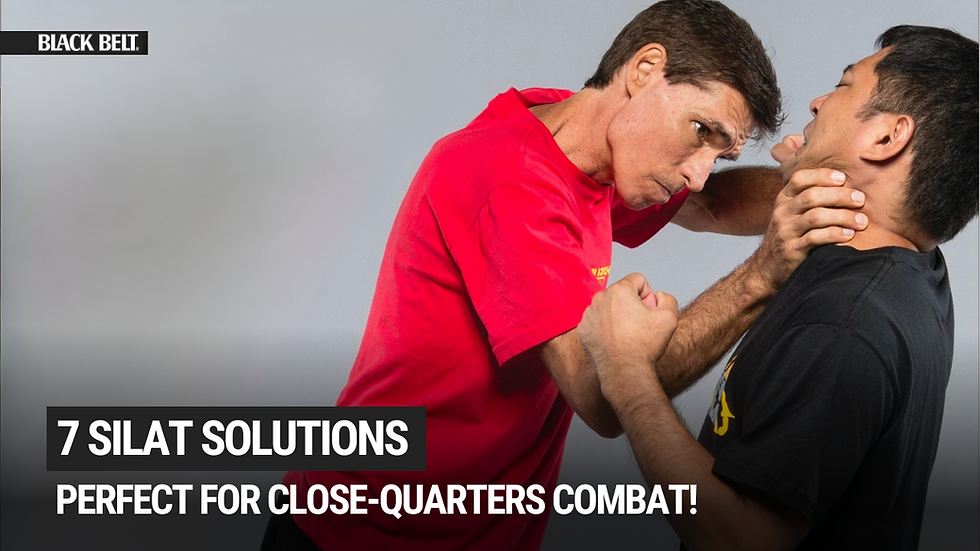
With the popularity of mixed martial arts (MMA) competition continuing to climb on television and online, martial artists of all stripes are becoming more well-rounded in their approach to fighting. The bad news is criminals are learning, too.
Police officers report that it’s now common for suspects to challenge arresting officers physically using MMA moves. That means the good guys and gals — people like you — must be prepared to fend off an attacker who may be skilled in kickboxing range, in the clinch, and on the ground.
The Most Neglected Area of Combat
Although close-range proficiency is important in any fight, the clinch is the most neglected area of combat for most martial artists.
Street assaults often begin with an aggressor getting in the victim’s face — that’s clinch range. Even when a real attack is initiated from farther away, the rage of the assailant often propels him forward and into close range. In short, clinch happens.
For me, the biggest reason to train in the clinch is that it’s the intermediate range between kickboxing and the ground. Why is that important? Because whoever controls the clinch decides where the fight takes place. The clinch is where almost all takedowns occur.
If you prefer to use long-range punches and kicks, you’ll need to counter takedown attempts and transition back out to long range, where you’re most comfortable. If you prefer to fight on the ground, you’ll need to use the clinch to put the aggressor on his back.
If you’re skilled in the clinch, you may choose to maintain that distance and finish the fight right there.
Clinch skills allow you to physically hold an attacker in that range so he can’t move away and land a wild swing. You control his movement, trap his arms, and deliver debilitating blows while he struggles to free himself. You position yourself to avoid takedowns such as the headlock or bear hug, as well as any technical throws he may initiate.
But what happens when the opponent has skills, too?
Have you ever seen a bout in which the combatants spend a large portion of their time in the clinch, trading knees to the thigh or midsection with little effect?
How many times do you see one fighter pressed against the fence or ropes while neither is able to do much damage or get a takedown?
This is because two fighters with relatively equal clinching skills will nullify each other. There are just a few dominant positions in the clinch where you can totally control an opponent. An adversary with a similar skill set will force you into a stalemate.
You certainly don’t want to have your techniques nullified in a street situation by an attacker who’s proficient in the clinch, so what can you do? I suggest going outside the realm of sport and using moves your opponent probably isn’t ready for.
This is where the close-range techniques of silat shine. In a street attack, there are no rules to abide by and no referees to ensure that you’re not fouled. Anything goes, as long as you can justify your use of force in a court of law.
Adding silat to your approach will give you an advantage over a fighter who’s trained only in the sport version of the clinch. Below are seven silat tactics you can add to your clinch. They’re illegal in competition but could save your life in a real-world assault.
1. Groin Strikes
Here’s a simple concept for you: Sport fighters don’t protect themselves from groin strikes. Their stances are designed to promote maximum stability in the clinch instead of protecting the most vulnerable target.
The lesson: If you’re in the clinch, go for the groin. When you arrive at close range, use your knees and feet immediately to debilitate the attacker while you use your hands to control his arms. A fighter who’s well-conditioned will often absorb knees to the midsection.
This makes him feel secure facing you, but it leaves his groin open for attack. Targeting the groin gives you the element of surprise. If he doesn’t expect it, he won’t see it coming.
You must use your arms well to control your foe and keep him from achieving a dominant position, striking, or taking you down. It’s important to spar in the clinch to ingrain proper offensive and defensive positioning.
While the assailant’s arms are occupied looking for a dominant position, attack the groin and get out of there.
2. Head Butt
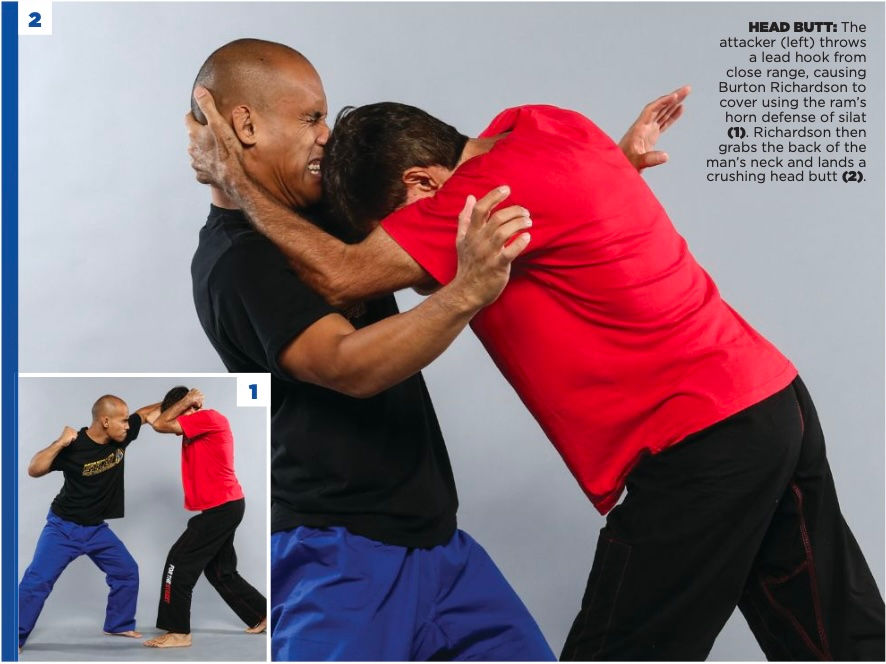
This is a powerful tool that's readily available at close range. The goal is to take that 11lb head of yours and slam it into the attacker's nose. It's like hitting him with a medium-size bowling ball. There are other targets, but the nose may be best.
If you aim for it and hit a little low, you’ll contact the knockout button on the chin or jaw. If you hit high, you may crack an eye socket. Just don’t hit the top of his head — that will give you both a big headache.
When you employ the head butt, you can increase your power and accuracy by gripping the back of your opponent’s head and jerking him into the blow.
This compounds the collision effect and leads to a shocking impact that can finish off even the toughest brute.
3. Eye Attacks
Very few people develop defenses for an eye attack executed at close range. Although this fight-ending move is easy to employ, it’s often left out of training, especially when sparring.
However, if you’re careful, you can run the soft portion of your thumb (think thumbprint) over the eyelid of a training partner because he or she will instinctively close that eye. My students and I do this regularly in sparring, so I know it produces just enough pressure to make the person acknowledge the gouge and react — without causing pain.
In a fight, an accurate, properly executed eye gouge or eye strike can make the strongest and most determined fighter lose heart. You can use the tips of your thumbs to target one or both eyes. If you deem the situation dire, you can use a fingernail like a knife and lacerate an eyeball.
This is an extreme measure, but if your life is in danger or you're protecting loved ones, injuring an assailant’s eye might buy you time to disengage and get to safety.
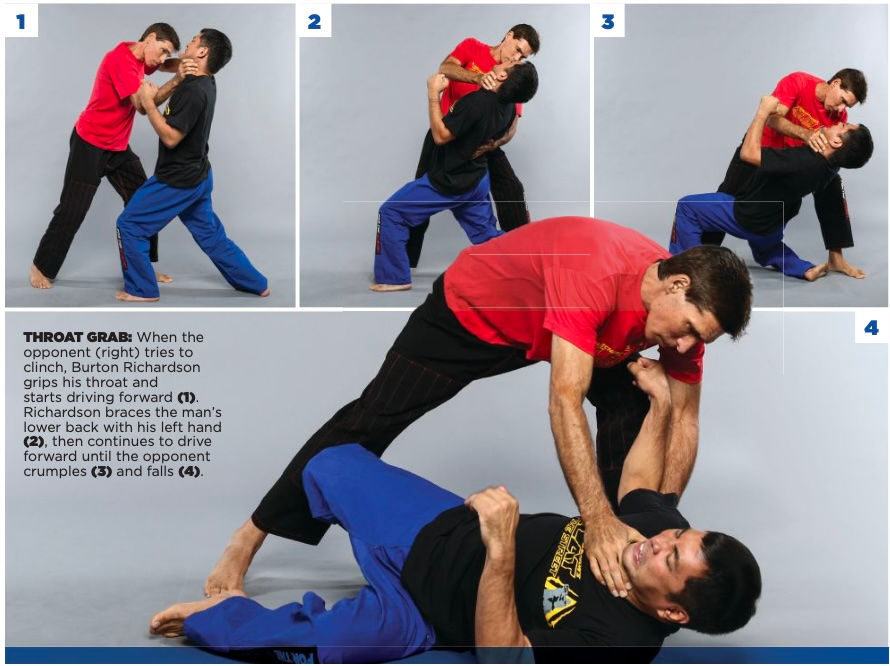
4. Throat Grab
The throat grab allows you to move a much larger opponent, which is important because at close range, off-balancing is crucial to facilitate a takedown. An easy way to maneuver a bigger person is to grip the throat, lift to get him on his toes, and then move him into the position you desire to make the takedown work. Lifting is key because it enables you to uproot that massive tree.
A benefit of the throat grab is you can practice it with no ill effects. If you're sparring the clinch with an experienced combat sports practitioner, you can actually grab his throat and use it to your advantage.
Most fighters won't object to this, even if it's illegal in their particular sport. In contrast, you can't kick them in the groin or rake your thumb across their eyes. The throat grab can also be used to distract. The natural response to it is for the recipient to use both hands to seize the arm that's gripping the throat. While all the opponent’s attention goes to breaking the grip, he leaves other targets (especially the groin) unprotected.
Implementation: Grip the throat and knee the groin. It works like a charm.
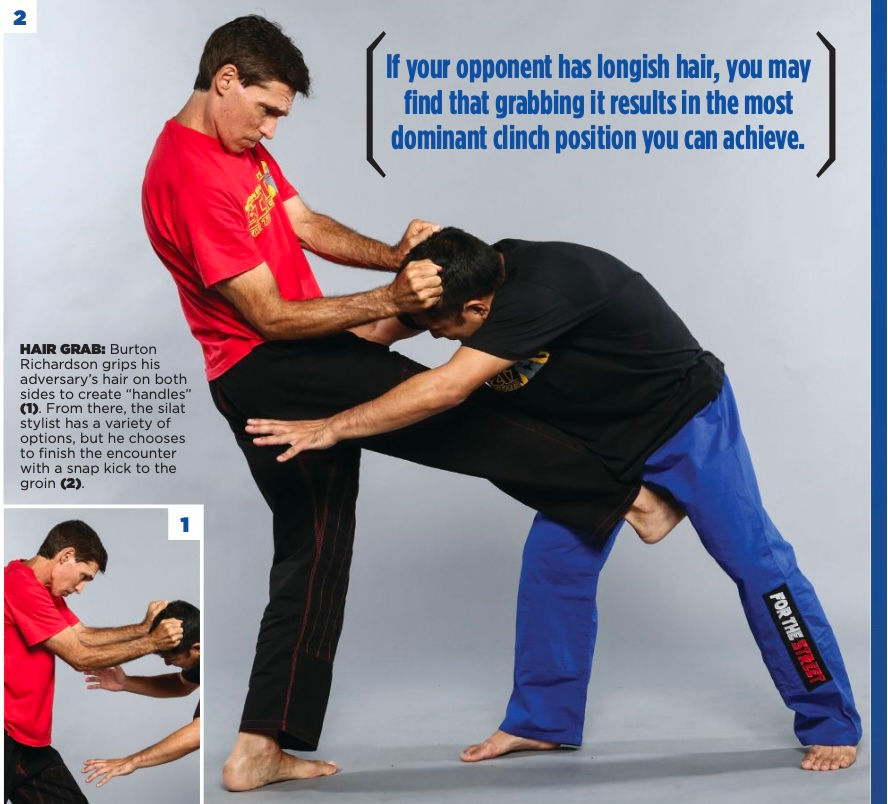
5. Hair Grab
If your opponent has longish hair, you may find that grabbing it results in the most dominant clinch position you can achieve. It’s easy to steer a person's head when you have hold of his hair. You can jerk his head down to make him bend forward.
By extending your arms, you can move out of range of his fists while staying close enough to throw knees to the face or kicks to the groin. Taking the assailant down is as easy as stepping back and yanking him face-first to the ground.
It’s true that you won't be able to use the hair wrap on some people because they keep their hair short, but if you get in a tussle with a person with a “do,” this can be a lifesaver when you need to achieve control.
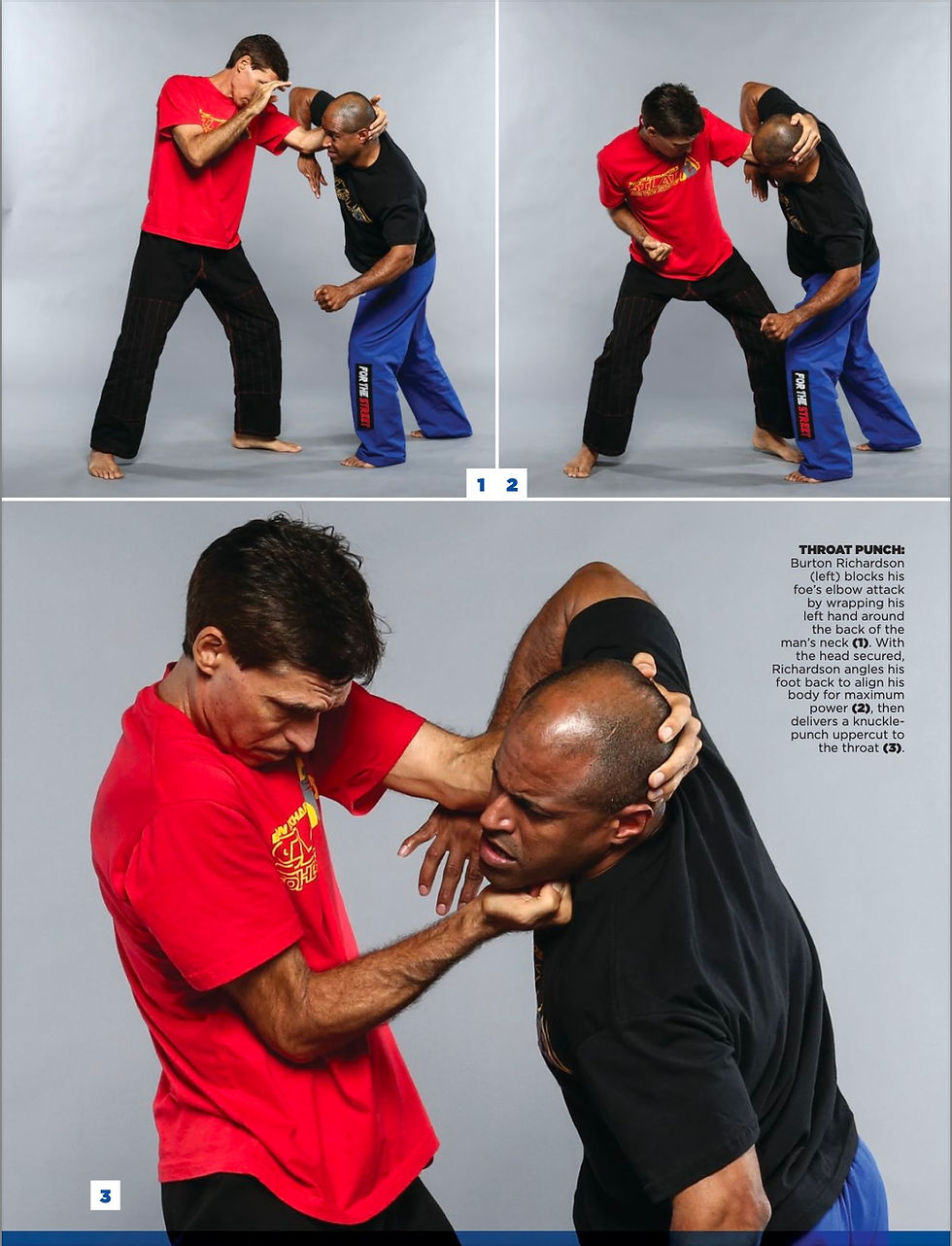
6. Throat Punch
A strike to the throat can drop any attacker. The problem is, this vulnerable body part presents a relatively small target that can be difficult to find with a normal closed fist.
There are two reasons for this: First, in a real fight, the opponent will be moving, and that impedes your ability to land a significant blow on a specific area. Second, if his chin is slightly lowered, it will block your fist from getting in. Hitting the chin isn’t a bad thing, but a tough opponent might be able to absorb a shot to the jaw and keep on fighting.
The solution to the moving-target dilemma entails launching your throat punch from the clinch after you’ve secured the back of your adversary’s head. This way, his head isn’t moving, and you’ve created a reference point that makes it easier to find the target in the middle of the chaos.
To get past the chin, form your fist into a “paw” and strike with the knuckles (specifically, the proximal interphalangeal joints). This configuration makes your hand smaller and better able to fit under his chin.
Bonus: Because the striking surface is smaller, the force of the blow is concentrated. It’s no wonder the throat punch is illegal in combat sports.
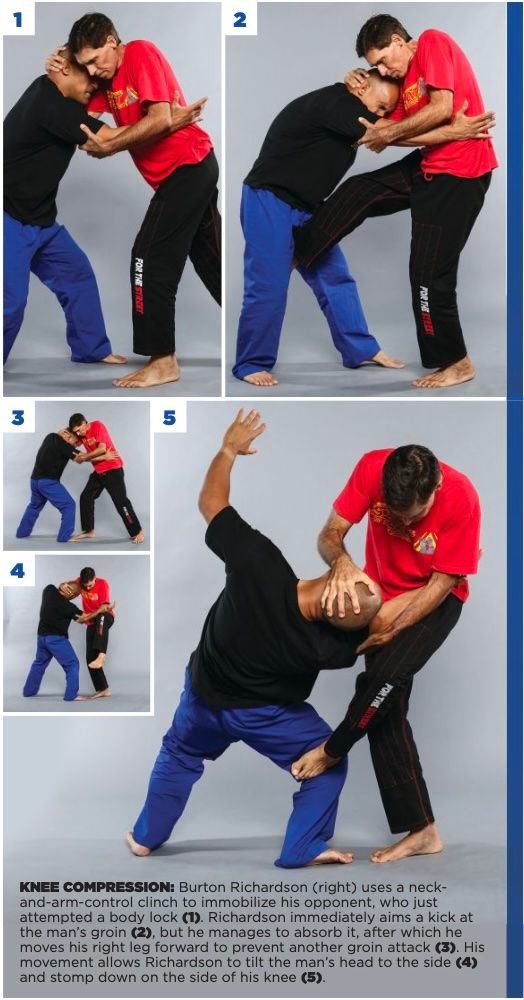
7. Knee Compression
The knee compression is illegal in all combat sports, from judo to kickboxing to MMA. The reason: Attacking the side of the knee usually results in torn ligaments.
Years ago, I witnessed a tall person being taken down with a silat knee compression. The silat instructor had begun demonstrating the takedown when the opponent suddenly decided to counter.
Bad idea.
The guy moved the wrong way, his foot stuck to the ground, and his body collapsed over his knee, bending the leg sideways. He screamed before he hit the ground and was later diagnosed with multiple torn ligaments.
His misguided response to the technique took him out of training for a year.
Lesson learned: The knee compression is a move you must practice with no resistance. It’s simply too dangerous otherwise, and it’s always too dangerous to use in sparring. If you rehearse it with a compliant partner, however, you can ingrain the move in your subconscious, which will make it accessible to you in a self-defense situation.
Proficiency in the clinch is vital for anyone who wants to have a complete approach to fighting. Fortunately, the art of silat provides proven methods for achieving this. If self-defense is important to you, I encourage you to go beyond using a sport-based methodology and focus on techniques that are illegal on the mat.
Your training will take you beyond the limitations of competition and into the realm of complete self-defense.
A practitioner of silat, jeet kune do, Filipino martial arts, and Brazilian jiu-jitsu, Burton Richardson was Black Belt’s 2015 Self-Defense Instructor of the Year.
Photography by Robert Reiff