- Sep 10, 2024
- 7 min read
Updated: Sep 15, 2024

Like most martial arts, karate originated as a system that was designed for hand-to-hand combat. However, things gradually changed over the ensuing decades. As the style began to spread around the world, more and more emphasis was placed on the sport aspect. Meanwhile, its combative side was downplayed.

In 2020, karate will debut at the Tokyo Olympics, which many practitioners worry will amplify its sport orientation. Karate’s usefulness on the street, it’s feared, will be minimized even further.
Shotokan, perhaps the world’s most popular style of karate, has not escaped this transition toward competition. That’s precisely what motivated me to create “combat shotokan.” This back-to-basics system reverses that troubling trend away from self-defense. As one might expect from its name, it emphasizes effectiveness in personal combat rather than effectiveness in sparring — which puts it in line with the reason most people take up martial arts in the first place.
Outlined here are the facets of karate that were most in need of an update. In some cases, the update was merely a return to karate’s roots.
Less Sparring
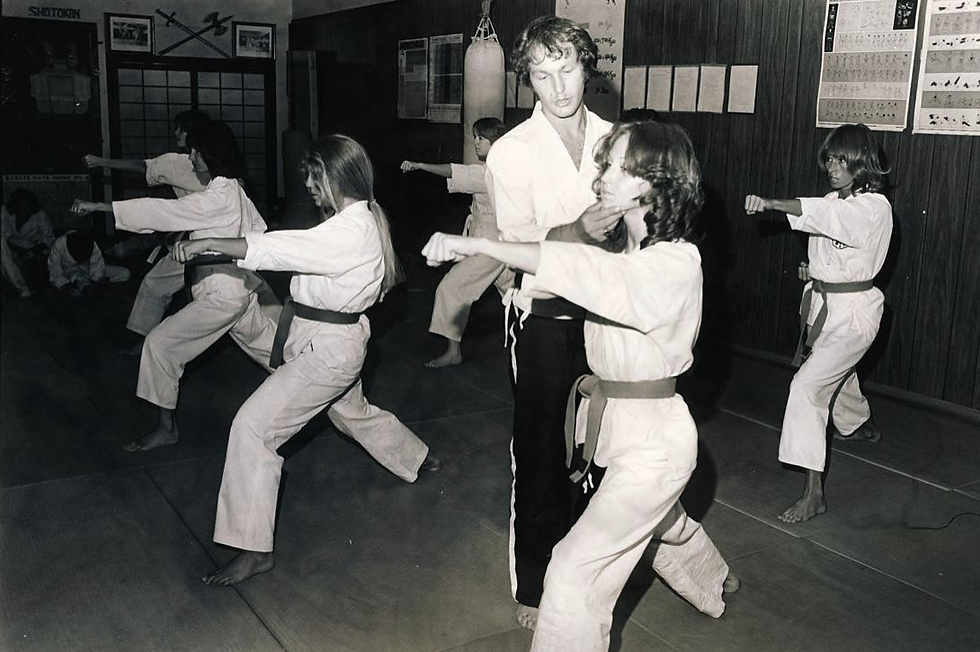
When I began studying karate in the early 1960s, shotokan emphasized strong, hard basics. We repeated the moves over and over and did very little kumite (sparring). That continued until we reached at least the level of brown belt. Today, however, the emphasis in most dojo seems to be on sparring, which leaves less time for students to build solid basics, and as we all know, a mastery of the basics is necessary if you wish to be effective on the street.
Examples: A lightning-fast back-knuckle strike might score in the ring, but the technique could get you killed in a real fight because it lacks stopping power. In contrast, a focused elbow strike won’t have much chance in the ring, where your opponent is ready and waiting for your attack, but it can be devastating on the street, where the element of surprise is on your side.
Yes, sparring is important. It plays a critical role in learning how to react under pressure and overcome fear. A problem arises, however, when you devote so much time to sparring that you no longer want to spend time on kihon (basics).
You must remember that when you face an opponent in the dojo, you’re not engaging in combat. You’re engaging in one form of training.

More Power
The emphasis in combat shotokan is on simple, effective moves that are delivered with speed. We avoid executing any technique that lacks the power needed to put down an attacker. For this reason, the system retains most of the techniques of traditional shotokan because they revolve around the intelligent use of body dynamics to generate maximum power.
However, a few additions have been made. Several taekwondo kicks that have proved themselves powerful in a variety of circumstances are part of combat shotokan, as are some grappling techniques. I’ve always believed that one should not be afraid of borrowing elements from different arts in an effort to more efficiently achieve one’s goal.
Airborne Kicks
No one can deny that a jump-spinning back kick that a martial artist has practiced for years can be effective on the street. However, no one can deny that a powerful palm-heel strike driven into an opponent’s nose is just as effective — and it’s certainly much easier to master and execute under duress.
Without a doubt, the jump-spinning back kick has its place, but a simple side kick to the knee will be more practical in most combat situations. Problem is, in most dojo where sparring is emphasized, kicks below the belt tend to be prohibited. That means students rarely get a chance to kick the knee or the groin.
Combat shotokan addresses this issue.
Proven Moves
During the many years I worked as a bodyguard, I learned a lot about techniques. In all the fights in which I was involved, not once did I use a sword-hand block or even an upward block. I never got into a back stance or threw a back-knuckle strike.
I depended on elbow thrusts, palm heels, bottom-fist strikes and chops to the Adam’s apple. I recall once breaking an attacker’s knee with a side kick and knocking the wind out of another man with a reverse punch. All these techniques were staples in the karate of yesteryear, and they’re indispensable components of combat shotokan now.
More Reps
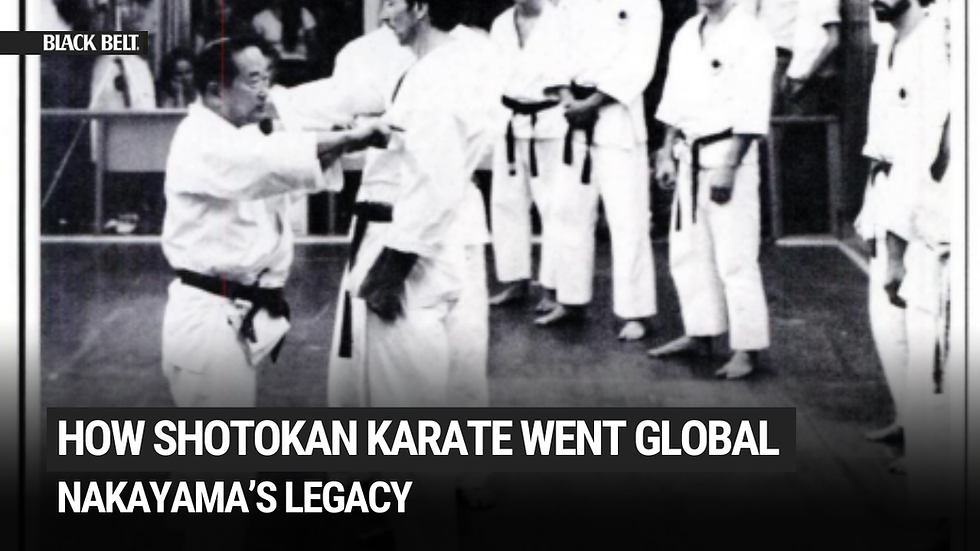
When I trained in Japan under the Japan Karate Association, I endured classes that typically consisted of 500 reverse punches; 300 front, side and back kicks; and hundreds of blocks and counters. Believing that basics were the foundation of shotokan, Masatoshi Nakayama discouraged us from concentrating on the flashier moves that are common in today’s karate.
That philosophy left its mark on me, which is why it’s part of combat shotokan.

Practical Defenses
In our system, we emphasize that fighting on the street is very different from sparring in the dojo or competing in a tournament. Some traditional blocks that might work in sparring are simply inadequate for self-defense.
Example: To prepare yourself to prevail on the street, you need to practice defending against a man who’s kicking at you with the toe of his boot so he can do more damage. That’s very different from blocking a bare foot that’s looking to score a point.
For this reason, we focus on defensive techniques that are practical and functional, and that means esoteric moves like the sword-hand block, outward block and wedge block are not part of a beginner’s training. They are covered when a student becomes a black belt because it’s assumed that experience will help the student know when to use them and when to avoid them.
Realistic Attacks
We teach that most assailants will not approach their victims with anything like a hopping side kick or a lunge punch. Therefore, we practice drills designed to familiarize students with realistic street attacks — wide swinging punches, big kicks, grabs, chokes and so on.
We also focus on the element of surprise. One way this manifests is we never face an adversary in a fighting stance and we prefer not to engage in an exchange of techniques. Our goal is to defeat him as quickly as possible, ideally before he discovers that we possess any fighting ability.
If surprise is impossible and we’re forced into an exchange of blows, only focused techniques are used. Any technique that lacks power is discouraged because in a real altercation, the only chance a smaller person has against a bigger enemy is to use precise techniques with proper body dynamics.
Penetrating Kicks
Because street effectiveness is the primary goal in combat shotokan, numerous conventional kicks have been altered. For example, our side kick is executed using a flat foot, with the heel, not the edge of the foot, being the point of contact. While it’s true that the penetration of a kick may be greater when the edge of the foot is used, if distancing is slightly off, a broken ankle can result.
The “flipping” side snap kick that’s often seen in tournaments likewise has been eliminated. In its place is a somewhat slower but much more powerful Korean side kick that fully uses the thrust created by the leg and hips.

Open Hands
In combat shotokan, closed-fist punches to the face are discouraged. Instead, facial attacks are delivered with the palm heel, the bottom of the fist or the elbow. This reduces the chance of broken bones for the martial artist.
Improved Strategy
Many of the blocks taught in conventional shotokan are also taught in combat shotokan, but students are cautioned that no matter how good their defense is, if their opponent outweighs them by 50 pounds or more, it’s foolish to attempt a block because of how forceful the impact will be.
For this reason, we place a greater emphasis on maneuverability and evasion — sometimes while blocking at the same time for redundancy.
Compulsory Kata
Kata training is a requirement for rank advancement in combat shotokan. The kata are the same as in traditional shotokan, but students are reminded that they’re not learning any hidden or exotic moves.
The main purpose of kata, they learn, is to build balance while moving, to improve the ability to turn and block in different directions with speed and power, and to boost overall fluency in technique.
By practicing kata frequently, our students hone their speed, power, coordination and balance. They know that all these elements are crucial for becoming an effective fighter.
Close Combat
Because many attacks begin with a push or grab, we highlight this in our training. That entails practicing defenses against grabs, chokes, head locks and other close-range attacks. We spend a great deal of time on elbow techniques, bottom-fist strikes, knee thrusts, stomping kicks and palm-heel blows because they’ve been proved effective at close range.
At the more advanced level, we engage in disarming techniques designed to thwart close-quarters attacks with knives, guns and sticks. When a student earns a black belt, he or she may elect to learn the cane, which is one of the few weapons one can legally carry anywhere.
Maintained Traditions
Combat shotokan retains many elements from traditional shotokan. In both pursuits, dojo etiquette, meditation and respect are integral parts of training. Although the focus in our system is self-defense, the art is never forgotten.
In both traditional and combat shotokan, sloppy technique is unacceptable. Proper form is vital, not only for aesthetic reasons but also because it’s more efficient and effective. Self-control is emphasized because with control of one’s physical movement, the path to endurance, harmony and humility is paved.
Final Thoughts on Combat Shotokan
The uniqueness of combat shotokan lies in what it can do for its practitioners. It provides the average person with the means to gain power and serenity and thus the knowledge needed to live with humility and self-confidence.
In short, the art is intended to guide practitioners along the path of the modern warrior in a way that’s not dissimilar to the way warriors were educated in ancient times.