Updated: Mar 10


There are people who swear “Judo” Gene LeBell has practiced martial arts for so long that an image of him putting King Tut in an armbar can be found etched in sandstone in an Egyptian tomb.
LeBell insists that isn’t true: “No, I’m not that old, but I was a bodyguard for Genghis Khan.”
From the time he was big enough to choke out the schoolyard bully, LeBell has been coming to grips with his destiny as a martial arts legend. As a Hollywood stuntman, he’s rubbed elbows with Tinseltown’s elite and tangled with some of the roughest, toughest wrestlers ever to slip into a pair of tights.
His mother, Aileen LeBell, was an icon in the ring: As the nation’s first female fight promoter, she ran the world-famous Olympic Auditorium in Los Angeles with an iron fist. Consequently, young Gene was able to pal around with some of the best boxers and wrestlers in the business.

“I was 7 years old when I started wrestling with the pros,” LeBell recalls. “My mother sent me down to the Los Angeles Athletic Club to play, and at the club were a handful of really good shooters. This was serious wrestling, a lot of technical skills — none of the clown stuff or gags like you see on TV. All we did was finishing holds.”
The owner of the club took a liking to the spunky redhead and asked him what he’d like to learn. His answer: Greco-Roman wrestling, freestyle wrestling, savate, karate, or judo.
“Well, karate wasn’t that popular at the time — it was mostly kata — and what they called ‘judo’ was like wrestling without a gi,” he says. “For example, when you grab for a harai goshi (sweeping hip throw), you hook the neck and use it as a handle.”
Back then, wrestlers referred to body parts like the ears, mouth, and nose as “handles” because they gave the grappler something to grip, LeBell says. “It’s a very effective way to make someone say ‘uncle.’”

12-SECOND CHAMPION
So began a legacy that reads like a script from a Hollywood movie. In 1954 and ’55, LeBell won the National AAU Judo Championships, placing first in the heavyweight and overall divisions. His path to the podium included a triumph over John Osako, who at the time was the top judo player in the United States.
At the AAU event, LeBell won 18 matches in two days, 17 with standing throws. To this day, that feat hasn’t been duplicated in a sanctioned judo competition. Gene LeBell may have walked onto the mat as an unknown, but he bowed out as a judo legend.
LeBell also competed in wrestling. He holds the dubious distinction of having held a world title for 12 seconds. It would have been longer, but in a moment of exuberance, he accidentally hit the Texas wrestling commissioner in the head while swinging his newly won belt.
“I tried to explain to the guy that it was an accident,” LeBell says with a grin. “But he was really steamed, and he yanked the belt and title from me on the spot. So I officially became a champion for 12 seconds.”
His experiences in those grappling arts led LeBell to develop his own style of combat, one that merged what he deemed the best of wrestling with the best of judo. As a result, many of his trademark submission holds can’t be found in any rule book or textbook.
But then, “Judo” Gene has always been a guy who makes up the rules as he goes.
PRETTY IN PINK
LeBell raised more than a few eyebrows when he bucked the rules and wore a rather untraditional pink gi to a very traditional judo tournament in Japan. When he bowed onto the mat wearing pink, the martial arts fashion police were outraged. LeBell just smiled, then set about pinning and tossing his opponents, proving that real men do wear pink.
“The pink gi wasn’t something I did intentionally,” LeBell says. “It happened while I was training in Japan. I accidentally washed it with a red shirt and some other brightly colored clothing, and my gi came out a deep pink. When people started teasing me, it gave me a good excuse to get them on the mat and stretch their bodies a bit.”
One Japanese judo champion and his entourage were less than impressed with the larger-than-life gaijin in pink, so much so that they traveled to Los Angeles armed with an attitude and a challenge.
“They came to my dojo at Los Angeles City College, and the interpreter said his friend was some kind of a champion in Tokyo,” LeBell recalls. “I really didn’t pay too much attention. Then he said they wanted to fight. I said, ‘You want to do randori?’ He said, ‘No! We do newaza,’ which is mat work. So I lay down and told him to get his best hold, and he put me in a side pin.”
The Japanese champ was a bit taken aback; he never expected LeBell would give him the opportunity to put him in a hold at the start of the match. With the American’s judo students sitting against the wall watching, LeBell calmly asked his opponent if he was ready. That apparently ticked him off, and he muttered something in Japanese to his interpreter.

“He said you need to have a doctor standing by,” the interpreter explained. That didn’t sit well with LeBell, as would soon become evident to everyone.
“We started, and I just rolled him over, and since he had an attitude, I choked him out real fast,” LeBell says. “When he came to, I turned around, and the guy and his entourage took off without even saying goodbye.”
What was the secret of LeBell’s escape from the side pin?
“From my wrestling days, I knew how to get out of that hold easily — which isn’t the Kodokan way of getting out of a Scarfhold,” he says. “One hand goes between the legs, and you squeeze his balls a bit while you roll the guy over. Since there’s no referee, you just do what you gotta do.”
FIRST MMA FIGHTER
Long before the Ultimate Fighting Championship made the Gracie name a household word in the world of grappling, there was a contest that pitted a nationally ranked heavyweight boxer against a world-class judo player. The boxer was No. 3–ranked Milo Savage, and the judoka was Gene LeBell.
It all started in 1962 when a man named Jim Beck boasted to a room full of karate students that he could beat any martial artist in the world. A black belt named Gene LeBell accepted the challenge, only to find out he’d be fighting Savage instead of Beck. The winner of the bout would take home $1,000, a hefty purse back then.
Plenty of intrigue and backstabbing are connected with what ensued. LeBell and Savage agreed to face off in a boxing ring, and Savage may or may not have had an advantage or three. “He used brass knuckles under his gloves,” LeBell says. “I was also fighting with a dislocated left shoulder, so I had to be careful not to get tagged.”
In round four, LeBell slipped under Savage’s jab and executed an explosive maki komi harai goshi, dumping the surprised boxer on the mat. The grappler then applied one of his famous chokes, putting the pugilist to sleep. “Judo” Gene had made history — and he had to slip out the back as a riot erupted. He did, however, pocket a grand for his labors.

HOLLYWOOD FALL GUY
As Gene LeBell devoted more of his life to the martial arts, the arts were kind enough to give back. They catapulted him into the movies, where he worked as a stuntman, television sportscaster, and promoter.
Even now, it’s tough to turn on a television and not see LeBell being set on fire, falling off a building, smashing a motorcycle into a big rig, or, my personal favorite, sinking in a vat of wet concrete in 1985’s Remo Williams: The Adventure Begins.
“I think my first job was on the Lassie TV show,” he says. “I've been working so many years that the son of the guy who directed Lassie grew up to direct movies of his own – I worked for him, too!”
In true Gene LeBell form, he even got to hit himself with a chair in one flick. “It was the movie Raging Bull, I played the announcer in the riot scene,” LeBell recalls.
“The next day, I was a stuntman wearing a mustache and a hat, throwing chairs and the ring during the riot. The magic of movie editing had me in the ring as the announcer while I was throwing chairs at myself from ringside. The best part of that was I got double residuals.”
Over the years, the martial artist has taken falls and more than 1,000 movies and TV shows. In the process, he's been privileged to work with everyone from Bob Hope to Bruce Lee.
“I met Bruce when he was working on The Green Hornet series,” LeBell says. “I got a call from the stunt coordinator for the show, asking me to check out some kid named Bruce Lee.”
“The first thing I noticed was that Bruce was very fast and always wanted to take the action beyond what the script called for. Once the director called, ‘action,’ he got that in a lot more from Bruce!”
LeBell and Lee became friends, frequently training at each other's dojo. “We worked out on a one-on-one basis,” LeBell says. “He taught me a lot of Kung Fu moves that I'd never seen, and he showed me how to do crescent kicks and spinning back kicks. In return, I showed Bruce some judo throws and grappling techniques.”

Been There, Done That
LeBell, who was Black Belt's 1991 Judoka of the Year, has traversed life on his own terms, and he's comfortable and confident with respect to the decisions he's made in business and martial arts. One of them pertains to showbiz:
LeBell belongs to an elite club called Stunts Unlimited."There are only 50 individuals in Stunts Unlimited," he says. "All the people are running shows and they're world-class stuntmen and stuntwomen. I'm still doing stunts, but I am getting older, and since it hurts when I tie my shoes these days, I don't want to roll anymore cars. But I still enjoy sliding them through a plate-glass window."
When asked about the changes he's seen over the years, the martial arts icon mostly focused on how much more he's paid now for abusing his body in movies. "I used to get $50 for stunts, but now it's $903," he says. "Last week, I did a job and had six hours of overtime and a stunt adjustment at $400. I ended up making three grand and didn't even need to put on a stunt pad."
An avid motorcycle enthusiast, LeBell often can be seen two-wheeling around Southern California on one of his 40 rides — when he isn't crashing one on a movie set. For decades, he's worked as a test rider for Yamaha, Honda, and BMW and frequently hangs out at a motorcycle shop in Hollywood, talking to customers.
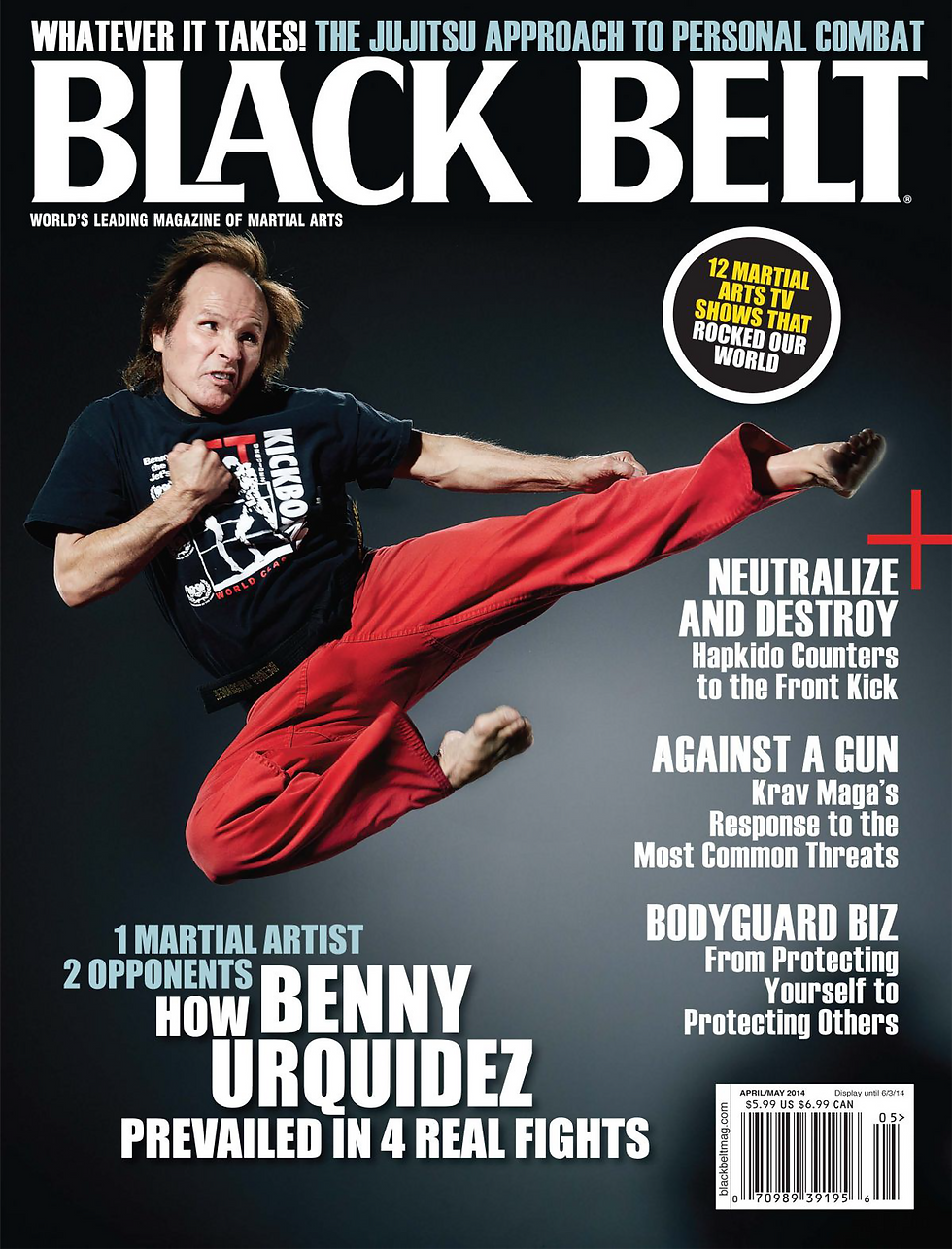
Never one to sit still, LeBell can be found every Monday evening in North Hollywood, California, engaging in an activity that's even dearer to his heart. There, at Hayastan MMA Academy, he and longtime friends Gokor Chivichyan and Benny "The Jet" Urquidez train the next generation of grapplers and MMA stars at Chivichyan's dojo.
After all, when he retires for good, someone will have to take the reins from "Judo" Gene LeBell, and they might as well learn from the best.