From the Streets of Liverpool to Leading Martial Arts Across Australia

For Graham Slater, 9th-Degree Black Belt and founder of Martial Arts Australia (MAA), building the nation's largest martial arts network was never part of a grand corporate strategy. It was the natural evolution of a young man escaping the violence of 1970s Liverpool, discovering purpose through martial arts after emigrating to Australia, and dedicating his life to helping instructors build successful schools and stronger communities.
Today, Slater's influence extends far beyond the dojo. As the new Managing Partner for Black Belt Magazine across Australia and the United Kingdom, he will lead the publication's expansion throughout two regions that have produced some of the most respected martial artists, fighters, and action stars in the world. From pioneers such as Terry O'Neill and Richard Norton to modern icons including Jason Statham, Scott Adkins, Dakota Ditcheva, and Bren Foster, Australia and the UK have long played a defining role in shaping the global martial arts landscape.
Together, Black Belt Magazine and Graham Slater aim to celebrate that legacy while introducing a new generation of athletes, instructors, and innovators to audiences worldwide.

In this exclusive feature, Slater reflects on the remarkable journey that brought him here—from surviving gang violence in Liverpool, to training in Japan, to building one of the world's most influential martial arts organizations. He also shares the deeply personal story behind receiving his 9th Dan promotion from the late Hanshi Tino Ceberano OAM, one of Australia's most revered martial arts pioneers—a recognition that honored not only a lifetime of technical excellence, but decades of leadership, mentorship, and unwavering service to the martial arts community.
Black Belt Magazine: Graham, when practitioners look at your achievements today, they see a successful media executive, insurance broker and a master of martial arts. Where did your drive originate?
Graham Slater: To understand where I am, you have to go back to 1973 in Liverpool, England. Like so many kids of that era, I was completely inspired by Bruce Lee, and I was fortunate to find a local Goju Karate dojo to find a way to survive.
I grew up in an environment dominated by many street gangs. As a teenager, you were attacked by gangs, or you ended up in a gang yourself just to walk down the street. There was no third option. Surviving street gangs in Liverpool taught me a harsh truth about human behaviour: an attack often comes without warning, born out of ambush, robbery, or displaced rage. That environment forces you to develop hyper-vigilance, reading hidden intent, maintaining distance, and being prepared to respond with absolute conviction, until the threat is completely neutralized.
When my family migrated to Australia in 1975, I arrived completely shell-shocked. I carried so much suppressed anger and hyper-vigilance, it took me years to accept that not everyone walking toward me down an Australian street, wanted to smash me in the face.
Finding Kyokushin Karate and Kickboxing in Australia was an absolute blessing. The hard, full-contact nature of the training, the sheer physical output and shouting Kiai from the depths of your lungs, acted as a massive emotional release valve. It processed that trauma and gave me a sense of grounding.
Black Belt Magazine: How did growing up around street violence in Liverpool shape your understanding of human behaviour, and how has martial arts served your business career?
Graham: By 1981 I opened my first club and felt I had released sufficient emotional attachment to the past experiences, I became absolute in my actions, no hesitation, eliminating any fear against physical challenges and business rejection. In 1982, I opened another club and went full-time, running karate and aerobics inside a major commercial gym. I wasn't just selling monthly memberships; I was executing 5-year training contracts, running supplement networks, fitness camps and designing my own marketing adverts. It taught me early that a martial artist must understand business mechanics and take chances to thrive.
THE JAPAN INTENSIVES & THE "CIRCLE OF KNOWLEDGE"
BBM: How did a chance phone call take you in a new direction?
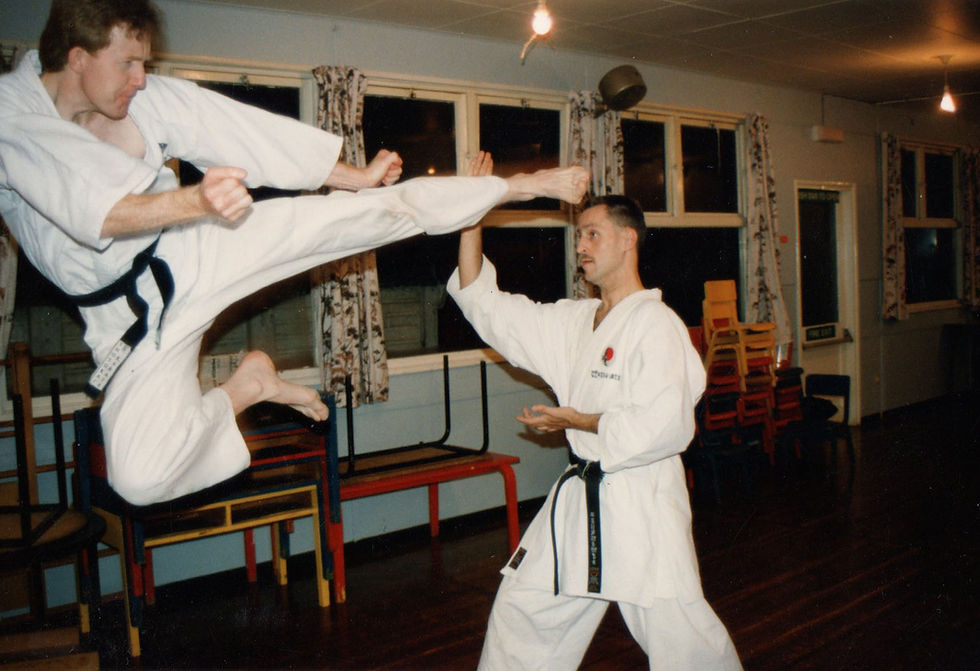
Graham: A friend called out of the blue with an opportunity to join a team of ten going to train in Japan. I had four months to prepare. However, since I was already running two clubs and training six to seven hours every day, the physical preparation was easy.
BBM: What was training like in Japan back in 1983?
Graham: Japan was an absolute shock to the system. The training ran three times a day for me at one pace: flat-out until you dropped, and then getting back up to do it again. Each class lasted only an hour, but it was relentless: holding Kiba-Dachi (horse stance) while punching hundreds of times, followed by endless Kihon drills. The goal was to completely exhaust your physical body, stripping away muscular tension to reveal pure, unrestricted fluid technique.
It was during this trip that I first experienced being thrown without physical contact. Like most people, they have all heard these sorts of stories and many thinking #Bull#it. Maybe you have to experience it yourself to believe it, but I can tell when you do, your mind opens and is ready to consider many more other possibilities. Here is what happened on this occasion.
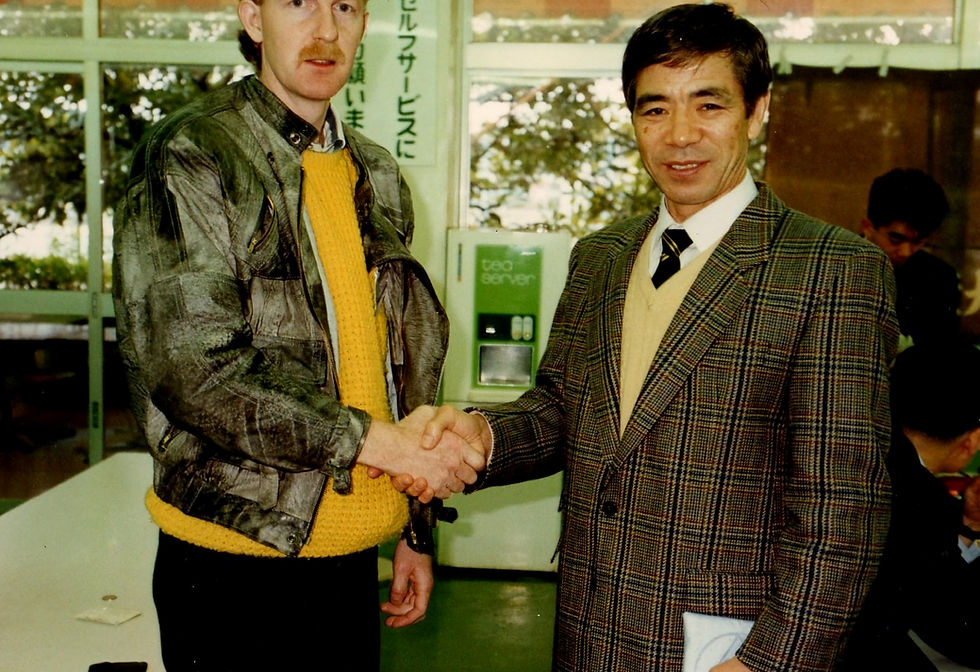
Sensei Ikeda was backed up against the wall of the dojo commanding me to kick him – mae geri in the stomach. I was at point-blank striking range and I hesitated because I thought I would nail him. He yelled again louder ‘mae geri’’ so I launched it with everything I had. Mid way through executing my kick, I felt my entire body lift into the air propelling me backwards as if hit by a massive cushion of energy. I landed flat on my back with only my ego crushed, while Sensei calmly moved to the next student, knocking them down. I couldn’t believe I was just dispatched without a glance back, I was left to get up and continue with the class.
It has taken me many years to understand what happened, how it works and how it can be duplicated. It is a matter of understanding the elements required to make it possible and there are varying degrees of effectiveness. These are the four main elements that make this possible: Timing, Entrance, Ki and Intent. To know how to apply them is a longer story and another article.
BBM: What else did Japan teach you?
You must be willing to repeat a movement countless times without hesitation. When your body can no longer move, you still command your limbs to continue. That is the point of this training: when nothing is left, your brain still sends the message to move, even if you physically don’t. This strength of mind and character translates directly into your success in life.I had private sessions with Sensei Ikeda and his senior student, Sempai Kazunobu Maekawa, who was a 4th Dan at the time. For two hours each day, we engaged in continuous Kumite. During the first hour, we did what we call one step kumite, I step forward with (oi-zuki) right-arm punch as hard and as fast as I can. Sempai steps forward to meet every attack with a fully committed block (gedan bari) smashing into my forearm or wrist block with no emotion or malice. Within minutes, my arm went into violent nerve spasms and I found it difficult to move. When I tried to switch to my left arm, I was ordered to keep using the injured one. I kept trying to switch, but I couldn’t until 30 minutes had passed when we changed. Within minutes both arms were throbbing, so I just dealt with it.
That experience forced me to look beyond brute strength. I had to alter my entry timing, distance, rotate my forearm at the exact micro-second of impact to cut past his block, and try to hit his stomach. I would also apply Kiai to manage pain and draw upon more power. I tried everything for one hour and never got through his guard.
When it was his turn to attack, his first punch hit my guard with such tremendous kinetic structure that it drove me sliding backward two meters. This would continue through the class unless he decided to stop it shorter. I hit every part of his arm trying to find a weakness, change my timing, focused my energy to a pinpoint, nothing stopped him.
We continued this for the rest of the week, I adapted, using reverse blocks, body evasion, and anticipatory timing. By the end of that week, my strikes and blocks had improved. I was closing the distance, and I had developed a far deeper capacity to endure pain and accept whatever was presented. I left feeling like I was a beginner, but in the end, they told me they were testing me to see when I would give up, they were happy I didn’t. Perhaps I passed something, because they invited back the next year. It was only when I got back to Australia and trained with other instructors that I realised, I had improved.
BUILDING THE INDUSTRY — FROM 60 TO 3,000 CLUBS
BBM: What made you decide to form an instructor’s training group and how did you turn a small regional alliance grow into Australia's largest industry body?
Graham: When my teacher (Sensei Yasuo Ikeda) passed away some years later, many of us were left without an official lineage head. I refused to let politics or the loss of a figurehead stall my club’s growth. In 1993, I formed an instructor group called the 'Circle of Knowledge.' It was a non-political space where master-less instructors open to all styles. We would gather, share skills without ego, and learn new disciplines taking it in turns to share skills, this ultimately became Martial Arts Australia (MAA).
You learn very quickly that trying to please everyone in a committee means nothing ever gets done. In the early days, we were failing to deliver real services to instructors because no one wanted to step up with capital or take administrative responsibility.
I decided to stop waiting. I said, 'We need to pay professional staff to run this properly.' Nobody else wanted to put money in, so I put up $50,000 of my own capital and took full ownership and liability for the enterprise.

That single decision changed everything. Over the next decade, we scaled from 60 struggling clubs to over 3,000 member schools by its peak in 2013. We built an infrastructure that delivered specialized instructor insurance, accredited coaching systems, government fund courses, national magazines, TV production, club software, billing, and event management. We gave school owners the tools they needed to turn their passion into a sustainable profession.
RECOGNITION BEYOND THE RANK
BBM: Rank can be a contentious topic in martial arts. You earned your 7th Dan in 2014 under Sensei Stan Schmidt, and then in 2025, you were presented with your 9th Dan. How did those milestones feel?
Graham: When Sensei Stan Schmidt awarded me my 7th Dan in 2014, it was one of the most validating moments of my life. Sensei Stan was a legend, an absolute icon of Shotokan, I had private lessons each week with him for around 15 years. To have a master of his calibre look at my movement and contribution, then take me on the grading journey, it was everything I ever dreamed of achieving. In my mind, 7th Dan was my ceiling. I felt complete.
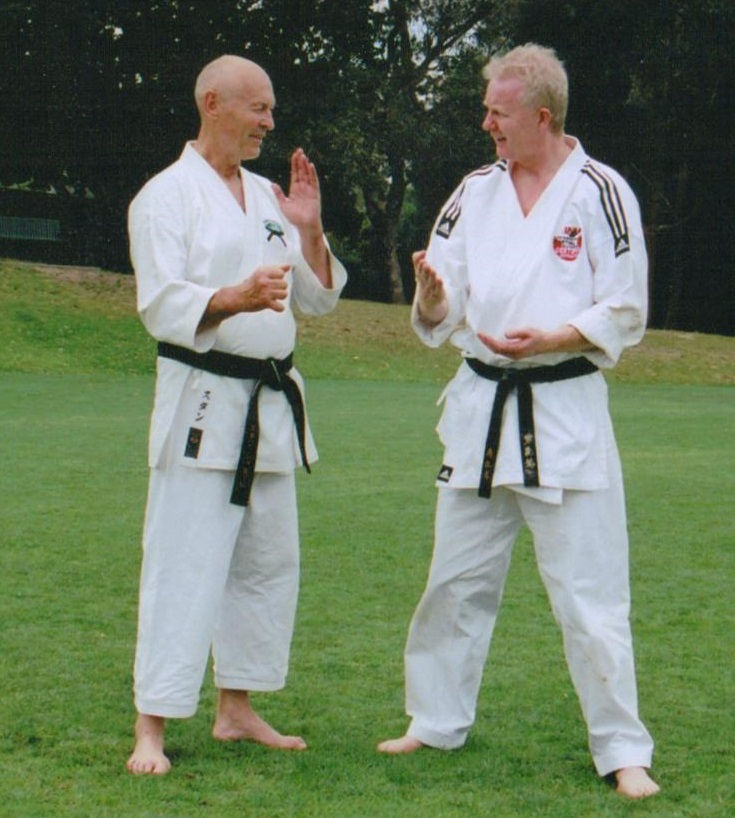
Then came 2025. I received an unexpected phone call from a senior peer who told me a master panel had been speaking behind the scenes. They weren't sounding me out for an 8th Dan, they were insisting on awarding me a 9th Dan, headed by the legendary Hanshi Tino Ceberano.
I was deeply humbled and, honestly, a bit confused at first because I had never sought rank for the sake of a title. But standing there in front of 300+ martial artists, peers, and friends who had gathered to witness the presentation, I felt a deep sense of gratitude. Now I feel a greater self-inflicted obligation to this title, a renewed motivation to better serve the industry.
BBM: Many instructors create their own styles. At what point does creating a new system become legitimate?
Graham: When your martial art truly becomes an expression of you, that is the starting point. If you have spent your entire career practicing only one style, you aren't practicing your own art, you are simply replicating your teacher’s style under your own name.
In reality, some instructors lack the commitment or skill required to progress to senior black belt ranks (3rd or 4th Dan). To bypass that effort, they invent a style, crown themselves 'Founder,' and adopt titles like Soke or Kancho to create an illusion of legitimacy.
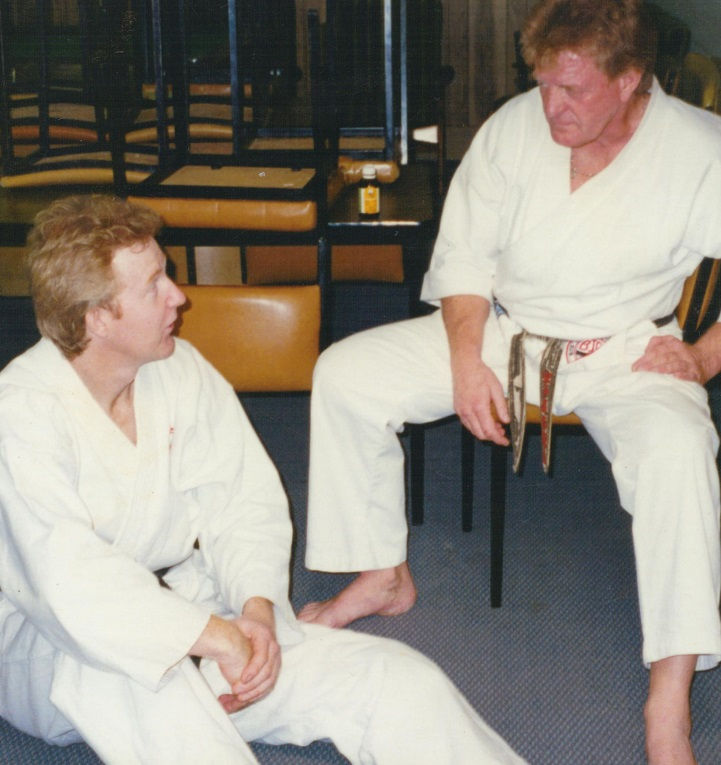
Legitimate system creation requires a vastly different path. First, you train deeply across multiple disciplines, earning senior black belt equivalency in several of them. Over decades of cross-training under various masters, you begin blending and refining techniques to suit your natural biomechanics, personal philosophy, and real-world environment.
Once you reach that level of synthesis, the process of formalizing a style involves four distinct steps:
Document the Curriculum: Codify the core principles and techniques so the essence of the system is preserved.
Build a Progression Pathway: Establish clear, measurable competency levels for future students to follow.
Peer Review: Share your material with senior peers and masters, inviting honest critique to stress-test your concepts.
Teach with Humility: Once you have put in the time, learned the hard lessons, and refined the material under scrutiny, you are ready to pass your art on to the next generation.
Some Key Takeaways for Every Instructor:
Business is a Duty: You cannot teach peace, discipline, and self-defense if your dojo doors close due to poor financial management. Learn the business mechanics of your school.RESPOND TO CIRCUMSTANCE: Turn adversity into fuel.
Drop the Style Egos: Style-ism divides practitioners. Real growth happens when instructors come together in a spirit of open skill-sharing.OWN THE RISK: If a system is broken, invest to fix it.
Service Over Titles: Titles like Soke or Kancho mean nothing if there is no substance, sweat, and community service behind them. Focus on the work, and the respect will follow.SERVE THE COMMUNITY: True rank is measured by who you lift.
BBM: Do you have a practical application for every movement in a kata, and how do you explore deeper Bunkai?
Graham: Early in my training, my Shotokai Karate club cross-trained with a local Goju Karate group. They had sophisticated two-person drills for their forms. When I asked if they had applications for every movement in a kata, they explained that they used two or three core drills to represent the primary lessons of each form.
That inspired me to take the concept further: What if every single movement of a kata had a functional response for every type of attack?
We began experimenting with the Heian forms. We started with two attackers launching simple strikes while a defender executed the full form. Next, the attackers would step in to grab an arm, a leg, or the waist mid-form, forcing the practitioner to adapt the kata movement into an immediate defense. By altering timing, adjusting angles, and integrating circular redirections, the form suddenly came alive.
We expanded this by incorporating pressure-point strikes (Kyusho Jitsu) and eventually weapons: knives, sticks, bo, sai, and swords. We discovered that an open-hand kata can seamlessly accommodate almost any weapon; the underlying movement doesn’t have to change you just have to find the right application.
When you perform a kata against continuous, unpredictable attacks, your brain operates at peak cognitive capacity. You are forced to analyze speed, distance, and timing in real time while executing the form. You learn to process dozens of variables simultaneously, viewing the engagement almost from above. When you perform the kata solo afterward, your spatial awareness and speed are completely transformed.
BBM: What specific training drill can instructors use to help students read an opponent's attack before it physically lands?
Graham: This is a foundational drill I use to develop anticipatory awareness, timing and intercepting intent in students. It’s specifically developed to improve "Pre-Trigger" Attack Recognition
Drill Guidelines:
Maintain Distance initially: Instruct students not to creep closer during the early rotations. Keeping a 3-meter buffer allows the receiver to focus entirely on visual cues without physical anxiety.
Identify Pre-Triggers: The receiver looks for micro-movements, a slight drop of the shoulder, a shift in hip weight, a change in breathing, or a widening of the eyes, that occur milliseconds before a punch is launched.
Mental Programming: The receiver visualizes breaking the attack at its inception, stepping in with an intercepting technique (Irimi) or clean redirection.
Progressive Contact: After two or three rotations, reduce the distance to allow light contact, starting with single techniques before advancing to complex combinations.
BBM: How do you apply those drills into realistic defences?
Graham: You must stop trying to beat action with reaction. If you wait for the opponent’s fist to travel toward your face, you are already behind the clock. One needs to read the thought of the attack before it drops from the brain to the body, before a striking limb initiates. We were taught to use gravity to fall into the move, not to 'spring' forward by flexing your leg muscles, that movement telegraphs your intent. Instead, keep your knees slightly bent and lean your centre of gravity forward. You literally fall into the space, letting gravity accelerate your entry, then your muscles blend with the momentum, without giving away upper-body movement signals.
Next one should seek to meet a striking limb without brute force. Precise placement onto a vital pressure point disrupts their central nervous system without wasting energy. Focus your intent into a tiny, laser-sharp point, like a pin prick to your target. The softer the physical connection, the deeper the technique penetrates. Alternatively, you hit them before they move or you allow their technique to go past you and your block becomes a throw.
Attackers expect anger, fear or defensive panic, but cultivating compassion and psychological indifference takes away their power. When you meet violence with absolute calm, a soft touch, and total emotional detachment, you shatter their psychological strength. Acting as a quiet mirror, projecting compassion while holding an unconcerned stance, it instils a profound, eerie sense of doubt in the aggressor. The conflict can be over before the strike is even completed without any physical harm. To me, that is a better outcome.
BBM: How do you convert the street survival skills and martial arts into the boardroom?
Graham: Surviving hostile environments builds intuition, detail orientation, and decision-making clarity in business. When you translate those lessons into business, martial arts becomes a powerful strategic asset. It teaches you discipline, adaptability, and the confidence to manage multiple complex projects simultaneously. You learn to view some obstacles not as failures, but as tactical challenges to be solved.
Most importantly, it sharpens your intuition. If a business deal or proposal doesn't sit right instinctively, I question it immediately, research the facts, and trust my gut. The same patience and attention to detail required to master a complex technique is the exact skill set needed to navigate high-stakes corporate decisions.
Three Key strengths you can develop -Reading Hidden Intent - Intuitive Risk AssessmentSpatial Distance - Patience for Business DetailAbsolute Conviction - Decisive Leadership Under Stress
BBM: You recently completed a pilgrimage along Japan's historic Nakasendo trail. How does the ancient path tie into the modern martial artist's role in society?
Graham: After nearly 20 trips this would have to be the most profound and rewarding experience. Walking ancient paths like the Nakasendo or the Kiso Road reminds you of the Shokunin spirit, the commitment to craft, quiet mastery, and everyday labour as a sacred duty. This would be pretty amazing on your own, but with five senior martial arts masters (Mike Stone, Gavriel Schneider, Greg Brady, Paul Mracek, Michael Dolan) each with 40 – 60+ years of training and living together for two weeks, it was an profound and extraordinary experience.
What was reaffirmed on this trip was the true test of a martial artist isn't found within the clean boundaries of a dojo or the high energy of a tournament. It is found in how we inhabit ordinary, menial moments. The concept of Mushin (mind without mind) allows us to bring severe physical discipline into everyday business, relationships, and leadership.
When senior practitioners gather on these journeys, the goal is no longer about acquiring more raw techniques, it is about becoming whole. It is about taking five decades of combat experience, stripping away the ego, and becoming a steward of collective harmony in a chaotic world. Something new evolves and emerges that we all contributed to and absorbed. This is a story that all the travelers will share in a future article as each person had their unique experience as we travelled together.
BBM: summarize 53 years of martial arts in five core words.
Graham:
Awareness (Reading the unseen)
Adaptability (Flowing without acceptance)
Intent (Focusing energy with absolute clarity)
Compassion (Choosing peace over destruction)
Commitment (Train with 100% spirit, or don’t train at all)