FROM THE BLACK BELT ARCHIVES | 2012
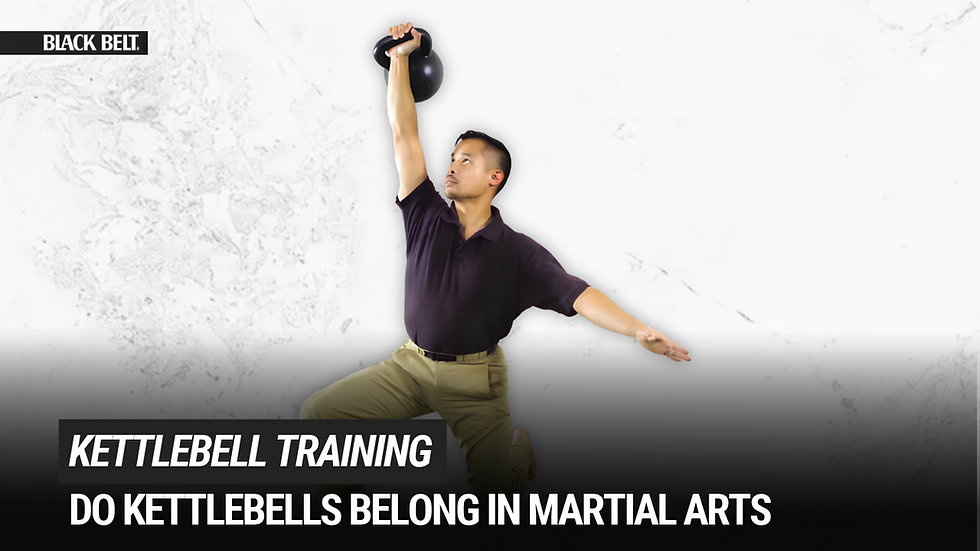
Editor's Note: Originally published in Black Belt in 2012, this interview features Dr. Mark Cheng discussing how kettlebell training can help martial artists develop strength, stability, explosive power and better movement mechanics.
WHY KETTLEBELL TRAINING MATTERS FOR MARTIAL ARTISTS
Those who pay attention to bylines know that Dr. Mark Cheng is one of Black Belt’s most knowledgeable writers. In his brain resides an almost freakish amount of information about nearly every martial art under the sun, and it’s not just a collection of superficial facts. He knows the history of the styles, the mechanics of the movements and the principles of the techniques.
Couple that with his academic training—he’s a licensed acupuncturist, a Ph.D. and a senior RKC instructor—and you get an unimpeachable source of guidance on all matters martial. For this interview, I grilled the good doctor on the subject of how kettlebell training can help you, the mild-mannered Black Belt reader, perform better in the dojo.
Kettlebells have been around for a long time. Now you see them all over—in MMA gyms across the country, on the Biggest Loser, even in Walmart and Target. Why are they so popular?
Dragon Door pioneered them here, and they’ve put a lot of time and energy into marketing them. It’s also because of Pavel Tsatsouline; he was the first person to put together a certification program—called RKC, which stands for Russian Kettlebell Certified—for instructors. Almost everyone teaching kettlebells in the United States has been taught by Pavel or has had doors opened because of him. Now people are seeing how successful he’s been, and they’re jumping onboard.
Knowing all that kettlebell training has to offer, why isn’t it more popular in the martial arts world?
I think they’re surprisingly popular in the martial arts world. Dan Inosanto has done a tremendous job endorsing them in his seminars and talking about his training with Pavel.
But if you were to go to Middle America and mention “training with a weight” to a traditional martial artist, he’d think of a dumbbell or barbell. Why don’t more people know kettlebell training can develop strength, balance and explosiveness?
It has to do with mindset. In the United States, we’ve been acculturated to the bodybuilding paradigm. I was the same way: When I first heard Dan Inosanto was doing weight training with a Russian guy, I thought it was insane. Guru Inosanto was almost 70, and he was going to start weight training and bodybuilding? I couldn’t see the value. I didn’t know about hard-style kettlebells, which is Pavel’s style, but when I saw it, it blew my mind. Now, I even use kettlebells for rehab in my clinic, as do many sports-med doctors and rehab specialists.
There’s also the misconception among martial artists that training with any weight will make you slow and stiff. If you train like a bodybuilder, yes, it can make you slow and stiff. But if you train in a way that focuses on using the weight to generate maximum mobility, to rehab your basic movement patterns and to improve your range of motion, and instead of doing all slow, grinding motions, you do some ballistic motions, it’s a different ball of wax.
Is that the key to deriving maximum benefit from kettlebell training—to do ballistic movements as well as grinds?
Yes. One of the best descriptions from Pavel about kettlebell training—and weights, in general—is that you should be able to go at any speed. If you look at kettlebell exercises like the Deadlift, the Turkish Get-Up, the Press or the Squat, you should be able to do them at “tai chi speed”—really slowly but with perfect form and joint alignment. With other exercises—such as the Swing or the Snatch—you should just explode, like you do with a one-inch punch. You should do them explosively for the maximum range of motion with maximum control. That’s the yin and yang of kettlebells: Sometimes you go slow and sometimes you go fast; sometimes you relax and sometimes you tense up.
What advice do you have for people who think, I don’t have the money for a kettlebell so I’ll just swing this dumbbell?
The benefits will be different because the coordination is different. Based on the tool in your hand, your technique changes. If you’re used to swinging a bo and you change to a mop, it won’t be quite the same because of the weight, the length and the balance.
While a kettlebell might be labeled the same number of pounds as a dumbbell, the center of mass is different and the exercises you can do are different. For example, if you try to swing a dumbbell between your legs, the odds are good you’ll take out your shins.
GRINDS VS. BALLISTICS: BUILDING STRENGTH AND EXPLOSIVE POWER
Is it accurate to say there are two categories of kettlebell exercises: grinds and ballistic movements?
Those are the two main ones, yes.
Could you explain each one?
A grind is generally a slower exercise designed to develop maximum control through every degree of movement. There’s no momentum involved. This category includes the Deadlift, the Squat, the Press and the Turkish Get-Up.
Do grinds function by activating the minor muscles that stabilize movement, as well as the major muscles that power movement?
Think of the sanchin kata. When you do it, you’re tensing your body—so much so that a person can break a board over your arm or leg. That’s a grind, with whole-body tension. Ideally, that’s best done under a heavy load to develop joint strength and stabilization. For martial arts purposes, that’s superior to using a fixed-axis machine that doesn’t force you to use your stabilizer muscles.
And the ballistic exercises?
Grinds are an expression of full-body, slow, steady, stable, coordinated power. In contrast, ballistics are an expression of full-body, explosive, violent, zero-to-100 power. When you express that kind of power, it’s like a punch in that you initiate it from the ready position, then keep your arm relaxed en route, then tense up just before and during impact, then relax again. With a ballistic exercise, you don’t tense all the way through the movement; you tense only when you need to to maintain posture at the beginning, then relax in flight and tense right before the end.
Is that hard to learn?
It’s no harder to learn than relaxing while you jab or throw a round kick. Of course, there are some people who spend their whole life in martial arts without learning how to relax; they only know how to be stiff. There are people like that, too, in the exercise world. Fixing the problem is the responsibility of the instructor.

HOW TO START KETTLEBELL TRAINING SAFELY
We have a few kettlebells in the Black Belt office, and I have one at home. Upon seeing one, the almost universal reaction from people who’ve never picked one up is fear of being hurt. How does a person get over that?
That’s the most fun part for me—to take an exercise and make it digestible for someone. When you have a scary exercise—“Oh my God, I’m going to hurt my back!”—it’s gratifying to dial people back and teach them something like the RKC Deadlift and allow their brain to understand those movements and feel those muscles exercising. You don’t even let them touch the kettlebell; you focus on the movement patterns. Once they understand the patterns, they start to get impatient: “Can you just get to the kettlebell already?” By the time they get to it, they think it’s easy.
Is that the strategy you used in Kettlebell Warrior, your new DVD set? Don’t you start by showing exercises that are done empty-handed?
Yes. That’s Pavel’s method. He’s adamant about teaching people that the movement comes first and the kettlebell is secondary. Whether it’s a kettlebell or an opponent in the ring, if you understand the movements that generate power, what you have in your hands is secondary.
Are all kettlebell exercises of value to martial artists, or do some translate better than others?
There are all kinds of exercises you can do with a kettlebell, but not all of them are intelligent. It’s like the sword. What kinds of movements can you do with a sword? All kinds, but some of them I wouldn’t recommend—like letting a beginner use a live blade to cut a cucumber on your stomach.
So it’s best not just to pick up a kettlebell book and start doing the exercises—it’s better to learn from someone who knows kettlebells and martial arts?
As Dan Inosanto says, the best way to invent something is to make sure you’re educated in the basics first.
FREQUENTLY ASKED QUESTIONS ABOUT KETTLEBELL TRAINING FOR MARTIAL ARTISTS
The following answers are new editorial summaries based on Dr. Mark Cheng's original interview.
What are the benefits of kettlebell training for martial artists?
According to Dr. Cheng, kettlebell training can help martial artists develop full-body strength, stability, mobility, coordination and explosive power. He emphasizes that these benefits depend on proper technique and choosing exercises that support functional movement.
What is the difference between kettlebell grinds and ballistic exercises?
Grinds are slower, controlled movements designed to develop strength and stability throughout a range of motion. Examples include deadlifts, presses, squats and Turkish get-ups. Ballistic exercises, such as swings and snatches, emphasize explosive movement and coordinated changes between relaxation and tension.
Can kettlebell training improve punching and kicking power?
Dr. Cheng draws parallels between ballistic kettlebell movements and martial arts striking mechanics. Both involve coordinated full-body movement, controlled relaxation and the ability to generate force explosively. Kettlebell training may complement striking practice, although the interview does not establish a specific improvement in punching or kicking performance.
Should beginners learn kettlebell exercises without weights first?
Dr. Cheng advocates learning proper movement patterns before introducing a kettlebell. In the interview, he describes teaching the underlying mechanics of an exercise first, allowing beginners to understand and control the movement before adding resistance.
Are kettlebells better than dumbbells for martial arts training?
Dr. Cheng explains that kettlebells and dumbbells have different centers of mass and therefore create different movement demands. Rather than treating the tools as interchangeable, he recommends understanding how each implement affects the exercise being performed.