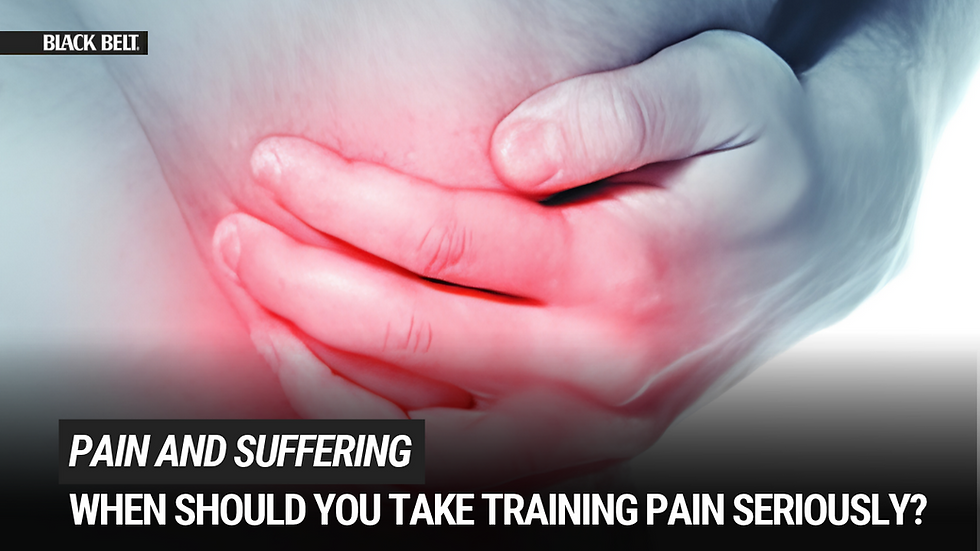
As a martial artist, you’re quite familiar with pain. You know it usually emanates from a particular body part, often after your opponent has used a particular technique against you in class.
In technical terms, pain results after a stimulus is received by peripheral nerve endings, which starts a neurochemical process in which the perception of discomfort is relayed to the central nervous system through numerous mechanisms, including nociceptive, neuropathic, psychogenic, mixed and idiopathic. Translation: Pain can come from a variety of sources, and how it’s felt varies from person to person.
THE SENSATION, as defined by the International Association for the Study of Pain, is “an unpleasant sensory and emotional experience which we primarily associate with tissue damage or describe in terms of such damage, or both.”
Note the use of the word “damage.” If pain is telling us that damage to the body has occurred, why can certain people continue training or competing while others have to stop? Example: At the UFC 140, Frank Mir caught Antonio Rodrigo Nogueira in an armbar. The lock itself is quite painful, yet Nogueira didn’t tap until his arm broke.
How can some people tolerate that much pain? As I mentioned, it’s partly because of individual tolerance, but it’s also because of the culture of the martial arts. You’ve heard the adage “no pain, no gain,” and there’s truth to it, especially when it comes to muscle soreness felt during and after training. With adequate rest and recovery, you’re able to get stronger. However, you must remember that certain types of pain can point to something more serious. The hard part is knowing the difference. The following are a few scenarios you’re likely to encounter in the dojo.

THIGH PAIN AFTER BEING THAI-KICKED: Depending on the power of the blow and the structure of your leg, most likely all you have is a charley horse. You might shake it off and continue fighting. You might wind up with a contusion, which is caused by ruptured capillaries, and the pain might be such that you have to halt the match.
Advice: A simple contusion isn’t dangerous and shouldn’t impact your training significantly. Repeated blows to the thigh, however, can result in greater muscle damage and even bleeding within the muscle. The more damage there is, the longer it takes to heal.
ELBOW PAIN AFTER BEING ARMBARRED: Your opponent in Brazilian jiu-jitsu class locked on the technique, perhaps not even thinking that he was applying a potentially dangerous amount of force to your elbow, a joint that’s definitely not meant to bend backward. And now you’re feeling it.
Advice: The best way to “treat” an injured elbow is to avoid the injury in the first place. In other words, tap as soon as you feel pain. If you resist, you only increase the chance that you’ll injure your ligaments or bones. Either will have serious consequences—and possibly cause permanent problems.
STIFF SHOULDERS AFTER YOUR FIRST SPARRING SESSION: The causes are numerous. They include plain, old muscle soreness, in addition to conditions like rotator-cuff tendonitis, rotator-cuff strain, bursitis, biceps tendonitis and labral tear.
Advice: Although your particular condition may not seem serious and you might think rest will make it go away, be careful. If the condition persists, the pain can become chronic and difficult to manage. If a pre-existing condition—for example, shoulder arthritis—is involved, the diagnosis can be worse. Even if you can tolerate the pain, you may be accelerating the degenerative process.
FACTORS TO CONSIDER: As you can see, evaluating pain is not easy. Mild pain can indicate something serious, and moderate to severe pain can stem from a benign condition. Further complicating the situation is the fact that pain is so subjective. That makes it difficult to determine whether the discomfort you’re experiencing will subside on its own or lead to a more serious condition.
In the end, it’s your decision because only you know your body and your health status. However, presented below are a few questions that might help you decide whether your symptoms require assessment by a health-care professional:
• What was the action that caused the pain?
• How severe is the pain? Did it force you to stop training or competing?
• Does the pain wake you from sleep? Does it bother you at rest?
• Is this pain different from what you’re used to from a pre-existing condition?
• Do you have any associated symptoms—for example, numbness, tingling, nausea, vomiting or fever?
• Is the pain localized, or is it spreading?
When in doubt, seek help. A doctor will identify the cause and advise you on treatment. Professional consultation is often the best way to alleviate the pain and ensure it won’t contribute to a deteriorating condition that can’t be reversed.