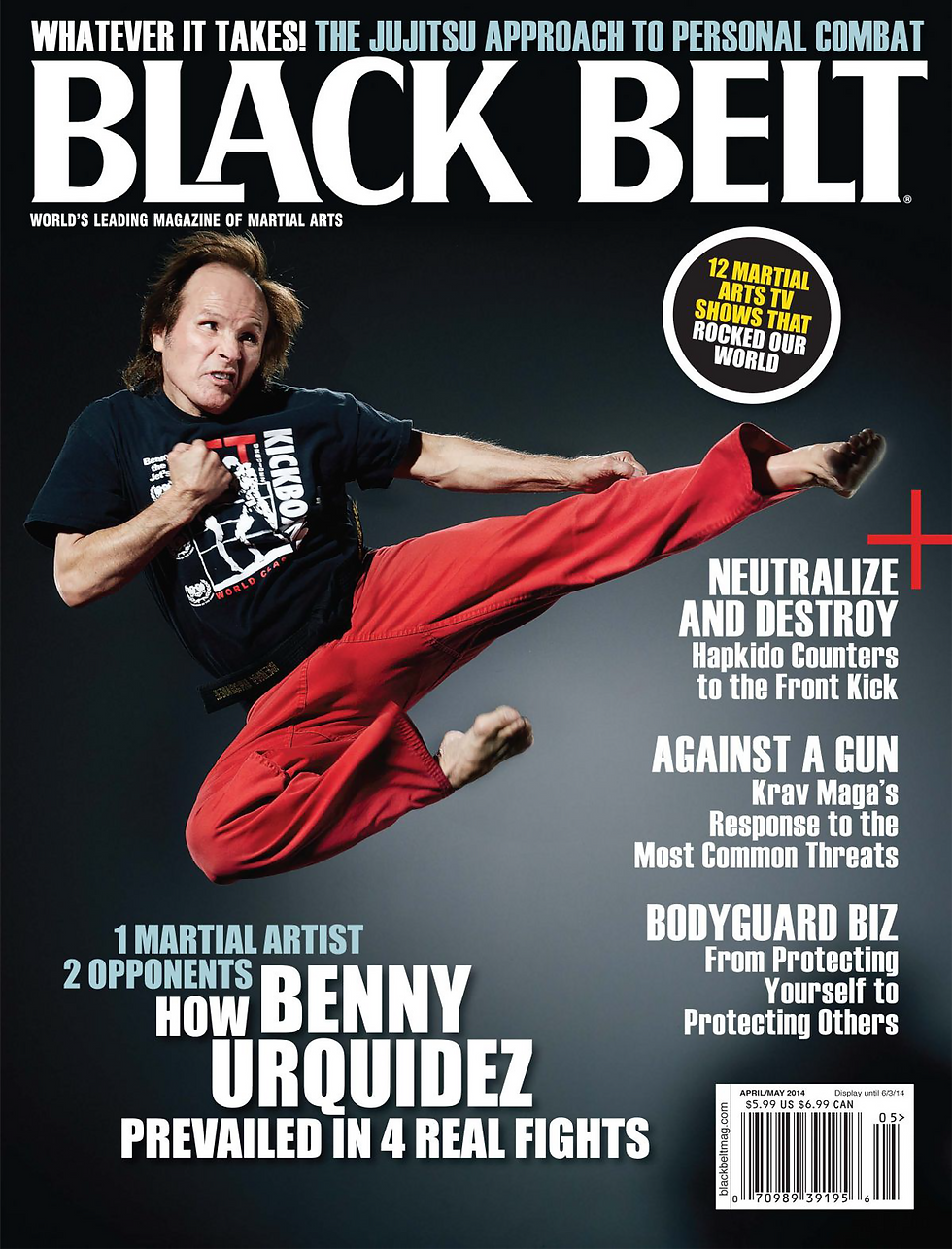
Mike Stone is using AI!
At more than 80 years old, martial arts legend Mike Stone is living on a remote island in the Philippines and embracing artificial intelligence, creating music, traveling around the world and riding in autonomous cars and contemplating a future in which robots may teach martial arts.
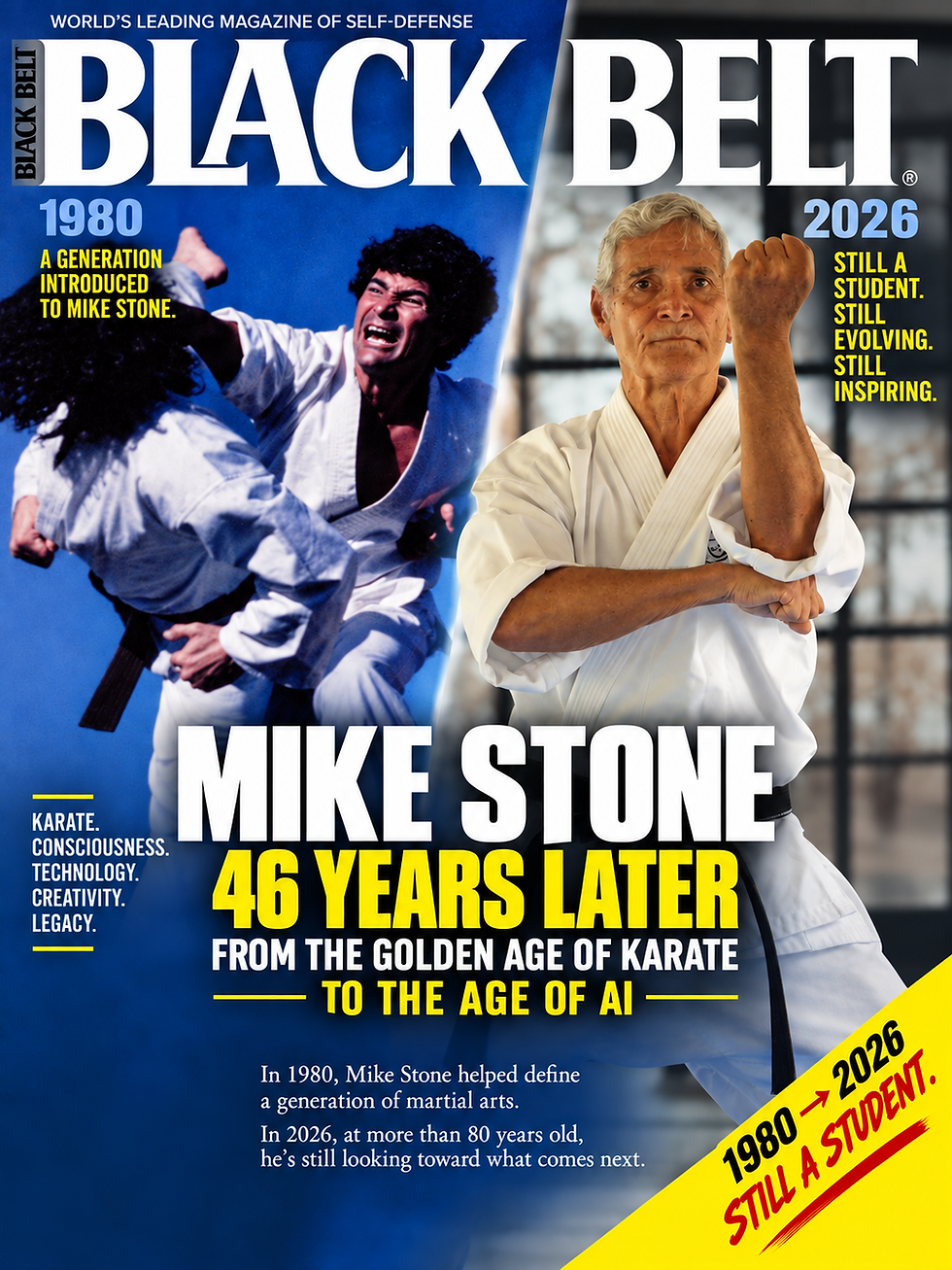
His message is surprisingly simple: Don't fear the future. Learn from it.
By George Chung
When I sat down with Mike Stone over Zoom, I expected our conversation to eventually return to karate.
After all, this is Mike Stone—one of the legendary figures from the golden age of American martial arts. Instead, we talked about ChatGPT.
We talked about AI-generated music. Driverless cars. Humanoid robots. Consciousness. Creativity. Fear. And whether some version of Mike Stone's knowledge could one day live on through artificial intelligence.
The setting made the conversation even more remarkable.
Stone, now in his 80s, was speaking to me from a remote island in the Philippines, a place he first came to decades ago when roads were primitive and communication with the outside world was anything but instantaneous.
Yet here he was, talking about the future.
And the more we spoke, the more obvious something became:
Mike Stone is still a student.
“I Wanted to Understand It”
Stone explained that artificial intelligence really came onto his radar about a year ago.
He was hearing many of the same things everyone else was hearing—particularly the fear surrounding where AI might lead.
But Stone's reaction was curiosity rather than avoidance.
He wanted to understand the technology instead of simply being afraid of it.
That decision eventually led him to ChatGPT.
For a man who has accumulated decades of writings, martial arts philosophy, personal observations and creative material, Stone quickly discovered a practical use for it.
He had an enormous amount of material that needed to be sorted and organized. Doing it manually could have taken months or longer.
With AI, he said, he could organize and categorize material that had accumulated over a lifetime in a matter of minutes.
That realization changed the way he looked at the technology.
AI wasn't replacing what Mike Stone had created. The experiences, ideas and philosophy were still his.
What AI could do was help him unlock what was already there.
And once he understood that, he started experimenting.
59 Songs in a Month from the Heart to the Cloud

One experiment led Stone to Suno, an AI music creation platform.
Stone began taking poems, philosophical writings and thoughts inspired by his martial arts journey and turning them into songs.
Then he kept going.
And going.
Within approximately one month, Stone had created 59 songs.
For someone in his 80s who had spent his life known primarily as a martial artist, champion and teacher, AI had suddenly opened another creative door.
Stone explained that the process allowed him to take ideas that previously existed as poems or written thoughts and experience them in an entirely different form.
More importantly, it made him want to create more.
His enthusiasm was obvious.
AI wasn't diminishing his creativity.
It was expanding the number of ways he could express it.
“Fear Is a Choice”
That same curiosity carried over into another new technology.
During a visit to California, Stone took a ride in a Waymo autonomous vehicle.
There was no human driver.
For many people, that first experience produces anxiety. Stone told me people had warned him about it and described how uncomfortable they would be getting into a car controlled entirely by technology.
Mike got in anyway.
He wasn't frightened.
His explanation went beyond driverless cars:
“Fear is a choice.”

Mike began riding Waymo's in 2025 and hasnt looked back, now every trip to California includes his driverless trips.
Stone's point was that we often create fear in our minds before we actually understand or experience something. Education can change that. Knowledge can change it. And so can the way we choose to approach an unfamiliar situation.
That philosophy didn't begin with karate.
Stone traced it back to when he was only 15 years old.
His coach, Jimmy Gregg, gave him advice that stayed with him throughout his life:
“Always be my best.”
Stone explained that this mindset existed before he became a martial artist. It helped shape the competitor he became and ultimately the way he approached his life.
More than six decades later, he's applying the same principle to AI.
Could an AI Robot Teach Karate?
Then I asked Mike a question that would have been pure science fiction during the golden age of karate.
Could an AI-powered humanoid robot actually teach martial arts?
Stone's answer was essentially yes.
He believes a sufficiently advanced machine could learn techniques, movements and training methodology. With access to enormous amounts of information, it could conceivably possess more technical martial arts knowledge than any single human instructor.
It could demonstrate a technique perfectly.
It could repeat it endlessly.
It could analyze the student's movements.
It might even become a better technical instructor than many humans.
But Mike immediately added an important qualification.
Martial arts instruction, he explained, shouldn't begin with teaching someone how to punch or kick.
It begins with values and principles.
Something as fundamental as the bow matters.
A student shouldn't simply learn how to bow. The student needs to understand why we bow.
And that's where Stone believes the limitations of an artificial instructor begin to appear.
“Consciousness, Compassion and Empathy”
I asked Mike what a machine would be missing.
His answer came down to three profoundly human qualities:
“Consciousness, compassion and empathy.”
A machine could potentially possess enormous knowledge.
It could know kata.
It could know fighting techniques.
It could understand biomechanics, strategy, history and philosophy.
But knowing about compassion is different from feeling compassion.
Having information about consciousness is different from being conscious.
And describing empathy is different from experiencing empathy for another human being.
For Stone, that distinction goes directly to the heart of martial arts.
The physical movements can be taught.
The information can be preserved.
But martial arts has always been about more than information.
That led me to perhaps the biggest question of our conversation.
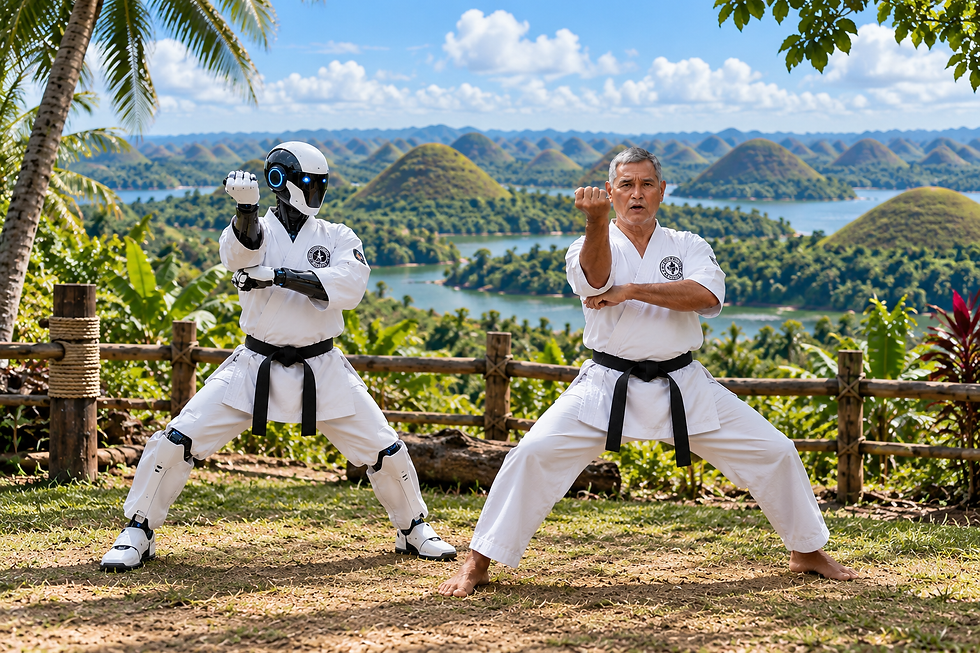
Could Mike Stone Live Forever?
I asked Mike:
“Could there someday be an AI Mike Stone Sensei that lives on forever?”
Imagine feeding decades of Mike Stone's writings, interviews, philosophies, videos, teachings and experiences into an artificial intelligence system.
Long after all of us are gone, a young martial artist might ask:
“Mike, how should I deal with fear?”
“What does it mean to become a champion?”
“How should a martial artist live?”
And something resembling Mike Stone could answer.
Mike believes we're much closer to that kind of future than many people realize.
When we discussed how dramatically AI might develop, he wasn't talking about what might happen in 50 years.
He suggested we look at what could happen in just five.
But his answer about legacy was also revealing.
Stone wasn't particularly interested in immortality for immortality's sake.
His idea of legacy is less about preserving Mike Stone and more about preserving ideas that might help another person grow.
For him, the real objective is personal development—becoming the best version of yourself, developing greater awareness and understanding who you really are.
If that transformation positively affects one other person, and that person affects someone else, the effect begins to spread.
It's an interesting answer to a question about whether a machine could make someone live forever.
Technology might preserve the teacher's knowledge. Mike Stone is more interested in what the student does with it.

“A Spark of Light”
Near the end of our conversation, Mike described what discovering AI had felt like.
The image was powerful.
He compared it to being in darkness and suddenly discovering a crack where light could enter.
He called AI a:
“Spark of light.”
For Stone, that light hasn't replaced anything.
It has illuminated possibilities he didn't previously know were there.
AI has helped him organize decades of work. It has given him a new way to write and research. It allowed him to transform his poetry and philosophy into 59 songs. Technology allows him to remain connected to people around the world while living on a remote Philippine island.
And instead of making his world smaller, Mike says the experience has expanded it.
That's what stayed with me most after our conversation.
Mike Stone has already lived through extraordinary change.
He remembers a world before the internet.
He experienced karate before it became a global industry.
He witnessed the golden age of American martial arts firsthand.
Now, in his 80s, he is exploring artificial intelligence and asking what comes next.
Not with fear.
With curiosity.
Maybe there is a martial arts lesson hidden in all of this.
We spend years learning from our teachers. Eventually, some of us become teachers ourselves. A very small number become masters.
But perhaps the best never surrender the mindset that got them there in the first place.
They remain curious.
They keep experimenting.
They keep asking questions.
They keep learning.
Mike Stone has spent a lifetime becoming a master.
But at more than 80 years old, he may still be most proud of being a student.