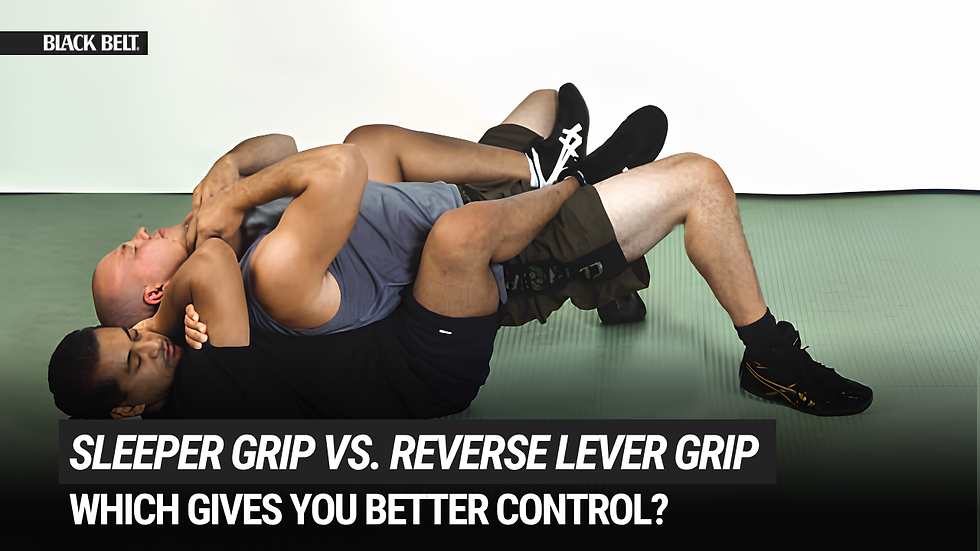
Before I start, allow me to come clean. I’m actually going to examine three submission grips: the sleeper grip, the rear-naked grip and the reverse lever grip.
As you know, grips are vital in wrestling and grappling. Without laying your hands on your opponent, there can be no grip; but if you lay your hands on your opponent and don’t apply a grip, there will be no retention of your opponent.
Here, I’m using the word “grip” in the idiomatic grappling sense. To nongrapplers, a grip is what you do when you shake hands or grab a baseball bat and is limited to what you can do with the closed hand. To grapplers, a grip is any retention of your opponent’s body using any portion of your own body. As important as gripping is in non-submission wrestling and grappling, it’s even more important in submission wrestling because the right grip is often the submission itself.

GRAPPLING GRIPS INCLUDE the palm-to-palm grip, finger-hook grip, three-finger grip, butterfly grip and bar grip. These are a few of the ones that involve the hands; if you expand the category to cover grips that use the entire arm, you also get the tombstone grip, underarm (or pit) grip, sleeper grip, rear-naked grip and reverse lever grip. If you add leg grips to this list, it spans the figure-4 (or triangle) grip, scissors and so on.
As you can see, to the submission wrestler, a grip is a weapon. In the remainder of this column, I’ll examine three of these weapons and explain how you can make your “handshake” a bit firmer by choosing the right one.
Note: By “choosing the right one,” I’m referring to the importance of adhering to the principle of leverage. The greater the leverage you exert on your opponent, the greater the pain. With an eye on painful leverage, I offer an experiment that will transform you into the “Archimedes of hurt.”
CHANCES ARE we’re all on the same page as to how the rear-naked grip is executed, but for the uninitiated, I offer the following: Place your right palm on your left biceps with the knife edge of your hand touching the crook of your left arm. Move your left hand toward your left shoulder as if you’re placing that hand behind an opponent’s head.
Perform the flex a couple of times and pay attention to your right forearm. It’s the “barring” (attacking) portion of this grip. Mentally measure the travel of the forearm from pre-flex to the flex position.
THE SLEEPER GRIP looks like the rear-naked grip with the following exception: When placing your right palm on your left upper arm, place it higher on the biceps, if not all the way up to the front deltoid. Once your right hand is in position, perform the flex test again and note the barring forearm’s travel.
FOR THE REVERSE LEVER GRIP, place your right palm not on your left biceps but on your left forearm so your right thumb is in the crook of your left arm with your entire right palm surface squarely on your forearm. Now perform the flex test and note the travel of the barring forearm.
DID YOU NOTICE ANYTHING? If you followed the hand placement that’s described in this experiment, you saw perhaps one inch of travel in the rear-naked grip, one inch to zero inches of travel in the sleeper grip, and three inches to four inches of travel in the reverse lever grip. That, my friends, is maximum leverage. In a game of inches, an additional two, three or four inches is manna.
If you want to achieve maximum leverage in your game and not pay mere lip service to it, you should examine all your grips and select those with the best leverage and retention qualities, then apply them where they’ll do you the most good—i.e., hurting your fellow human being in the appropriate context.
Caveat: As good as the reverse lever grip is, it has a limitation—specifically, the exposure of the “long tail,” which is your protruding left forearm. This tail makes the reverse lever grip vulnerable to being countered when it’s used in a back-riding position. (There is, however, a counter to this counter: Switch-gripping usually does the trick).
Where the reverse lever grip does excel is in practically all other realms, particularly head-and-arm-included chokes (the shoulder choke/arm triangle and D’Arce class of attacks). The superior leverage provided by this subtle variation pays generous dividends with far less work, and doing more work with less effort is what leverage is all about.