Photos by Peter Lueders
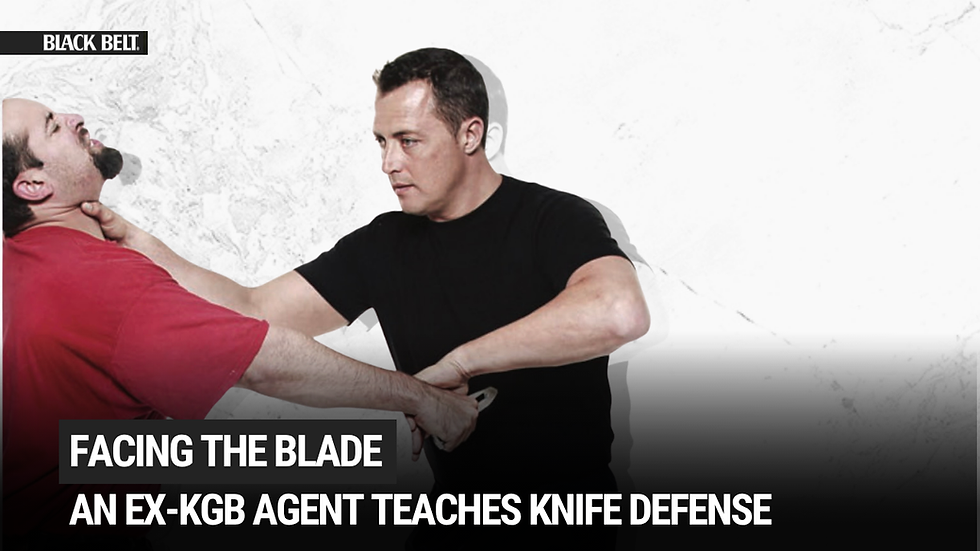
An Ex-KGB Agent Who’s Also a Master of Combat Sambo, Systema and Judo Fills You In On Knife Defense!
If you read our November 2010 issue, you no doubt remember Val Riazanov, the martial arts expert featured in “Punch Line: Mastering the Ballistic Strike.”
For those who didn’t see the article and can’t wait to find out who Riazanov is, know this: The former KGB agent is a Russian special-forces vet and a systema instructor certified by Mikhail Ryabko.
He’s also a combat-sambo master who owns a sixth-degree black belt in judo. Translation: He knows what he’s talking about.
Val Riazanov launches right into his lecture on knife defense rather matter-of-factly, especially when you consider the lethality of the topic. “If you’ve ever been stabbed before, you know that what a lot of people teach isn’t very practical,” he says. I immediately believe he’s been stabbed, probably more than once.
“A knife is a nasty thing,” he continues after a pregnant pause. For effect, he executes a simple low thrust with a training blade—the kind of attack most martial artists want their demonstration partners to feed them—and his opponent blocks easily. Just as the other guy starts to look proud of himself, Riazanov redirects his blade and stabs him several times while he fumbles to block. Point taken.
“Even a man whose only experience with a knife comes from cutting a chicken should be considered dangerous when he’s angry,” Riazanov says. “If a man has ever put a knife into the flesh of a human, he should be considered really dangerous.”
When faced with a blade, Riazanov continues, you have two choices: “You can give him whatever he asks for, and then you might or might not get stabbed anyway. Or you can try to do something about it.”
You should try to do something about it, he says, only if you think you’ll have no psychological issues with the outcome, which obviously can entail you getting cut, him getting cut or both of you getting cut.
If you get stabbed, get almost stabbed or actually do the stabbing, he says, there’s a good chance you’ll have psychological issues to deal with afterward. Once again, I believe he’s speaking from experience, and it’s that experience that’s pushed him toward a more realistic approach to knife defense.
SERIOUS BUSINESS
“The main thing about knife defense is you don’t play games with techniques,” he says. For emphasis, he has his opponent execute a half-speed horizontal slash, and he does a conventional two-hand grab of the knife arm, which is followed by a chop to the neck, a kick to the leg and a strike to the knife arm—each one punctuated by an exaggerated kiai.
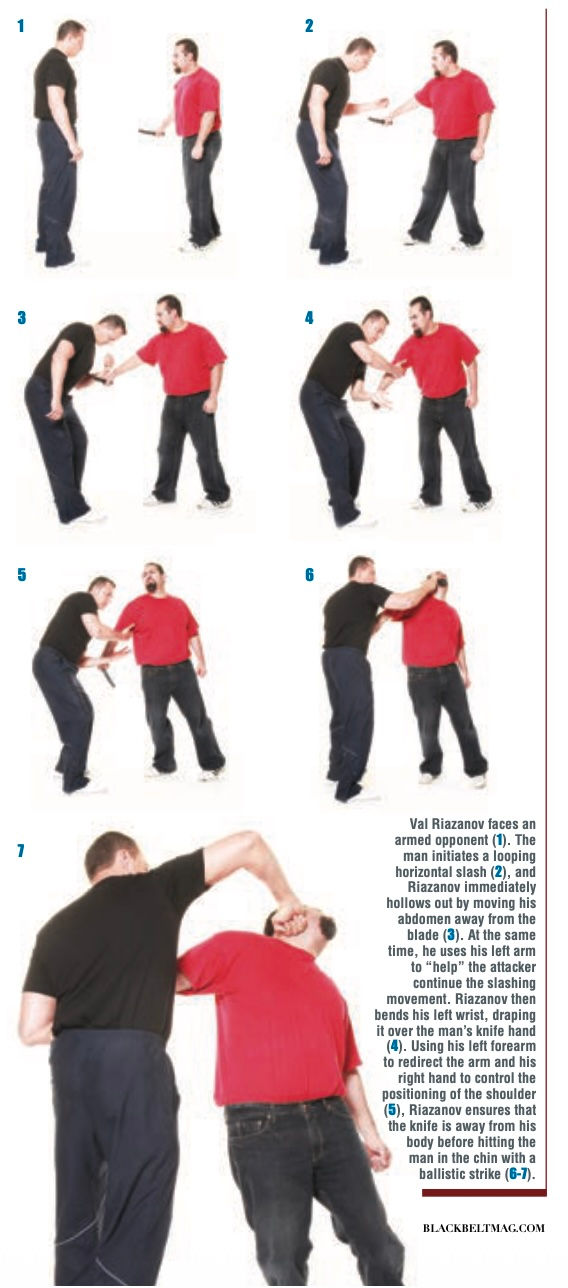
That bit of comedy sets the stage for one of his preferred defenses. “When the knife comes in, you’ll probably have time to move only your stomach away, so that’s all you do,” he says. Western martial artists often call this method of avoiding a blade “hollowing out.”
Riazanov almost subconsciously uses his hand to “help” the weapon continue along its original path, which is to the attacker’s left, or across the front of his body. I say “almost subconsciously” because depending on the nuances of the attack and his position relative to the other man, he switches back and forth between using his left hand and using his right. It’s a minor detail, apparently.
“At the same time, you strike,” Riazanov says as he pops a punch into the man’s chin. Earlier in the day, he talked about the value of even low- to medium-power punches that are delivered while the opponent is moving toward you. Seems the speed of your fist is boosted by the velocity of the attacker. Couple that with a precision strike to a vulnerable spot like the chin, and you have a blow that can sap the enthusiasm of any attacker, especially if he’s not expecting to be hit.
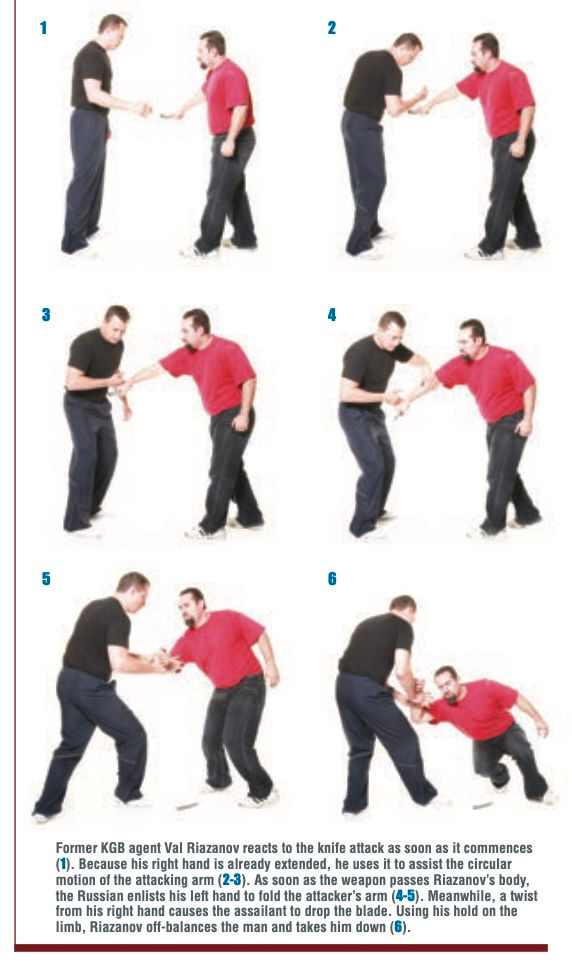
Riazanov then demos a series of disarms that mesh with what he just did. Most of them include immobilizing the knife hand and stripping the knife, at which point he can opt to finish his opponent using the blade, to inflict pain using the butt of the handle on a pressure point or to coax him into behaving by judiciously pricking the skin with the tip.
“Whatever you do now,” he says, “never let go of the knife.”
JACK-OF-ALL-TRADES
To drive home his next point, Riazanov grabs the training knife and instructs his partner to take it away. He can’t break the Russian’s grip even though he tries a variety of angles and hand positions. “See how much struggle there is?” Riazanov asks. “All it takes for me is this …” and he yanks his knife hand backward, breaking the grip of the opponent, after which he proceeds to carve him up like a Thanksgiving turkey.
The lesson is clear: Mastering the art of the knife entails knowing how to use it, how to defend against it, how to maintain your grip on it and how to break your attacker’s grip.
He hands the weapon to the opponent—“You hold it!”—and with his left hand momentarily placed against the back of the man’s knife hand, Riazanov uses the heel of his right hand to leverage the opponent’s thumb back, causing him to release the weapon. It looks so simple.
Riazanov returns the knife to him and says, “This time don’t hold it that tight.” With his opponent expecting the same technique, Riazanov raps him on the knuckles using his own knuckles. The weapon falls to the floor. The third time, all he says is “Biomechanics.” With his left hand, he grips the man’s forearm, and with his right, he grabs the back of the knife hand—then brings them together as if he’s snapping a giant toothpick. The man’s wrist folds, and the pressure Riazanov applies to the knife handle in the direction of the thumb causes the knife to be released. The Russian establishes a grip on the weapon and pretends to slice his foe’s biceps.
Quick to please, Riazanov runs through several more disarms, one of which involves using the knuckles of his right fist to drill the man’s forearm so he can effortlessly peel the knife out of his grip, again in the direction of the thumb. Another one has him fending off an attack in which the assailant gets close enough to press the tip of the weapon against his chest. Riazanov uses the back of his hand to push against the side of the blade, angling it down and then back toward the attacker. It winds up in his hand, so of course he uses it against him.
In more than a few of the examples, Riazanov manages to cut the assailant with his own weapon even though he’s still clutching it. Biomechanics, as he said earlier—control the limb, bend it in a direction that severely reduces its strength and then apply enough force to ensure it does your bidding. The defenses that don’t involve counter-cuts take advantage of a quick strike to the chin or throat and even a short stomping kick to the nearest shin, followed by a takedown.
RESOLUTION
That takedown is Riazanov’s cue to explain his philosophy on effective follow-ups. “When you throw someone on the floor, there’s a very small chance he will come up—however much he’s trained—because the concrete floor is very different from the dojo floor,” he says. “With concrete, once you’re down, you’re down if you don’t know how to fall.”
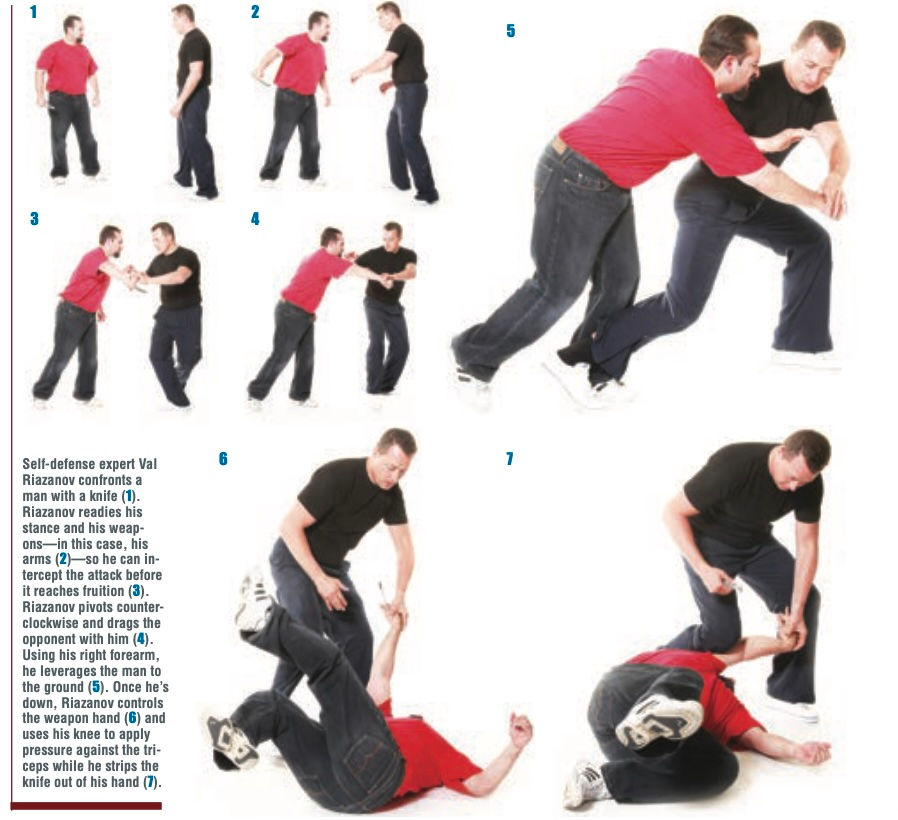
To illustrate the seriousness of the takedown and highlight a method for initiating it, Riazanov steps to the rear with one foot and then pivots as the opponent slashes—all while facing the weapon, of course. “When the knife is approaching, you let it go by and move away from the attack,” he says.
As he steps and turns, he grabs the opponent’s wrist with his left hand and pushes down near the crook of the elbow with his right, taking him to the ground. “It’s a typical technique you’d see in sambo or judo,” he says. “Once he’s down, your knee goes just behind the elbow, into the triceps area.”
A standing armbar results, but Riazanov immediately applies additional pressure with his knee to roll the man onto his stomach, his knife hand still trapped.
“Then you take the blade, and if you have to hold him, you hold him,” he says. “If you have to disable him, you cut the tendon in his arm—you don’t have to get nasty. If you have to take him somewhere, you put the point of the knife against the crook of his arm—it’s not very nice—and he will come up as quick as he can. Then you stick it under his armpit and walk him. He’ll walk anywhere you like. If he resists, he bleeds a little.”
“Even with the rubber knife, it hurts,” Riazanov’s training partner volunteers.
THEORY AND PRACTICE
Most of Riazanov’s knife defenses involve creating what he calls initial shock. For some of them, he hits the knife arm to distract, maybe causing the opponent to drop the weapon. For others, he clips him on the chin or drives his open hand into his throat before throwing. Occasionally, he kicks the inside of the kneecap with the bottom of his foot, collapsing the supporting leg so he can more easily take away the knife. “You have to be extremely precise with things like this, though,” he says with a smile.
Once you’ve inflicted that initial shock, don’t get overconfident—even if your opponent is on his back, Riazanov cautions. “At that point, it’s not over. He will struggle and punch and kick—especially if he’s under the influence of drugs or alcohol. Here’s a little trick: As he desperately struggles to [regain control of his knife], you do this!” He drops his knee into the man’s gut. “Now it’s easy to take the knife away, and you didn’t do any damage.”
He then demos a variation in which he drops his knee onto the man’s face. It would seem to be a bit more damaging—something he learned in the KGB, no doubt.
“All this is good to practice,” Riazanov says before he ends the lesson. “But try to learn it from someone who’s been stabbed before—so they know what they’re talking about.”