Black Belt's Perspective: More Than a Movie

What Enter the Dragon did was open the doors of the dojo to the entire world.
Suddenly millions of people who had never attended a tournament, opened a martial arts magazine or stepped inside a school knew what a side kick looked like.
They knew the sound of a kiai.
They knew the words karate and kung fu.
And they knew the name Bruce Lee.
But Bruce wasn't the only legacy of Enter the Dragon.
The movie introduced Jim Kelly to a worldwide audience. It gave Bolo Yeung an international showcase. It preserved Bob Wall and Pat Johnson during a remarkable era of American karate. It placed members of the Black Karate Federation before millions of moviegoers. It captured Angela Mao during the golden age of Hong Kong martial arts cinema.
And hidden among its fighters were Sammo Hung and Jackie Chan — men who would help carry martial arts cinema into its next generation.
That's why, 53 years after its release, Enter the Dragon isn't merely a classic martial arts movie.
It is a martial arts family album.
Some of the people in it became legends. Some became teachers. Some became champions. Some became filmmakers. Some are no longer with us, while others remain living links to an extraordinary moment in martial arts history.
Freeze almost any fight scene and you may discover someone whose story extends far beyond the few seconds they spent on screen.
The Fighters Who Changed Martial Arts Forever

On August 19, 1973, American audiences met Bruce Lee in the film that would forever change the way the world viewed martial arts.
Fifty-three years later, Enter the Dragon remains much more than a movie. It is a remarkable snapshot of martial arts history — filled with champions, pioneers and future superstars whose influence can still be felt today.
When Enter the Dragon arrived in American theaters, there had never been anything quite like it.
Produced as a collaboration between Warner Bros. and Bruce Lee's Concord Productions, directed by Robert Clouse and filmed largely in Hong Kong, the picture combined the scale and polish of a Hollywood action movie with something audiences rarely saw on the big screen: real martial artists performing real martial arts.
Bruce Lee wasn't simply playing a fighter. He was one.
And he wasn't alone.
Look carefully through Enter the Dragon today and the movie becomes an extraordinary gathering of martial arts history. Alongside Hollywood veteran John Saxon were karate champion Jim Kelly, Hong Kong veterans Shih Kien, Angela Mao and Bolo Yeung, American karate pioneers Bob Wall, Pat Johnson, Steve Sanders, Donnie Williams and Darnell Garcia — and, almost hidden in the action, two young Hong Kong performers named Sammo Hung and Jackie Chan.
TCM notes that many of the film's extras were actual martial artists and that Lee himself staged the martial arts sequences. Sammo Hung appears opposite Lee near the beginning of the film, while Jackie Chan appears as one of Han's men during the climactic fighting.
It is difficult to imagine another martial arts movie containing so many people who would collectively influence the next half-century of the arts.
For Black Belt, their stories are as fascinating as the movie itself.
BRUCE LEE — THE MAN WHO OPENED THE DOOR

Everything begins with Bruce Lee.
By 1973, Lee was already a superstar in Asia through The Big Boss, Fist of Fury and The Way of the Dragon. But Enter the Dragon was different. This was the film designed to introduce Bruce Lee as the leading man of a major international Hollywood production.
Tragically, Lee never witnessed the phenomenon that followed.
He died on July 20, 1973, at only 32 years old. Enter the Dragon reached American audiences less than a month later.
What audiences discovered was unlike the conventional screen fighter of the era.
Lee was fast, explosive and physically spectacular, but there was also philosophy behind the violence. His movements communicated economy, timing, adaptability and intent. For millions of young viewers, Bruce Lee wasn't merely an action star.
He became their first martial arts instructor.
Dojo and kung fu school enrollments exploded. Martial arts entered mainstream popular culture. Hollywood's image of the Asian leading man changed. Generations of fighters, actors and stunt performers suddenly had a new reference point.
Fifty-three years later, virtually every martial arts action star who followed operates in a world Bruce Lee helped create.
JOHN SAXON — THE HOLLYWOOD BRIDGE

John Saxon brought something essential to Enter the Dragon: Hollywood credibility.
Playing Roper, Saxon wasn't merely an actor pretending to know how to fight. He had studied martial arts before making the film, and his physical ability allowed the filmmakers to present him convincingly alongside Lee and Kelly.
Saxon represented the bridge between traditional Hollywood filmmaking and the emerging martial arts movie.
His long career would continue across action, horror and television, including A Nightmare on Elm Street. But for martial artists, Roper remains one of his most memorable roles.
Saxon died in 2020, but his presence in Enter the Dragon helped demonstrate that martial arts could exist comfortably inside a mainstream American action film.
JIM KELLY — A NEW KIND OF HERO

Then there was Jim Kelly.
Tall, athletic, charismatic and unmistakably cool, Kelly's Williams became one of the most memorable characters in the film.
Kelly was a legitimate karate practitioner and champion before becoming a movie star. Hollywood suddenly had something it had rarely seen before: a Black martial arts hero presented as confident, sophisticated and formidable.
Enter the Dragon became Kelly's breakthrough and helped lead to starring vehicles including Black Belt Jones. Contemporary accounts of the production specifically identify
Kelly as a karate champion recruited to strengthen the film's martial arts credentials.
For many young Black martial artists, seeing Kelly standing beside Bruce Lee was enormously significant.
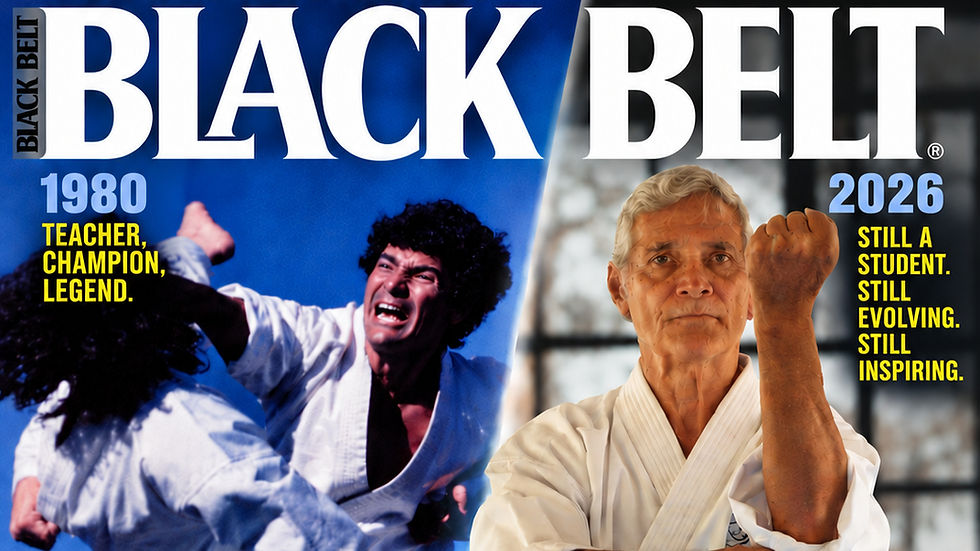
Kelly died in 2013, but his image remains iconic — Afro, side kick and attitude included.
SHIH KIEN — THE PERFECT MARTIAL ARTS VILLAIN

Every great martial arts hero needs a worthy villain.
Shih Kien provided one in Han.
Already an experienced Hong Kong screen performer, Shih brought menace and authority to a character who could easily have become a caricature. His mechanical hand, underground army and hall of mirrors helped create some of the most recognizable imagery in martial arts cinema.
But beneath the theatrical villainy was an experienced martial arts performer. Shih's background gave his movements an authenticity that helped make the final confrontation believable.
He died in 2009 at age 96, leaving behind a career stretching far beyond Enter the Dragon. Yet around the world, Han remains his defining role.
BOLO YEUNG — THE PHYSIQUE THAT BECAME A TRADEMARK

Before Bloodsport, before Chong Li and before decades of appearances at martial arts conventions, there was Bolo.
Credited at the time as Yang Sze, Bolo Yeung barely needed dialogue. His extraordinary physique told audiences everything they needed to know.
As Han's imposing enforcer, Bolo became one of the film's most unforgettable physical presences.
The role helped establish the screen persona Yeung would perfect over the following decades: the massively powerful martial arts antagonist capable of intimidating an opponent before throwing a punch.
For a later generation, he would become equally identified with Jean-Claude Van Damme's Bloodsport. But Enter the Dragon introduced international audiences to the man who would become one of martial arts cinema's most recognizable villains.
JACKIE CHAN — BLINK AND YOU MAY MISS A FUTURE SUPERSTAR

One of the joys of revisiting Enter the Dragon is spotting Jackie Chan.
He wasn't a star.
He wasn't even a featured player.
He was a young stunt performer appearing among Han's men during the massive underground battle.
Bruce Lee dispatches him quickly.
Nobody watching that scene in 1973 could reasonably have imagined that the young stuntman would eventually become one of the most internationally successful action stars in cinema history.
Chan would ultimately develop a screen identity almost opposite Lee's: humor, vulnerability, spectacular stunt work and fights built around improvisation with the surrounding environment.
Yet there he is in Enter the Dragon, one generation literally colliding with the next.
SAMMO HUNG — THE MAN FIGHTING BRUCE AT THE BEGINNING

Before audiences even reach Han's island, they see another future legend.
The fighter facing Bruce Lee during the opening sequence is Sammo Hung. That scene many credit as the first glimpse of MMA, martial arts, boxing and grappling and Lee wins the match with a tap out not the stereotypical kick or punch.
Hung would become one of the most important figures in Hong Kong action cinema — actor, director, producer, choreographer and action filmmaker.
His career would help define the extraordinary Hong Kong action boom that followed Bruce Lee.
That makes the opening sequence historically fascinating. It isn't simply Bruce Lee demonstrating his martial arts.
It is Bruce Lee facing a young Sammo Hung — two enormously influential figures in Asian action cinema sharing the screen before the audience fully understood what either man's legacy would become.
ANGELA MAO — THE WOMAN WARRIOR

Angela Mao appears as Su Lin, Lee's sister, and although her screen time is limited, martial arts fans already knew — or would soon discover — that Mao was far more than a supporting actress.
She became one of Hong Kong cinema's most important female martial arts stars.
Her presence in Enter the Dragon also reminds modern audiences that women were part of the martial arts movie revolution from its earliest days.
Long before today's generation of female action heroes, Angela Mao was demonstrating that women could carry martial arts pictures themselves.
BOB WALL — FROM THE TOURNAMENT FLOOR TO BRUCE LEE'S ENEMY

Bob Wall represented another important dimension of the film: the connection between Hollywood and America's rapidly growing karate tournament scene.
Wall was a genuine karate champion and part of the Southern California martial arts community that included Chuck Norris and Pat Johnson.
As O'Hara — the scar-faced fighter responsible for the death of Lee's sister — Wall participated in one of the movie's most brutal confrontations.
Their battle felt different because both men understood fighting.
Wall continued teaching, appearing in films and remaining a highly visible member of the martial arts community for decades. He died in 2022, but his association with Bruce Lee and Enter the Dragon remained an important part of his legacy.
PAT JOHNSON — THE MAN WHO WOULD HELP DEFINE THE KARATE KID

Martial artists should look closely at the early golf-course scene involving Roper.
One of the thugs is Pat E. Johnson.
Johnson was already part of the formidable Chuck Norris martial arts circle. But his influence on Hollywood martial arts would eventually extend far beyond his small appearance in Enter the Dragon.
He became one of the industry's most respected martial arts choreographers and trainers and would become deeply associated with The Karate Kid, helping translate traditional karate into choreography that millions of moviegoers could understand.
Johnson died in 2023, but his fingerprints remain on some of America's most enduring martial arts films.
DARNELL GARCIA — A BLACK BELT MAGAZINE CHAMPION ON SCREEN

Darnell Garcia's inclusion is especially meaningful from Black Belt's perspective.
Garcia was a serious American karate competitor who trained in the Chuck Norris system and defeated Joe Lewis to win the Grand Championship at the 1972 International Karate Championships in Long Beach.
Just months before Enter the Dragon reached theaters, Garcia appeared on the February 1973 cover of Black Belt.
In the film he appears alongside Pat Johnson and Mike Bissell as one of the men confronting Roper on the golf course.
For today's viewer it may look like a small role.
Historically, it is something more.
It was another example of Enter the Dragon drawing directly from the authentic American tournament karate community rather than simply casting actors and teaching them a few techniques.
STEVE SANDERS — THE BLACK KARATE FEDERATION ON THE BIG SCREEN

Another historically important appearance comes during Williams' introduction.
Steve Sanders — later known as Steve Muhammad — was one of the pioneering figures behind the Black Karate Federation.
In Enter the Dragon, Sanders appears as the BKF instructor training students as Jim Kelly's Williams prepares to leave for Hong Kong. Donnie Williams also appears as an assistant instructor.
That brief scene carried enormous cultural significance.
The BKF had been created during an era when Black competitors faced significant barriers within American tournament karate. Seeing Black martial artists training together in a major Hollywood production gave audiences around the world a glimpse of a genuine martial arts movement taking place in Los Angeles.
Sanders became known for his speed, his teaching and his development of BKF Kenpo concepts.
DONNIE WILLIAMS — ANOTHER PIECE OF AMERICAN KARATE HISTORY

Donnie Williams' appearance is brief but historically significant.
Williams was another pioneering member of the Black Karate Federation and appears during the BKF sequence as an assistant instructor. His connection to martial arts continued well beyond the film.
He later won the overall title at the 1977 International Karate Championships in Long Beach and continued working in films and fight choreography.
Again, Enter the Dragon wasn't merely borrowing the appearance of martial arts.
It was putting actual members of America's karate community on the screen.
MORE LEGENDS HIDING IN PLAIN SIGHT
Even this list doesn't tell the entire story.
Look deeper into the cast and stunt performers and you'll find Yuen Wah and Yuen Biao, two more names that would become deeply important to Hong Kong martial arts cinema.
That's what makes Enter the Dragon extraordinary 53 years later.
The film wasn't assembled around Hollywood actors who happened to learn some fighting for a movie.
It brought together martial artists who happened to be making a movie.
Bruce Lee.
Jim Kelly.
Bob Wall.
Angela Mao.
Bolo Yeung.
Sammo Hung.
Jackie Chan.
Pat Johnson.
Steve Sanders.
Donnie Williams.
Darnell Garcia.
Different systems. Different countries. Different backgrounds. Different futures.
But for a brief moment in 1973, they occupied the same piece of film.
For Black Belt, perhaps that is the enduring importance of Enter the Dragon.
The movie did not create martial arts.
The arts had existed for centuries, and the American karate tournament scene was already thriving.
Bruce Lee may have entered the dragon in 1973.
But the remarkable collection of martial artists who entered with him helped change popular culture forever.